A few years ago, just after the pandemic and before generative AI entered everyday work, I hosted a webinar with Poppulo on employee experience, communication, and alignment.
Organizations were grappling with fatigue, churn, and a widening gap between leadership intent and what employees were actually experiencing.
The focus of that conversation was employee experience, but the deeper issue was alignment. When leadership intent, strategic priorities, and lived experience fall out of step, employees feel it quickly in the form of confusion, frustration, and erosion of trust.
Communication and digital experience mattered then, not as the source of alignment, but as the means by which alignment or misalignment became visible.
From the beginning, my lens on employee experience has been a brand and alignment lens, with communication at the center—how intent, information, and meaning flow through organizations and show up in what people live day to day.
That question hasn’t gone away. It has become harder to contain.
Employee Experience Is Forming in Human-AI Environments
As AI becomes more embedded in everyday work and as agentic moves beyond experimentation into early organizational use, the employee experience is beginning to take shape under different conditions.
Alongside leaders, managers, policies, and platforms, AI increasingly shapes how work is prioritized, how information is surfaced, and how actions are triggered.
Work increasingly takes place in human-AI environments, where people and AI act together rather than sequentially. From a comms perspective, this means AI agents will increasingly draw on data and content from multiple functions—HR, internal comms, corporate affairs, IT, operations, and beyond—at the point when an employee asks a question or seeks guidance.
Traditional information silos start to blur from the employee’s perspective, even if the underlying ownership structures remain.
This does not turn employee experience into a technology problem. However, it does reduce the buffer that organizations once had between strategic ambiguity and lived experience.
When work is shaped by a combination of human judgment, digital interaction, and augmented intelligence, experience becomes more sensitive to clarity of intent and to coherence of direction.
Every interaction becomes a “moment of truth”:
- Does this interaction reflect what the organization says it stands for?
- Does it help employees understand how their work connects to priorities?
- Does it respect context, judgment, and accountability?
- Does it reinforce the brand promise employees were hired into?
Most organizations will recognize versions of this long before agentic tech is in play. Decisions arrive without context. Managers struggle to communicate strategic priorities they don’t fully understand.
Employees hesitate to trust a direction that feels disconnected from what they were told mattered. These moments are familiar. What changes as AI becomes embedded is not their existence, but their speed and reach. Patterns that once appeared slowly now emerge more quickly and in more places, making alignment (or misalignment) harder to ignore.
These moments accumulate, and as they do, they quietly shape trust long before they appear in organizational surveys.
Revisiting Alignment Through the Experience Lens
Before agentic featured prominently in organizational conversations, I reworked my earlier thinking into the Brand Experience Alignment framework to reflect the growing complexity and pace of the intelligence ecosystem.
In this framework, communication sits at the core—human, digital, and augmented—supported by an intelligence ecosystem that includes human, digital, and AI capabilities.
Leadership commitment, employee experience, customer experience, and stakeholder value are interconnected elements. Together, they shape a brand experience that stakeholders recognize as coherent, credible, and difficult to copy.
Communication in itself does not create alignment. Rather, it enables it. It carries intent into experience and makes gaps visible when intent and reality drift apart.
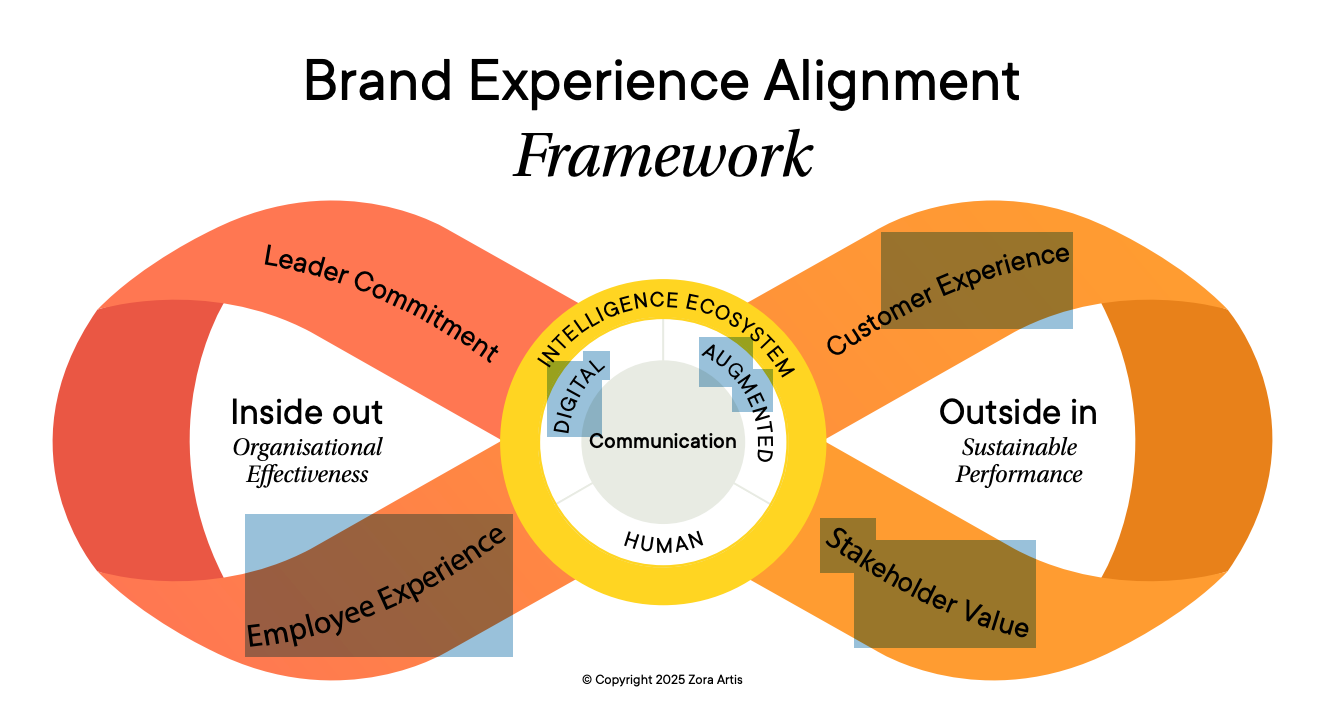
Agentic does not sit outside this framework. It intensifies the intelligence ecosystem and narrows the gap between strategic clarity and lived experience.
What This Means for Employee Experience Now
Several considerations stand out as employee experience increasingly takes shape within AI-human environments.
• Strategic clarity becomes more visible
As generative AI and early agentic tech begin to influence how work is guided, they act on whatever direction already exists. Where intent is clear and coherent, this can reinforce focus and consistency. Where priorities compete or remain unresolved, employees experience that ambiguity more quickly—through mixed signals, inconsistent guidance, or actions that don’t align with stated or shared values. AI may not create misalignment per se, but it makes it harder to overlook.
• Experience and responsibility are intertwined
As systems influence decisions and workflows, responsibility becomes part of everyday experience. Employees encounter this in whether decisions are explainable, whether escalation paths are visible, and whether human judgment is respected and incorporated. Ethics shows up here as fairness, transparency, and trust, not as policy but as practice.
• Stewardship depends on shared leadership
Employee experience in human-AI environments cannot sit with one function alone. It depends on shared leadership across the organization—leadership that is clear about intent, willing to hold itself accountable, and prepared to work across boundaries.
— HR plays a critical role in holding the experience lens.
— Internal Comms brings a deep understanding of how information, feedback, and narrative flow across the organization and helps keep those flows coherent as AI draws from multiple sources.
— Tech and IT teams shape the systems through which decisions and content are delivered. Executive and senior leadership remain accountable for strategic direction and the conditions under which decisions are made.
• Learning still depends on leadership behavior
AI can surface signals faster than organizations are used to. Whether those signals lead to learning depends on leadership behavior. When assumptions are revisited and priorities clarified, experience can be strengthened.
However, if ambiguity persists, automation simply accelerates existing patterns, behaviors, and systems, including those that erode trust.
A Reflection for Leaders, HR, and Internal Communication Professionals
Employee experience has always been shaped by alignment with something larger than the individual. AI, in its evolving forms, does not change that. It shortens the time between misalignment and consequence when it is not recognized and addressed.
For leaders, HR professionals, and those working in internal comms, the work ahead is about stewarding strategic clarity, responsible use, ethical intent, and the brand promise as work becomes increasingly human-AI. It is not about simply trying to keep pace with technology and AI.
The question is whether organizations choose to design the employee experience deliberately in this emerging reality, or discover over time that it has been shaped elsewhere.
*Zora Artis is CEO of Artis Advisory and Co-Founder of The Alignment People, based in Melbourne. She is a strategic advisor, facilitator, and leadership coach who helps executives and senior teams tackle tough challenges, find clarity, build capability, and act. An IABC Fellow and company director, Zora is certified as a Strategic Communication Management Professional, an ICF Associate Certified Coach, a Mirror Mirror Alignment practitioner, and a Certified Practising Marketer. She is recognized for her global research in strategic alignment, leadership, and communication, and is currently writing her first book on creating and sustaining healthy, high-performing teams and organizations.