First in our industry to be responsible AI certified
Learn more →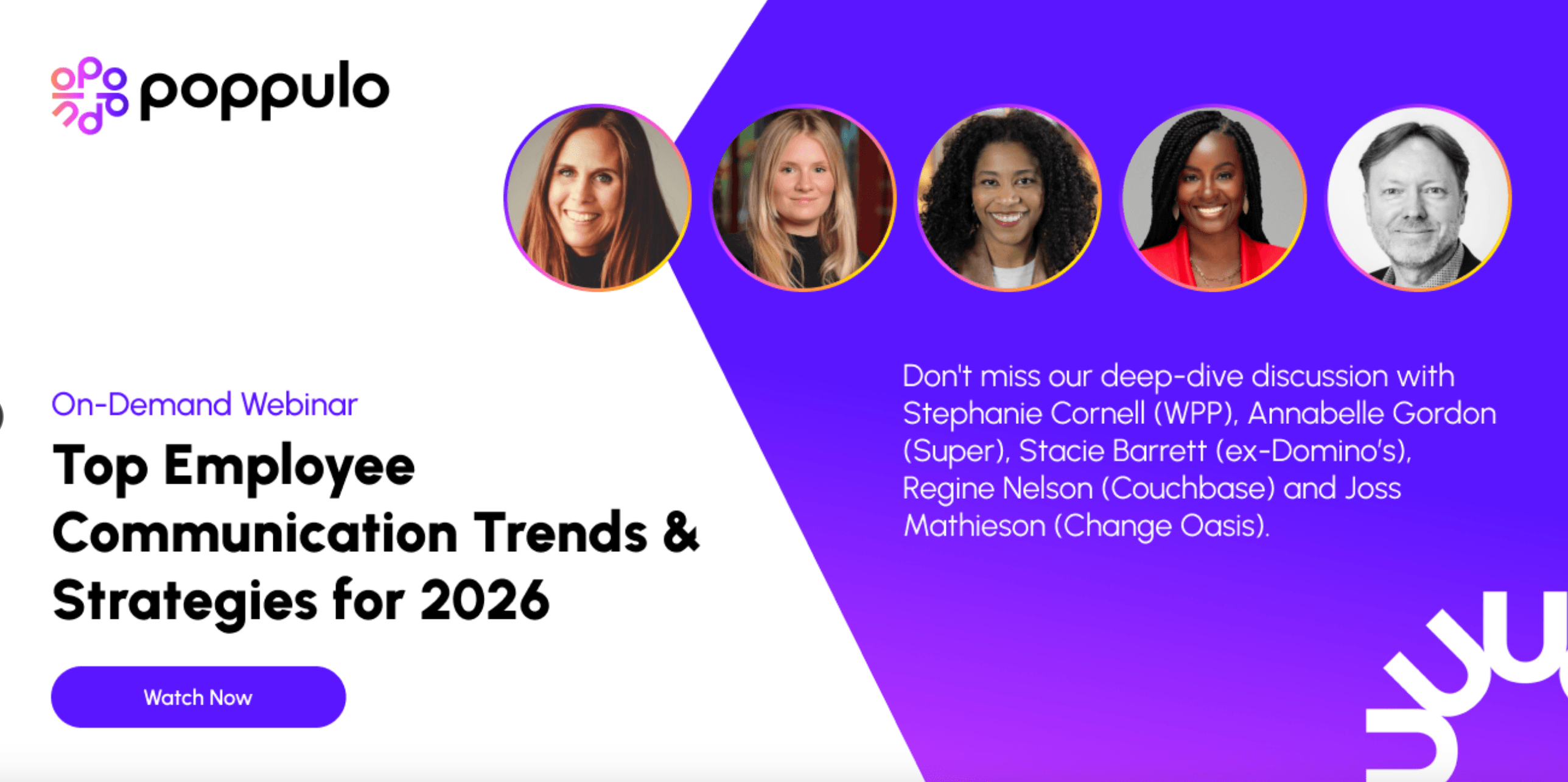
Top Employee Communication Trends & Strategies for 2026
Watch On-demand

Speakers

Annabelle Gordon
Director of Employee Communications, Superbet

Regine Nelson
Director of Internal Communications, Couchbase

Stacie Barrett
Former Director of Internal Communications, Domino's

Stephanie Cornell
Head of People Communications & Marketing, WPP

Joss Mathieson
Founder and Chief Encouragement Officer, Change Oasis
About this webinar
Internal comms is heading into 2026 with more uncertainty about its role than at any point in recent memory. AI is changing the work at speed. Trust is slipping. Managers are stretched thin. Employees are tuning out. And the expectations placed on IC keep widening into work that falls well beyond its traditional scope—often without the structure or support to match.
The familiar models aren’t holding, and the function is being pulled into a new order that still isn’t fully defined.
2026 will ask big questions of IC: what it stands for, where it fits, and how it leads through a year marked by uncertainty and shifting expectations.
To understand what this means in practice, we’re bringing together four leaders who are working at the sharp end of these changes:
- Stephanie Cornell, Head of People Communications & Marketing, WPP
- Annabelle Gordon, Director of Employee Communications, Super
- Regine Nelson, Director of Internal Communications, Couchbase
- Stacie Barrett, Former Director of Internal Communications, Domino’s
Moderated by Joss Mathieson of Change Oasis, this 60-minute session, including time for your questions, will get into the real pressures facing IC in 2026 and how teams can work through them.
Expect to Explore:
- The shifting identity of internal comms and what it means to play a deeper role in shaping the employee experience
- Where AI is genuinely changing the work of internal comms, and the risks that emerge when speed increases but understanding doesn’t
- How IC can work alongside leaders and other functions when old command-and-control habits no longer hold up
- How IC can rebuild trust and strengthen resilience by creating communication that feels human, transparent, and genuinely meaningful in a year defined by ambiguity
- The emotional and practical load on IC practitioners, and how to stay steady when you’re communicating through the same uncertainty as everyone else
Access On-Demand Webinars
How Leading Healthcare Organizations Reach Every Frontline Worker
Ask a hospital's communications team whether last week's safety alert reached every person who needed it—nurses, care assistants, porters, techs, cleaners, kitchen staff—and most can't tell you. The message went out, but who read it is guesswork. That blind spot is the real problem, and it starts with the staff. Most of the people keeping a hospital running have no company email and no desk, so an update reaches them through a manager who remembers to pass it on—or it doesn't reach them at all. When that message is a changed protocol or updated equipment guidance, a missed message is a patient-safety risk you never see. What you'll learn During this session, we'll show how healthcare organizations: Reach every clinical and support worker across hospitals, clinics, home visits, and community sites, without relying on email or a shared device. Deliver shift-relevant safety and compliance alerts with read tracking and must-read acknowledgment. Personalize communications by role, location, shift, and language, so people get only what's relevant to them. Use AI to help staff find the right policy or procedure in seconds. Replace scattered, manager-by-manager messaging with communications every employee receives, whatever their shift or location. Support wellbeing and recognition programs that help retain people in demanding roles. Let ward and department leaders communicate locally while central teams keep governance intact. See who opened and acknowledged each critical message. Watch the on-demand recording now.
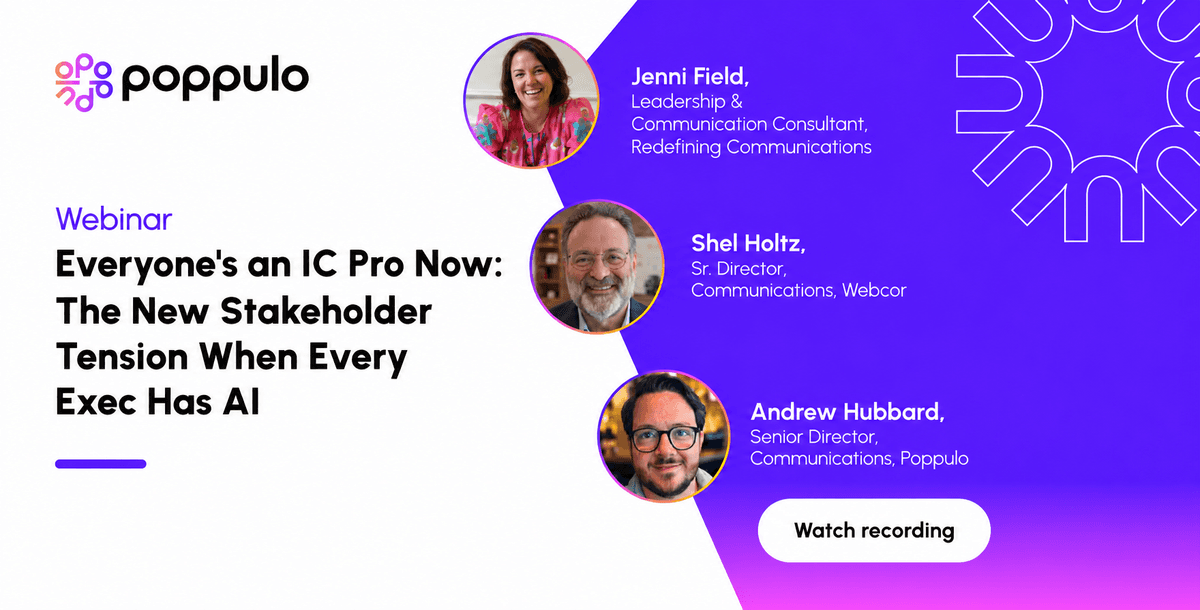
Everyone's an IC Pro Now: The New Stakeholder Tension When Every Exec Has AI
Sign-off used to mean a few comments in the margin. Now a routine leadership announcement comes back carrying six sets of detailed, confident, strangely similar feedback—because somewhere between your outbox and theirs, half your stakeholders ran it through an AI. Executives aren't just reviewing comms work anymore. Armed with the same tools, plenty of them now believe they can do it. Stakeholder management was already the hardest part of the job; it wasn't built for reviewers with an assistant that never runs out of opinions. This session is about easing that tension—running a review process that still works, and keeping the final say where it belongs. What you'll learn: How to recognize AI-assisted feedback and weigh it for what it is—directional input, not a rewrite Ground rules for review cycles when every stakeholder has a co-pilot How to push back on machine-made opinion without damaging the human relationship behind it How to keep the final say with IC—not with the loudest AI-assisted opinion Plus: a live audience poll putting the first real numbers on how far this has spread. Bring your worst example. Who it's for: Internal comms leaders and senior practitioners who own the review cycle—and intend to keep it. Watch the on-demand recording now.
How Leading Professional Services Firms Are Modernizing the Employee Experience
In most professional services firms, information is scattered, and valuable time is wasted trying to find it. Company news, policies, business updates, key documents—all in different places, and rarely in the first place you look. Now there's real risk on top of wasted time. Clients are questioning the value of professional advice at the same time AI is raising the stakes on quality and accuracy. As employees increasingly use AI to accelerate their work, firms need to ensure people are working from approved content, trusted knowledge, and the latest policies—not outdated or unofficial information. Keeping people aligned on standards, governance, and current policy is now part of how a firm can protect what it's spent years building. Join us to see how leading firms are building a modern digital workplace that gives employees one personalized place to find company news, documents, policies, people, and business applications—and see what's happening across the wider firm, so they spend less time searching and more time delivering work that clients trust. What you'll learn During this session, we'll show how professional services firms: Give employees a single place to find news, knowledge, policies, applications, and everyday resources. Keep people aligned on the standards, governance, and quality expectations that protect client work. Reach employees wherever they work, across mobile, Microsoft Teams, and digital signage. Make sure people receive only what's relevant to their role, office, or practice area, in their preferred language. Confirm critical updates are seen and acknowledged, with must-read communications and reporting. Connect colleagues across offices and practices, so local teams see the wider firm without losing their own focus. Use AI to help employees find the right policy, procedure, or precedent in seconds. Integrate with Microsoft Teams and Microsoft 365, so communications and knowledge sit inside the tools people already use. Measure real engagement and reach, not just publishing activity. Watch on-demand recording.