Back in 2013, we started a conversation at Airbnb by asking a simple question: Can we do this differently? It was a single spark that ended up transforming HR into Employee Experience.
But as we navigate the complexities of 2026, that shift—which was revolutionary at the time—has evolved from a cultural experiment into a necessary business blueprint.
To understand where we are going today, we have to go back to the moment the map was first redrawn in San Francisco 13 years ago.
When I was invited to interview for the top HR role at Airbnb in mid 2013, I had heard of the company but had never traveled staying in a stranger's home.
When I went for my first of many interviews, the company’s unique cultural vibe could be felt everywhere in the building, starting with the “houseboat”—an iconic boat-shaped meeting room—where I was greeted by two friendly faces, Chrissy and A’Keiba, both of whom I still stay in touch with.
Eventually, when I made it to one of the final interviews, I met Brian Chesky, the 29-year-old CEO and co-founder. He said he didn’t know a lot about HR, but everything he heard he didn’t like. He asked me, “Can we do this differently?"
It was music to my ears!
My response was that if Airbnb had a Customer Experience (CX) team, focused on listening and responding to the customers' needs for a better product and services, why wouldn’t we create something similar for employees?
He agreed, and Employee Experience (EX) was born.
The Mindset: Shift from "Doing TO" to "Doing WITH and FOR."
The focus from the get-go was on doing things WITH and FOR our employees, not TO them. We wanted to find ways to include them in helping us to prioritize the priorities to improve how we worked. We then had them assist us to co-create and design the best solutions to deliver on the company’s promise to our hosts and guests.
In essence, how could we set our employees up to support our hosts to deliver on the company mission “to create a world where anyone can belong anywhere”?
So, our initial EX strategy was to create an organization where people felt like they belonged, so they could assist our hosts to deliver that sense of belonging in their homes.
Early on, we realized it was not about the home, but the experience, which led to the expansion from just homes to experiences, and now services.
The Method: Why Internal Comms is the Core of EX.
The shift to EX is not just about a shift in mindset, but also the ways of working. It is not an “HR” initiative, but a way for all leaders to create two way dialog and truly listen and then take action based on employee input.
At the core was internal communications—focused on asking, listening, co-creating, and iterating. All functions that touch the employee needed to change their approach to think of employees as their customer.
The Secret Sauce: How "Ground Control" Built Brand Ambassadors.
The shift also expanded the traditional remit of HR. We cobbled together many disparate groups who all provided support or whose function was actually in service to the employees.
In addition to the usual Centers of Excellence, Business Partners, and Operations teams, we incorporated the following areas- Workplace, Social Impact, and Ground Control.
Ground Control was the secret sauce of Airbnb. They were not cheerleaders in the sense that they owned the culture and got the rest of us to join them; they found ways to include everyone and create brand ambassadors out of all of our employees.
The two pillars of Ground Control were the Mission and Values as well as Internal Communications. They then engaged everyone with the values and behaviors as our foundation to be part of events, recognition, and celebration.
Internal Communications were the team that not only had their finger on the pulse of the organization, but were knowledgeable about every aspect of the business, team, and country.
Communication was always a two-way dialogue. They made sure the employee's voice was heard in every interaction, delivering information that was inspiring, targeted, and timely.
Internal Communications worked closely with the Core Values council, which was made up of early employees and those that deeply understood and embraced the mission, values and behaviors.
This group was handpicked by the Founders and represented all aspects of the business and the diversity of our employees. This group was called in to review critical decisions, from organizational restructures to marketing partnerships, as well as any acquisitions.
Their voice was important as a gut check to ensure that important decisions were made in line with the core values.
The Belonging Imperative: Scaling Culture through Connection
The shift from HR to EX was the engine that allowed Airbnb to scale its culture during a period of incredible growth. When I started, we had 450 employees; four years later, we were over 3,000. Despite that rapid expansion, the "magic" and the vibe of the company remained intact.
By democratizing the culture, the employees truly owned it, were proud of who we were, what we did and how we did it. They were an integral part in ensuring the values were the way we made decisions, and their voices were heard.
While we were privileged to have such a meaningful mission based on belonging, as I reflect back, this concept of belonging, which if you break it down is all about creating connections, applies to all organizations.
The four most critical connections that resulted in belonging were:
- The Company: Connections between employees and the company mission.
- The Team: Connections between employees—and not just those on your team
- The Customer: Connections with the customer, and
- The Community: Connections with the communities in which you operate.
Beyond the Manifesto: Designing Your Own EX Strategy
These stories are more than just memories; they are the foundation for a new way of working. While many leaders watched what we did at Airbnb and tried to follow suit, too many organizations simply changed the name on the door without changing the mindset.
To help others move past the "rebrand" and into a true shift in ways of working, I partnered with Samantha Gadd, a smart and energetic HR leader from New Zealand. She approached me to codify what EX actually is—because so many were getting it wrong.
Together with her consultancy, HumanKind, we convened some of the best and brightest to co-create The EX Manifesto. While many signed on, we knew we needed to provide a deeper blueprint for leaders and organizations.
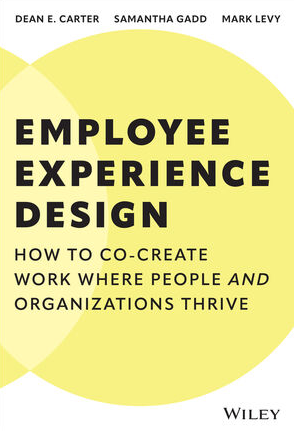
That need led Samantha and I to include our colleague and friend, Dean E. Carter, to write the definitive guide: Employee Experience Design: How to Co-Create Work Where People and Organizations Thrive. The book is published by Wiley and is available for purchase now.
About the Author
Mark Levy is a globally recognized culture strategist and the architect of the first-ever Employee Experience function. During his tenure at Airbnb, he pioneered the landmark shift from traditional HR to EX, sparking a global movement that continues to redefine how organizations look at the end-to-end employee journey.
His leadership in this functional transformation was instrumental in Airbnb being named the #1 Place to Work by Glassdoor.
Beyond his executive career, Mark advises startups and venture capital firms, with a particular focus on supporting underestimated founders in securing the resources they need to grow.
His commitment to social impact includes serving on boards dedicated to helping first-generation students graduate from college and designing programs that enable employees to support those less fortunate through community involvement and volunteering.
A sought-after public speaker on the "Shift to EX" and "Belonging," Mark is the co-author—along with Dean E. Carter, and Samantha Gadd—of Employee Experience Design: How to Co-Create Work Where People and Organizations Thrive (Wiley), available now.