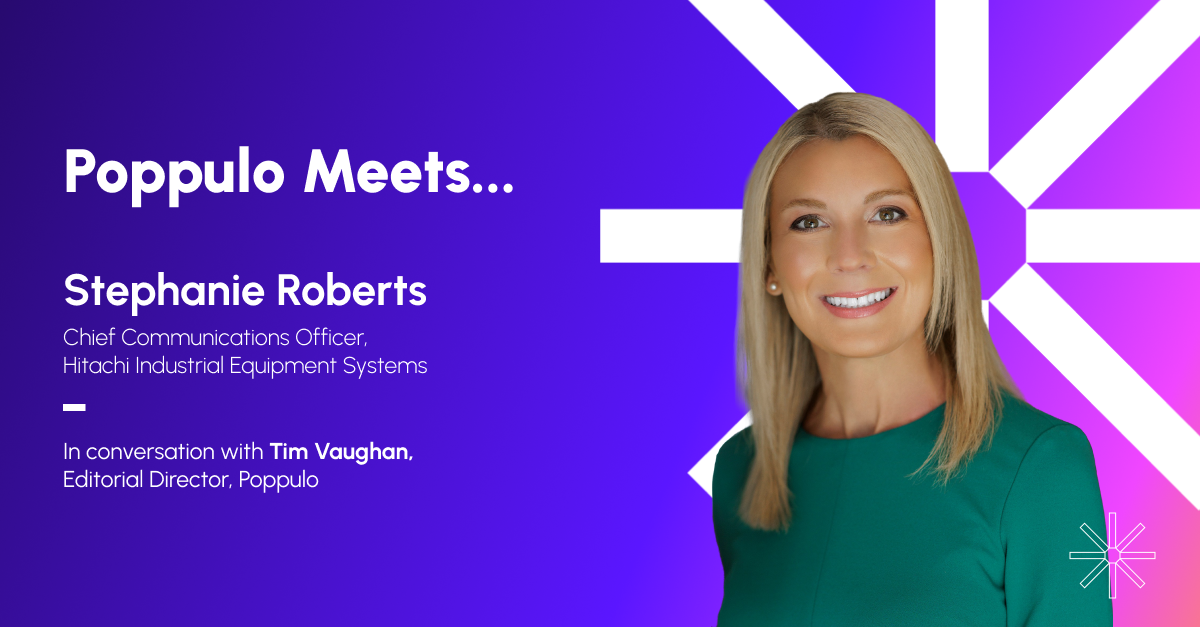
Welcome to the latest edition of Poppulo Meets...— our series of conversations with senior communication and people leaders about the work they do and the experiences that shaped them along the way.
This time, we’re delighted to be joined by Stephanie Roberts, Chief Communications Officer at Hitachi Industrial Equipment Systems in Tokyo—an American communicator working inside one of Japan’s most established industrial brands.
It’s a role that demands fluency in more than language: culture, hierarchy, and context are all part of the equation. For Stephanie, working in Japan has been about learning how influence works in a different system and earning trust inside it.
Here, she talks about the early breaks that shaped her, the leap that brought her to Tokyo, what surprised her most about doing communications there, and what she’s learned from leading across very different cultures.
— In conversation with Tim Vaughan, Poppulo’s Editorial Director.
My first real job was working as a service cashier at a luxury car dealership in Chicago while I was in college. I was living in the city and helping pay for school and expenses, so I worked about 25–30 hours a week alongside my studies
From that experience, I learned how important it is to manage your time and priorities. Balancing a full course load while working that many hours forced me to be disciplined and organized.
Looking back, it was an early lesson in work ethic and accountability that has stayed with me throughout my career.
The biggest influence in my life has been my parents because of the example they set through their work ethic and support.
My dad worked for Caterpillar for more than 47 years and commuted about 110 miles round-trip every day. And when he wasn’t working, he was usually busy with something else. Evenings and weekends were spent helping on the farm, renovating the house, working on school projects with us, or playing sports together as a family.
My mom was primarily a stay-at-home mom raising me and my two siblings, but over the years she also worked at different times as a receptionist, waitress, and at an insurance agency before eventually retiring.
Both of them came from humble beginnings but worked incredibly hard, supported us in everything we did, and set a strong example of responsibility. They showed us the importance of showing up, working hard, and creating opportunities for ourselves.
Everybody needs a break when they’re starting out. I got mine in comms when I was working at the second company in my career, H.W. Lochner, a national architecture, engineering, and construction firm in the United States. I had started as a marketing coordinator focused primarily on proposals and qualifications (RFPs and RFQs).
After a couple of years, someone took a chance on me. Jill Stadler, who led the corporate communications team, gave me the opportunity to move into the department as a communications specialist.
That role opened the door to the field I’ve spent the rest of my career in, and I’ve stayed in the communications lane ever since.
A defining moment that set the course for my career was earning my graduate degree at Northwestern. The experience gave me access to an incredible education and network, and it helped open doors early in my career that might have been much harder to access otherwise.
More importantly, it reinforced the value of continuous learning, something that has stayed with me throughout my career.
The decision to move to Japan came about when a former CEO I had worked closely with was promoted back to a role in Japan. We had a strong working relationship, and at one point, I remember mentioning that if there were ever an opportunity to work in Japan, I might be interested.
At the time, it was really just a comment in passing. I did not think it would actually happen.
A few months later, the conversation became real. The company was looking to strengthen and globalize its branding and communications function, and given my track record, the opportunity came up for me to take on that challenge in Japan.
Because of COVID, the move was delayed for more than a year. Eventually, I found myself on a plane to Tokyo, having never been there before. The rest is history.
Working as an American communications leader inside a Japanese company has taught me the importance of patience and listening.
In many Western organizations, conversations tend to be very direct, decisions move quickly, and involve fewer people. In Japan, the process is much more deliberate and consensus-driven.
It is also a high-context culture, which means you often need to read the room and understand what is being communicated between the lines. Learning to navigate that environment has made me a better listener and helped me develop a deeper understanding of a culture very different from my own.
Something that surprised me about leading communications in Japan is the relatively small role LinkedIn plays compared with Western markets.
In the United States and Europe, LinkedIn is a critical platform for executive visibility and thought leadership. In Japan, it is still often seen primarily as a job-search tool, and adoption remains relatively small at roughly 4% of the population.
It serves as a good reminder that communications strategies, especially digital ones, do not always translate the same way across markets.
The three things I love most about being privileged to work in Tokyo are the energy of the city, the sense of safety and respect in everyday life, and the concept of omotenashi, or thoughtful hospitality.
The safety piece is something I really value. Of course, no place in the world is completely risk-free, but in Tokyo, I don’t feel like I have to constantly watch over my shoulder or my belongings.
I once left my phone behind at a table in a restaurant and only realized it after I had walked down the street. An employee actually ran outside to catch me and hand it back.
And then there is the level of service. There is a small restaurant I visit regularly where they once made a mistake on my takeout order. I didn’t notice and never mentioned it.
However, the next time I came in, the manager approached me on his own, apologized sincerely, and insisted on refunding the meal from the previous week, which I politely declined.
Experiences like that say a lot about the culture here and are part of what has made living in Tokyo such a special experience.
What I love most about my role as CCO of Hitachi Industrial Equipment Systems is the vantage point it gives you across the business. Communications sits at the intersection of strategy, leadership, and reputation.
The role is about helping leaders think through complex issues and communicate with clarity and credibility when it matters most—or sometimes knowing when not to say anything. That is where communications brings real value, by anticipating the second- and third-order consequences of decisions.
But what can make it challenging at times is that the role of communications is still evolving in many organizations in Japan. In many environments, the function is not always fully understood or recognized as a strategic business role.
As a result, part of the job is continually explaining the value of communications, advocating for the right structure, and helping leaders see how the function supports strategy, culture, and reputation.
The leadership behavior I hope people experience from me—whether in a Western or Japanese corporate culture—is a willingness to roll up my sleeves and help when and however needed. I never want to ask my team to do something I wouldn’t be willing to do myself.
In communications, there are moments when the work is strategic and moments when it’s very hands-on, and I’ve found leaders have to be comfortable with both.
The main thing I’ve learned about managing reputation at scale is how fragile it actually is. In today’s environment of nonstop geopolitical and technological change, reputation isn’t something the communications team can manage alone. It’s shaped by the decisions leaders make across the company every day.
Companies can spend years building trust with employees, customers, and other stakeholders, but that trust can erode quickly if the company isn’t aligned, transparent, and prepared when issues arise. In many cases, it takes years to build reputation and only minutes to damage it.
Looking ahead, especially in the age of AI, I think the role of communications will become even more important. AI brings benefits for communications teams, but it will also accelerate challenges like misinformation, disinformation, and things like voice cloning or manipulated content that can easily misrepresent leaders or companies.
AI can certainly be a powerful tool for many parts of the communications function. But judgment, discernment, and knowing when to speak, when not to speak, and how to respond are still fundamentally human skills. Those are not things technology can replicate, at least not today.
One trait I really value in the people I work with is curiosity and a commitment to continuous learning. The environment around companies is constantly changing. The most effective people are those who are always trying to understand what is evolving around them and how it affects the company.
But a trait I find challenging to work with is when people operate in silos or default to “that’s not my job.”
In large, complex companies, the work simply doesn’t happen that way.
The best outcomes come when people take shared responsibility and focus on the broader goal rather than staying narrowly within their own function.
One accomplishment that means a lot to me is the opportunity to live and work internationally. I grew up in a small town in the United States with about 7,000 people, so the idea that I would one day spend several years living and working in Tokyo, the largest metropolitan area in the world, would have seemed pretty unlikely when I was younger.
Professionally, the experience has stretched me in ways that are hard to replicate anywhere else. Leading communications across cultures forces you to listen more carefully, adapt your approach and recognize that there isn’t always a single “right” way to do things.
It’s also been deeply meaningful on a personal level. Living in Japan for several years has broadened my perspective in ways I’ll carry with me for the rest of my career.
The best advice I ever got was to stay curious and never think you’ve fully “arrived.” There is always more to learn.
That mindset has stayed with me throughout my career because the world around companies is constantly changing. Communications leaders are always navigating new issues, technologies, and expectations, so curiosity is essential.
The advice I wish I’d known sooner is the importance of understanding the business well beyond communications.
At the senior level, it’s not enough to simply be a good communicator. You need to be a business person first and a communicator second.
The best communications leaders now need to understand the financials, the strategy, and the operational realities of the business. That perspective changes the kinds of questions you ask and the advice you can give to leadership.
I’ve spent the past couple of years intentionally deepening that business foundation through courses and self-study, but it’s something I wish I had started much earlier.
Something about me that might surprise my colleagues and friends is that even though I love to travel now and do it very frequently, I didn’t actually step on a plane for the first time until I was around 21 or 22.
Since moving to Japan four years ago, I’ve visited close to 15 countries. Travel has become one of the things I enjoy most and prioritize, but it’s funny to think that for a long time, flying wasn’t even part of my life.
If I could speak to my 20-year-old self, I’d say not to worry so much about having everything figured out. When you’re young, it can feel like you’re supposed to have a clear plan for your career and your life, but in reality, many of the most meaningful opportunities come from unexpected places.
Some of the experiences that shaped my career the most started with simple conversations or moments that I almost dismissed at the time. Staying curious, working hard, and being open to opportunities can take you much further than trying to map out every step in advance.
After all, if someone had told my 20-year-old self that I would one day be living and working in Tokyo, I never would have believed it.
In another life, I could see myself as either a dentist or a pilot. I believe the smile is one of the most important features of the face, so I could see myself enjoying a career helping people maintain and improve theirs.
On the other hand, I love to travel and do it often, so the idea of connecting people to destinations around the world as a pilot also sounds appealing.
*For more information on Poppulo Meets... contact tvaughan@poppulo.com