

WEBINAR
Why the 4 Day Week is the Future of Work—And How it Changes People’s Lives
About this Webinar
Four years ago, Andrew Barnes, a British-born New Zealand entrepreneur, knew all about creating a highly successful business—because he’d been there, done that. But he also knew that the way we work sucks. Too much stress, too many hours and days for the productivity delivered, too many burnt-out disengaged people locked into outdated ways of working that owed more to the 19th century than the 21st.
So he had a very bright idea. Why not trial a 4 Day-Week at his company Perpetual Guardian, with no reduction in pay for employees, and put the trial under the scrutiny of independent academic researchers. And if productivity and profits did not drop, make the 4 Day Week permanent.
The results—higher productivity and engagement, lower stress, happier employees—made headlines around the world and led to Andrew launching 4 Day Week Global. His aim is to encourage others to create a new way of working which will improve business productivity, worker health outcomes, stronger families and communities, challenge the gender equality issue, and work towards a more sustainable work environment.
In this session you will learn:
- What drove Andrew’s mission and how he defied the skeptics
- How his 4 Day Week journey could radically change the lives of your employees
- The latest on how the 4 Day Week pilot program is rolling out in the United States, the United Kingdom, Ireland, Australia, and New Zealand.
Related content
Internal communication is under real pressure. IC teams are expected to support leaders, shape culture, and deliver relevant, personalized communication to an increasingly diverse audience—all while operating at greater speed and scale than ever before. AI arrives at the right moment. It doesn’t replace communicators; it elevates them. Applied well, AI sharpens the fundamentals of effective communication: diagnosing issues, shaping the narrative, guiding leaders, and delivering messages that connect people to purpose and progress. At its best, AI accelerates drafting, adapts content for different formats, improves accessibility, and surfaces insights about what’s landing. Without governance, though, it can create noise or risk. The opportunity for IC teams is to bring AI in thoughtfully, with governance and human judgment at the center. This guide shows how to do exactly that. Inside, you’ll find practical guidance on when to use AI, where humans remain essential, how to establish guardrails, how to prompt effectively, and how to scale AI responsibly across channels and teams.
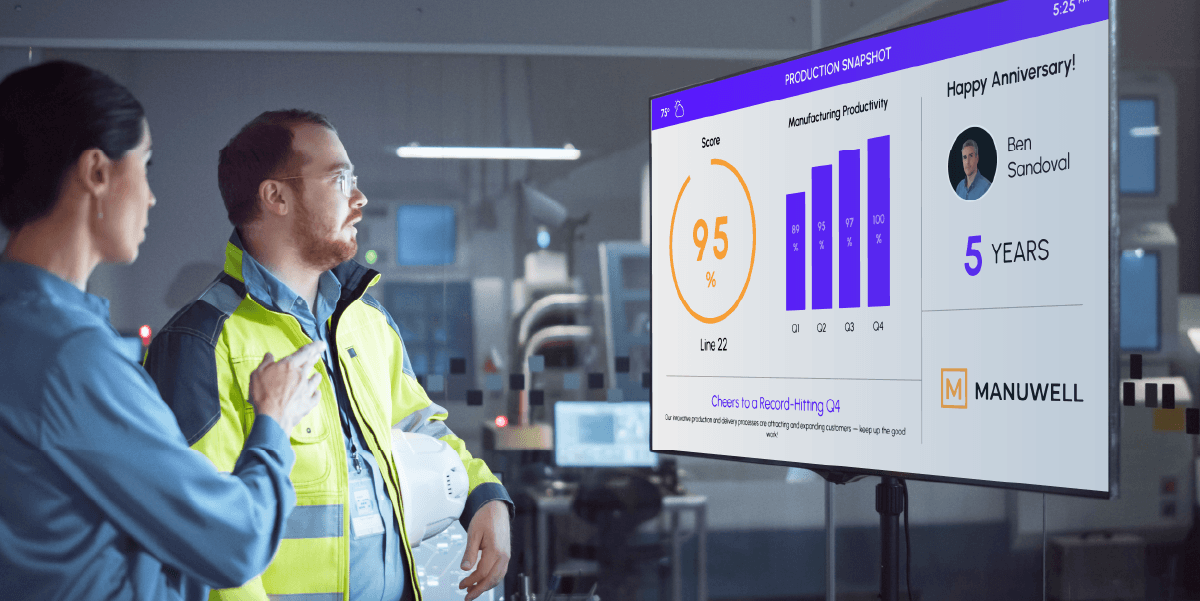
Manufacturing and production facilities are operating in an era defined by disruption, labor shortages, supply chain volatility, and rising safety and compliance demands. Leaders are under constant pressure to optimize processes, reduce downtime and rework, improve quality, and engage a workforce that is largely deskless. In this environment, clear, real-time communication isn’t a “nice to have”—it’s mission-critical. Yet production-floor employees are often the hardest to reach. Traditional channels like email, mobile apps, and intranet platforms don’t effectively connect with workers who don’t have access to devices during their shifts. When communication breaks down, so does alignment around KPIs, safety protocols, quality standards, and company goals. Digital signage has become a critical infrastructure layer in modern manufacturing environments. Together, Poppulo and BrightSign® enable manufacturers to deploy secure, scalable, and high-performance digital signage networks across thousands of endpoints. From KPI dashboards and manufacturing execution systems (MES) integrations to safety communications and employee engagement initiatives, this guide explores how manufacturers can leverage enterprise-grade digital signage to drive operational excellence, strengthen culture, and future-proof their production floor communications.

Manufacturing facilities face unique challenges when it comes to driving productivity, safety, and operational efficiency with a primarily deskless workforce—many of which can be addressed with strategically deployed digital signage. From production dashboards and manufacturing execution systems (MES) displays to wayfinding, standard work signage, safety messaging, and general employee communications, digital signage is an effective way to reach all on-site workers, regardless of their roles. That’s why manufacturing organizations around the world rely on Poppulo’s digital signage platform and secure, purpose-built media players from BrightSign® to deliver reliable, real-time information across their facilities. However, starting a new digital signage initiative or optimizing an existing network involves careful planning. In addition to defining integration requirements, you must determine the number and location of screens, the purpose of each endpoint, and the content each zone should display. Mapping out the zones in your facility that require digital signage—and identifying the audience and use case for each—can help define your digital signage footprint and uncover gaps in your current network. The templates included in this guide provide recommendations for endpoint planning across different facility zones, helping you align screen placement with operational goals and communications needs.