
I first wrote about employee experience in 2014 in The Future of Work, then explored it in a regular column starting in 2015, which became The Employee Experience Advantage.
Back then the term barely registered. Companies had engagement, annual surveys, foosball tables, the occasional pizza party. What they didn't have was a serious conversation about what it actually feels like to work somewhere.
Organizations were spending enormous energy trying to make people engaged and almost none designing the conditions where engagement could happen on its own. Billions poured into engagement every year, and the scores barely move.
My argument was, what's the point? Engagement is an outcome. Experience is the architecture that produces it. So instead of surface-level investments, I argued that employee experience is a combination of three environments organizations can actually design: culture, technology, and space.
More than 10 years later, employee experience is a discipline. There are EX teams, EX budgets, EX executives. That's real progress.
And here's the part that surprised me: the framework hasn't needed a rewrite.
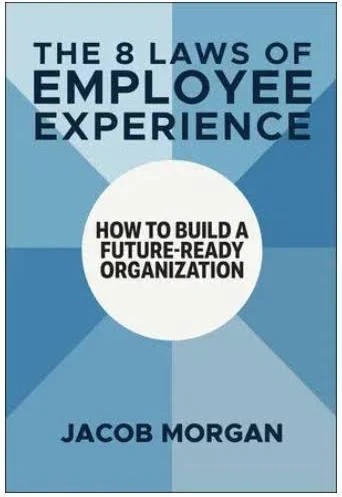
My latest book, The 8 Laws of Employee Experience, was originally supposed to be a second edition of the first one. But after speaking with over 100 CHROs at companies around the world, I realized the models still hold. So I wrote an entirely new book that builds on them instead.
What Organizations Are Still Getting Wrong
They made it a program instead of a principle.
Employee experience got a team, a budget, a dashboard, and a place on the org chart—and the moment it became a function, it stopped being an operating assumption.
I don't think this happened because leaders are careless. It happened because programs are legible to a board and principles aren't. You can put a program in a deck. You can show its budget, its headcount, its quarterly metrics.
A principle produces no artifacts, and in most organizations anything that produces no artifacts eventually produces no funding. So EX became something you could point at, which meant it also became something you could defund. And when the quarter went sideways, it was.
If your employee experience strategy can be cut, it was never a strategy.
They mistook listening for acting.
Organizations are collecting more employee data than at any point in history. Pulse surveys, sentiment analysis, always-on listening platforms, dashboards refreshed weekly.
Employees have noticed that almost none of it changes anything. This is worse than not asking. Every survey that produces no visible action teaches people their input is decorative. You're not building trust, you're dismantling it, one questionnaire at a time.
Plenty of leaders know their eNPS to the decimal and cannot tell you whether their people believe a word they say. And we've become so reliant on technology for listening that we've forgotten the most powerful form of it: leaders actually spending time with their people. Coffee. Lunch. Casual conversation. Not pulse surveys.
They separated experience from leadership.
Building an EX function let leaders off the hook.
But experience isn't delivered by a department. It's produced or destroyed in the ordinary decisions leaders make under pressure. Most employees don't experience "the company." They experience the person they report to.
You can have world-class technology, a beautifully designed workspace, and values written by the best firm money can buy, and a single manager renders all of it irrelevant for the eight people on their team.
They forgot it was an exchange.
This is the one I've come to believe matters most, and the one almost nobody says out loud.
For ten years, employee experience has been framed as something organizations give to employees. Better tools. Better space. Better culture. All of that is right, and all of it is half the equation.
An experience worth having is a mutually beneficial exchange. The organization creates a place people want to show up to, and people show up and do work worth wanting them there for. Both sides carry something.
Somewhere in the last decade we stopped asking the second half of that question, and what we got instead was brittle: one side giving, the other receiving, and neither saying what it actually needed. That doesn't produce gratitude. It produces entitlement on one side and quiet resentment on the other.
So let me name it: employees own part of this too. Showing up disengaged and waiting to be inspired is not a strategy. Treating an employer as a vending machine that owes you meaning is not a strategy. We built an entire discipline around one side of a two-sided relationship. That's why it feels unstable. It is.
And they're treating AI as a technology problem.
AI will not fix your culture. It will amplify it. If your organization is anxious, low-trust, and status-obsessed, AI accelerates all of it faster, and at scale. If it's healthy, AI becomes leverage. The tool is neutral.
AI is also applying pressure that nothing before it has. When people are uncertain whether their work still has value (or whether they still have value), every principle above gets loaded to its limit at once. Trust gets tested. The say-do gap gets scrutinized. And the exchange gets renegotiated whether you participate in the negotiation or not.
None of it shows up in your attrition data in time to matter. The people who leave over a broken experience are rarely the ones in your exit interviews. They were quietly gone months before they resigned. You don't get a warning. You get a calendar invite.
Where This Leaves Us
Ten years ago the job was convincing organizations that employee experience mattered. That argument is over.
The new job is harder, because it can't be delegated, purchased, or launched. The reason the original framework survived a pandemic, a mass remote experiment, a return-to-office war, and now AI is that it was never a best practice.
Best practices are borrowed from someone else's company and someone else's moment, and they expire—which is why almost everything else written about work in 2016 is unusable now.
Laws don't work that way. A law operates whether you acknowledge it or not, regardless of your industry, your size, or your decade. You don't implement gravity. You account for it, or you fall.
The laws are already operating inside your organization. The only question is whether you're working with them or against them.
- Jacob Morgan is a professionally trained futurist, bestselling author, and keynote speaker focused on AI, leadership, the future of work, and employee experience. Over the past decade, he has written six books that have shaped how organizations think about leadership and work including The 8 Laws of Employee Experience, The Future Leader, and The Future of Work. His work has been endorsed by the CEOs of Cisco, Mastercard, Unilever, T-Mobile, SAP, Schneider Electric, and thought leaders like Adam Grant and Seth Godin.