Business leaders understand that employee wellbeing matters, but for most companies that knowledge doesn’t translate into action.
Introduction:
While most senior executives believe investing could give their company a competitive advantage, relatively few do so. It’s the same with managers: only 35% of managers rated “belonging”as one of the Top 5 drivers of employee happiness at work.
But the results of the largest global study into employee wellbeing and experience by Jan-Emmanuel De Neve, Professor of Economics and Behavioral Science at Oxford University, could be a turning point.
It moves wellbeing away from what might be described as well-intentioned intuitive sentiment, and plants it firmly in the world of hard data, showing how it impacts every fundamental aspect of an organization, from productivity to recruitment, retention, and financial performance.
Professor De Neve, who also heads up Oxford University’s Wellbeing Research Center, has been running the employee wellbeing research project for the past four years, in collaboration with Indeed, the world’s largest job site company. He and his team compiled the wellbeing data from over 20 million workplace experience inputs.
How to Measure Employee Experience at Scale
Before you can establish the impact of employee wellbeing and the employee experience on a business, you’ve got to measure it, and to be able to measure you first have to define it.
So, the first thing is, how do we define and measure workplace experience? The best way to do this is to ask people along three lines:
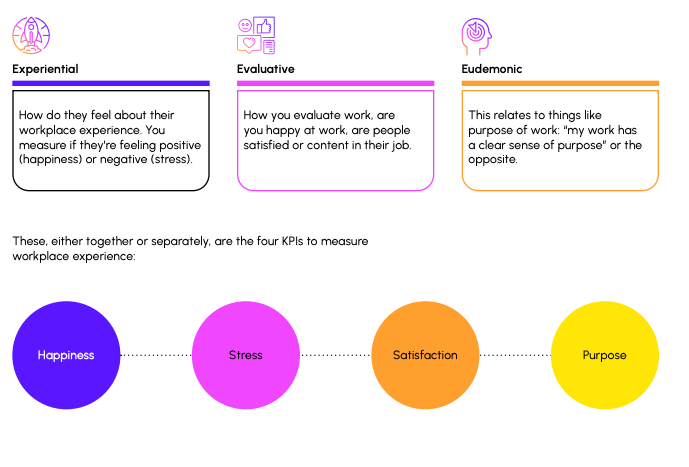
Professor De Neve stresses the importance of distinguishing between input and outcome measures. “What I’m measuring with happiness, stress, purpose and satisfaction is how you feel at work and about your work, not why you feel the way you do.”
So how do we measure this at a scale never seen before? “Well, you need extraordinary industry partners and I found those in the shape of Indeed, which is the only company that has the reach to speak with people in jobs and really capture their experience of work at a scale never seen before across all markets,” said Professor De Neve.
“This is really important because, for employers and HR managers, Indeed and Glassdoor are the places that potential recruits will look at your company to get a sense, not only for the jobs in your organization, but also as an aggregator for information around the jobs and the quality of the jobs, and the experiences people are having working for your company.”
From researching work experience at very large corporations in the US, one of the standout findings of Professor De Neve’s research is that there can be huge variations in employee wellbeing and experience even within the same company: it is not predetermined. It means wellbeing can be changed - if one part of the same company ranks higher for employee experience than another part, it means it can be improved.
What we’ve found is that even in tough industries and tough regions, even within the same company, and companies that are not known for being great places to work, there are good examples of workplace wellbeing and positive employee experience. And that’s something aspirational, something we should all aim for: it’s possible to generate good workplace wellbeing experiences—Professor Jan-Emmanuel De Neve
The Drivers of Workplace Wellbeing
What are the drivers of workplace wellbeing and what explains the differences and the variations between - and even within - companies?
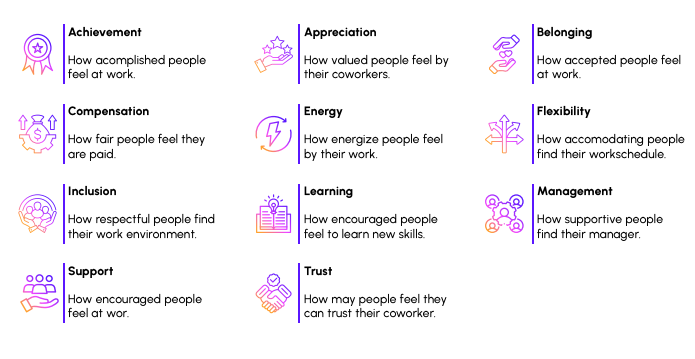
“In our research, we don’t just ask people about job satisfaction, happiness, stress and purpose. We also ask them about other things, such as, do you feel like you’re achieving something. Are you being appreciated? Do you feel like there’s a sense of belonging? Are you being compensated fairly? Do you feel you have the flexibility you need? Do you trust people at your workplace?” said Professor De Neve.
Measuring drivers that help explain why people feel the way they do at work.
Over five thousand people were asked questions relating to what they think drives employee wellbeing, and the results showed a huge disparity with what employees say influences their workplace wellbeing.
Traditional opinions around what drives employee wellbeing - and which still underpin CEO, CFO, and HR thinking and initiatives in many companies - centers on what could be considered transactional: compensation, flexibility, appreciation, but what the research shows is that, while compensation is important, particularly for lower paid workers, the social elements of workplace experience are underestimated.
As the below graph illustrates, having a sense of belonging tops the list of wellbeing drivers for most employees.
Employee Wellbeing Driver Analyses
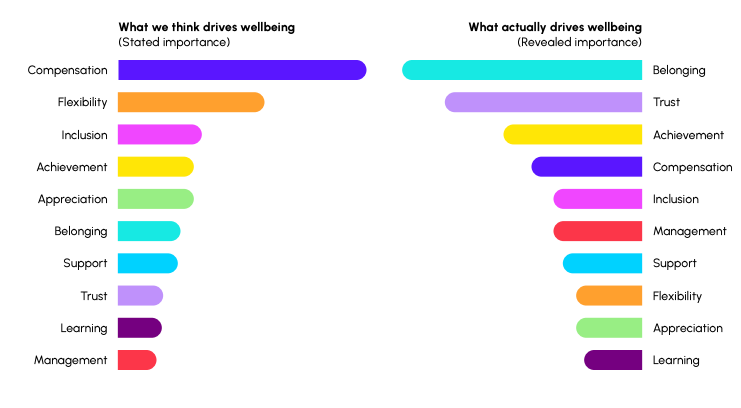
Belonging is therefore a lot more important than people tend to expect. They underestimate the importance of trying to generate a sense of belonging in their organization.
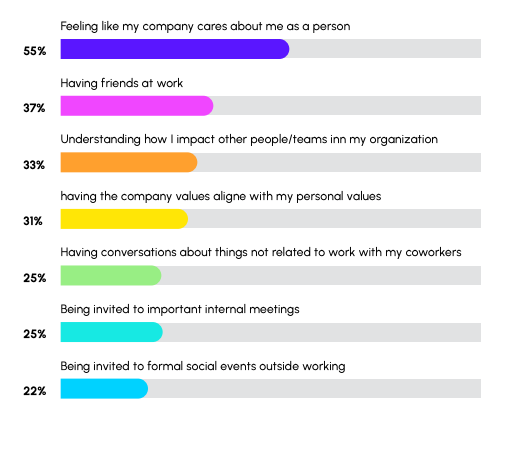
But what does the research show creates a sense of belonging for people? Topping the list is “feeling that my company cares about me as a person.” Another key influencer is “having a friend at work.”
“This answer always makes people laugh, but I am an advisor to Gallup and they make it very clear that from their Q12 Engagement Surveys, the single item that has the most predictive power of workplace wellbeing is having a friend at work.”
This is what gets people out of bed and excited to go to work. This is what retains people at work and keeps them engaged and motivated. So, companies need to focus more on the social capital they build in their organizations and one way they can do this is through their employee communications.
Focus Area: Belonging
People feel their company cares about them, they have friends at work, and they understand their empact on other people and teams.
What makes you feel a sense of belonging?
How Employee Wellbeing Impacts Productivity
While organizations wildly underestimate the importance of employee wellbeing, does it really matter in relation to productivity, employee recruitment, and retention? The answer is a categorical yes, according to Professor De Neve’s research.
This included a productivity case study at British Telecom, which showed a positive correlation between worker happiness and productivity, between employee happiness and customer satisfaction - and even a significant impact on sales.
Employees at BT call centres were asked on a weekly basis how happy they were, and this was tracked over time. The results showed the higher the levels of happiness, the greater the level of customer satisfaction.
The most powerful results came when we looked at the individual and what we saw is there is that changes in how people feel from one week to even influences sales,” said Professor De Neve.
If people move from “very unhappy” to “unhappy” to “neutral” right through to “happy” and “very happy” you are moving the dial on sales every step of the way.
The impact of employee happiness was more pronounced in cases where BT employees had to deal with more complex issues that involved selling broadband packages, for example, rather than basic tasks like order taking. More complex tasks require greater social and emotional intelligence, which are, in turn, influenced by how the employee feels on a particular day. The happier they are, the more productive and the better the sales results they achieve.
So, what we saw here is that if you could move an employee from being “very unhappy” to “very happy” you could expect a 13% increase in weekly sales—Professor Jan-Emmanuel De Neve
How Wellbeing Impacts Employee Recruitment
Professor De Neve said the evidence is there that publicly available data on employee wellbeing and employee experience, on huge jobsite platforms such as Indeed, influences job searches for companies with high levels of wellbeing. Research by his colleague George Ward at MIT showed that “companies that had high workplace wellbeing scores saw increases in job applications to them”.
And on the flip side, people were less likely to apply for jobs in companies where workers rated wellbeing and their workplace experience as low.
This is very important for anybody in HR and talent recruitment because it’s clear that when the employee data around workplace wellbeing and experience is publicly available—which it increasingly is today—job seekers are responding to this—Professor Jan-Emmanuel De Neve
How Wellbeing Impacts Employee Retention
The impact of wellbeing and workplace experience is probably most obvious of all on employee retention, according to Professor De Neve. Again, this is publicly available information on sites such as Indeed’s sister company, Glassdoor.
If someone rates their workplace and wellbeing experience as high, they are going to be way less likely to start applying to leave for somewhere else. Retention is a lot higher where workplace wellbeing is higher, he said.
From data on Glassdoor, we’ve been able to show that employees who, for example, rate their workplace experience as two out of five stars, they are twice as likely to start applying for another job in a different company—Professor De Neve.
He describes employee productivity, recruitment and retention as three pathways to performance. So, the big final question he and his team wanted to address was “do these pathways to performance lead to general performance improvements and prove a business case for investing in employee wellbeing. To answer this, he applied financial and stock market performance to this question.
Wellbeing and Financial Performance
Professor De Neve and his team leveraged the crowdsourced workplace wellbeing information from Indeed’s vast database and linked it to around 1,600 companies listed on either the New York Stock Exchange or the NASDAQ. They linked the average responses to how people feel at work, with the financial performance and, ultimately, the stock market performance of these listed companies.
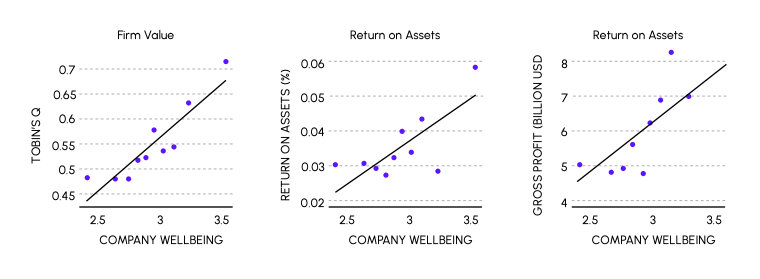
The research showed a very strong correlation between how workers felt at these companies and how well the company performs on the financial hard metrics of Firm Value, Return on Assets, and Gross Profitability.
Work wellbeing score and company financial performance
Professor De Neve’s research also sought to establish if listed companies in the US with higher levels of wellbeing could outperform the stock market.
The answer is yes, he said. Using stock market data from 2020 to 2023, the research found that wellbeing and workplace experience had a predictive power in driving company performance and outperforming the stock market.
Drivers of Employee Wellbeing, Companies Doing It Well—and 3 Steps to Getting There
While the business impact of employee wellbeing and experience might appear intuitively obvious, Professor De Neve’s data-based research could be an inflection point for leaders who up to now have felt wellbeing was important but didn’t make it a priority.
So, what do organizations need to do to move the wellbeing and employee experience dial? There are three essential steps.
The 3 Steps to Driving Better Wellbeing
Step 1. The first thing to do is measure current levels of employee wellbeing and experience and do it properly. And that means not just the annual employee survey, but regular pulse surveys to measure and track employee sentiment, perhaps on a monthly basis.
The problem with relying on an annual survey alone means that problems could have grown bigger and faster and you’re behind the curve in trying to solve them. The technology is there to get a faster and more regular sense of how people are feeling at work.
87% of leaders report that prioritizing employee wellbeing could give their organization a competitive advantage. But when you dig deeper and ask these same people whether they’ve actually made it a priority, only 35% have done so.
I feel very strongly that technology, communication platforms like Poppulo and others, enable us to do much better now in both informing people and putting their voices, in a dynamic sense, into the mix as well— Professor Jan-Emmanuel De Neve.
“You’re way behind the curve if you’re not leveraging the new technologies that enable you to get the actual pulse of your organization and act on it. There’s no more excuses for the big organizations out there,” said Professor De Neve.
Step 2: After measuring the workplace sentiment, the second step is making sense of the data and understanding what’s really going on. That’s the driver piece, getting a sense of what’s driving the employee experience in your organization, and as we’ve seen earlier in this guide, it might be very different than what you think is driving it.
CEOs, CFOs, and HR executives might have their opinions and gut feelings around what’s driving employee sentiment and wellbeing - compensation, flexibility etc. - but if you run a proper driver analysis, it might be other things that are driving employee experience at your company. And it might be different by type of worker, gender, race, or location.
Step 3: The third step to move the wellbeing and workplace experience needle is the most difficult: evidence-based interventions by the organization’s leadership.
Based on correct measurement and analysis of the data that gives a real understanding of what’s driving workplace experience, the leadership of the organization needs to properly think about what interventions actually work and then commit resources to doing the right thing to move the dial.
Professor De Neve said companies who are taking employee wellbeing very seriously include Unilever and its Chief Health and Wellbeing Officer, Diana Han, and HSBC and its Group Head of Wellbeing, Andrew Gibbons.
Ultimately, in relation to workplace wellbeing, he said he couldn’t emphasize enough the importance of belonging and people feeling that they have a voice.
The research showed that, contrary to what many think, a sense of belonging in an organization is the No.1 driver of employee wellbeing. And one of the most effective interventions to drive belonging is improving worker voice, getting people’s voice more into decision making.
About Professor Jan-Emmanuel De Neve
Jan-Emmanuel De Neve is Professor of Economics and Behavioral Science at the University of Oxford and is Director of its Wellbeing Research Centre. He is also a co-founder of the World Wellbeing Movement and a co-author of the annual World Happiness Report. Professor De Neve is the driving force behind the world’s largest study of workplace wellbeing.