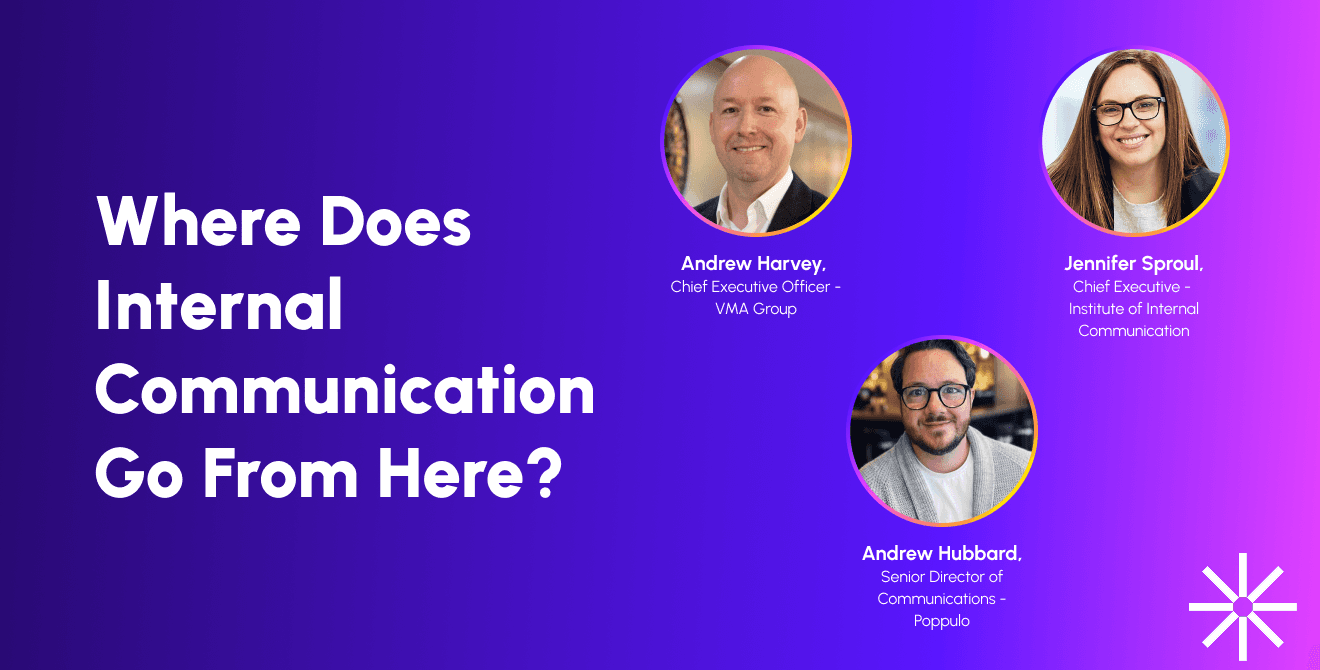
Jennifer Sproul runs the Institute of Internal Communication. Andrew Harvey has spent 20 years placing communications professionals into organizations. Between them, they have a clearer view than most of where the profession is heading and what's driving it there.
Neither is particularly cheerful about the current picture—but both are clear that the opportunity, for those willing to reach for it, is real.
The two were guests on a Poppulo webinar this week, moderated by Poppulo's Senior Director of Communications Andrew Hubbard. The question on the table: is internal communication facing a period of disruption, or a permanent change in its nature and purpose?
The AI Toolkit for Internal Communicators
The Market Has Already Shifted
Andrew Harvey's answer was unambiguous. The IC market, he argued, probably peaked around 2023. For two decades before that, the pattern was consistent—more organizations hiring more communicators to do more things.
That changed. Economic pressure bit. Teams got smaller. Some disappeared entirely. And now AI is in the mix, promising to scale communications output without scaling headcount.
Harvey's read: organizations won't hire more people to do more stuff. They'll buy more tech.
He went further. The boundaries between internal communication, HR, and external comms, he suggested, are likely to blur as technology embeds itself more deeply into how organizations function.
The IC teams of five years from now may not look much like the ones that exist today.
The Fault Line in the Profession
Jennifer Sproul didn't push back on any of that, and she added a different layer. Businesses are chasing efficiency, speed, and cost reduction—AI has become the answer many leaders have reached for, often before they've worked out what the question actually is.
She was pointed about this: a significant proportion of leaders, she noted, are effectively bluffing their way through AI conversations, projecting confidence they don't have.
The pressure to implement is real. The evidence base for what good implementation looks like is still thin.
The Business Case is the Audition
Both speakers kept returning to the same fault line in the profession. If internal communication defines itself by writing, producing content, and managing channels, it has a problem—because those tasks are increasingly automatable.
The function's future value lies somewhere else: in strategic influence, organizational intelligence, and the kind of advisory relationship with senior leadership that content production alone will never secure.
Harvey was direct about what CEOs actually want when they're hiring senior IC leaders. They're not interested in a detailed account of someone's comms experience—they assume that exists.
What they want to know is whether the person in front of them understands the business, its pressures, its competitive position, the things keeping the CEO up at night, and can talk about those things before pivoting to communications.
The comms conversation, in that sense, is almost beside the point. The business conversation is the audition.
Sproul framed the same idea through the lens of risk and trust. Communication shapes whether employees believe their leaders, understand decisions, and feel confident about the direction of travel.
Those outcomes matter directly to the board. An IC professional who can walk into a leadership conversation with data, a clear-eyed diagnosis of where trust is eroding, and a view on what needs to happen is an asset. One who arrives with a channel plan is much easier to cut.
What the Data is Actually Saying
The IOIC research Sproul referenced made the stakes concrete. Trust in leaders is down nine points in a year. The proportion of employees who rate internal communication as excellent has fallen.
Fewer than 60% feel confident about the future of their organization. The content machine is running hard, but the outcomes are going in the other direction.
AI got substantial airtime, though the conversation was more measured than the hype usually allows. Neither speaker argued for resistance or wholesale adoption. Both came back to the same word: curiosity.
Harvey observed that the pace of AI uptake inside any given team tends to reflect the mindset of the person running it. Enthusiastic leaders are experimenting aggressively. Cautious ones are barely touching it. The profession is moving in several directions at once.
What to do With the Time AI Gives You Back
Sproul described a profession still feeling its way—some teams redesigning their functions around AI agents, others stuck behind compliance and governance concerns, many simply running existing processes faster without asking whether those processes were worth running in the first place.
Her concern was less about whether AI would take jobs and more about whether the profession would use the technology to genuinely reposition itself, or just to stay busy more efficiently.
On one point there was no ambiguity: communicators need to be AI-literate, and the window for claiming they're still figuring it out is closing. Harvey put it plainly—walk into a senior interview in the next twelve months still describing AI as something you're working through, and someone else in the room will have moved on from that.
Sproul's point was even more pronounced: leaders don't understand AI either, which is precisely why they need people around them who do, and who can advise on the ethics and risks without overselling the outcomes.
The conversation closed on career development. Harvey's advice was to treat your own skills the way you'd treat a communications plan—audit them at the start of each year, identify the gaps, build something deliberate around filling them.
Sproul urged practitioners to stay curious, look beyond their immediate brief, and not let the pressure of day-to-day delivery erode the habit of critical thinking.
Internal communication still matters. The work of building trust, moving people to act, making organizations legible to the humans inside them—that work hasn't gone anywhere, and no one is close to automating it.
Whether the profession makes that case compellingly enough to the people who control the budgets is, for now, an open question.