Welcome to the latest edition of Poppulo Meets… our series of conversations with senior leaders about the work that defines them and the experiences that shaped them.
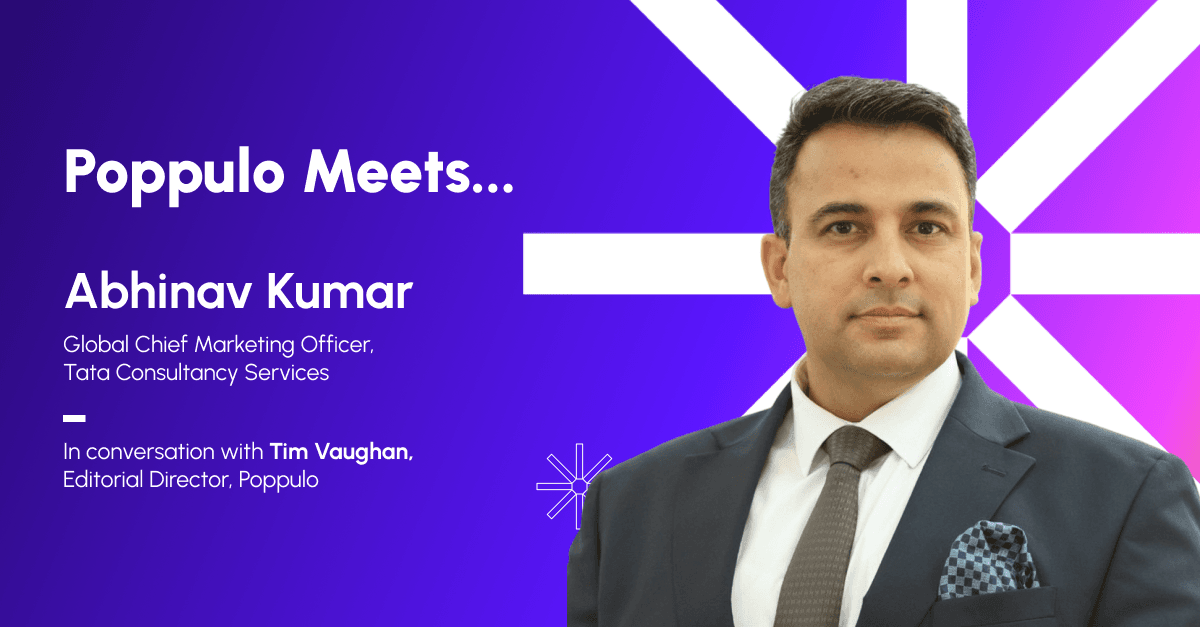
In this edition we're delighted to welcome Abhinav Kumar, Global Chief Marketing Officer, Tata Consultancy Services.
Abhinav leads brand and marketing for one of the world's largest technology services firms—with almost 600,000 employees across 55 countries with $30 billion in revenues. Over more than two decades at TCS, he has been the driving force behind one of the most remarkable brand transformations in the industry: from $2.3 billion in brand value in 2010 to $21 billion today.
That growth was built on integrated marketing, executive engagement, thought leadership, and a sponsorship strategy that raised eyebrows when it was first conceived—going all-in on marathons. TCS now sponsors 14 major races globally, and is Title Sponsor for three of the five World Marathon Majors it supports: New York, Sydney and London.
The TCS dominance of global marathon sponsorship has led Abhinav to joke that his CMO title really stands for Chief Marathon Officer. The strategic bet by TCS on a singular sport—instead of a spread of other sports—paid off in spectacular fashion at the London Marathon this year when Sabastian Sawe became the first athlete to break the two-hour barrier, placing TCS at the heart of a landmark moment in sporting history.
Beyond being a proud custodian of the TCS brand, Abhinav has spent his career advising CEOs on reputation, leadership communications, steering communications through mergers, geopolitical changes and crises, and arguing—quietly but consistently—that what a company says to its own people matters as much as anything it says to the world.
He is based in Brussels, Belgium, but often found in any corner of the world given the global presence of TCS.
In conversation with Tim Vaughan, Editorial Director, Poppulo
Everybody needs a break when they're starting out. I got mine early in my career, just two years after I joined TCS, when I was asked if I wanted to go and set up the marketing department for our new operations in Latin America.
And that taught me the importance of understanding the local context, culture, language and dynamics of a very different set of markets. People from outside see ‘Latin America’ as a homogenous region, but Brazil is very different from Chile, Argentina is different from Mexico. To be an effective marketer you need to immerse yourself in your markets and your clients, working hard to truly understand them and what makes them tick.
The person who has had the most influence on who I became — professionally and personally—was undoubtedly our former CEO, who is now our group Chairman, Mr. Chandrasekaran. I learnt from him to always think big, be bold in taking actions, and always stay close and be available to both your clients and your teams.
The moments early on when I felt completely out of my depth — but kept going anyway—was every time that I was asked to take on a larger leadership responsibility. You need to reinvent yourself to play a different game, build a new set of skills, all the while working to earn credibility both externally as well as internally.
The hardest thing is to earn the respect from those who up to that point were your peers, but you have now been elevated to lead. I am proud of my record on retaining almost all of them and creating great working relationships with each of them, every time I was given an elevation.
The best advice I ever received about leading people—and still come back to—is the seminal work by Julien Birkenshaw in his book Becoming a Better Boss. Surveying thousands of people, he has distilled the formula of leading people into five key principles:
- Praise good work
- Seek to inspire people
- Give them challenging tasks
- Take tough calls, and
- Always be available to them.
It captures well what I seek to do, although you need to keep working on becoming a better leader. The job is never complete.
And the advice I find myself repeating most often now to the people I lead is never forget to bring balance to your life. Work is important but it should never infringe on the important personal moments in your life, and you should always find time to rest and recuperate.
If you look at the world’s best athletes, they spend less than 5% of their time performing, 50% on training and the remaining 45% on recuperating. To be a high performer it is important to look after your health and wellbeing as the top priority.
One professional decision I made that’s never really left me was a collective decision we made as a company about 15 years ago. We had sponsorships in many sports from F1 and cycling to cricket, but when we discovered running and how deeply it engages our clients and communities, we went all in on it. Today we have a strong portfolio of 14 iconic marathons that TCS partners with, and it has been a tremendous decision that has boosted our brand and our engagement with all our communities globally.
Friends and colleagues might be tired of hearing it, but my favorite saying is “It is what it is.” Perhaps drawing inspiration from the field of stoicism, I don’t like to waste my time thinking about what is not in my span of control. Often things happen in your favor and often they happen against your interests, but what matters is how you react to them and quickly forge a way ahead, in spite of any setbacks.
I’ve always been passionate about how companies communicate with their people because at the end of that day that is what matters most. If your people are inspired, engaged and feel they are valued, they will in turn look after all your other stakeholders, from clients to investors. If your people feel disconnected, the reverse will be true and you start losing ground as a business.
The communications hill I'll never abandon—even when it makes me unpopular—is to push for communicating instead of hiding in the bunker when things go wrong. In moments of crises, companies and teams often freeze.
Those inflection points are what define you most as a company. Even if something has gone wrong, if you take accountability, communicate how you fix things and are humane in your response, you recover much better as a business than when you hide.
The best communicators I’ve ever heard are undoubtedly Barack Obama in politics, Gary Vaynerchuk in entrepreneurship, Jensen Huang in technology, and Simon Senik on leadership. What they have in common are three things; a real depth of perspective and knowledge on their subject, the ability to bring their points to life through deft storytelling and, most importantly, the ability to convey their message with great simplicity that makes it inclusive to everyone.
When TCS became title sponsor of the New York City Marathon in 2014, many people might have thought it was all about branding but our strategy was never just about just putting our name to major global events. It was about engaging our communities, showcasing the power of technology and creating positive value for the communities in which we operate. Today our 14 marathon partnerships have 6,000 of our clients and 10,000 of our employees participating annually, it has given us a 40% brand consideration uplift.
But, most importantly, every year these marathons have create US$ 2.25 billion of incremental economic growth for the cities that host them, raise US$279 million for charities, boost the wellbeing and health of millions of people—and have transformed themselves into centers of sustainable sport.
When Sabastian Sawe crossed the finish line at the TCS London Marathon in under two hours a couple of months ago—crossing the TCS-emblazoned tape at the finish—I felt privileged. Privileged to have witnessed one of the greatest sporting moments in human history. To the world of running this was a moment akin to what the lunar landing in 1969 meant to space exploration.

Sabastian Sawe creating sporting history at the TCS London Marathon on April 26, 2026. Picture courtesy of London Marathon Events.
When the TCS Global CMO role came, the thing that surprised me most wasn't the scale, it was the speed. The pace of change has accelerated on all fronts in recent years, whether its geopolitics, acceleration in technology with AI, disruptions in supply chains, climate change, and the pace at which brands can be built or destroyed in an always connected world.
Early in my tenure as CMO, our CEO and I recognized this and launched the theme of “Perpetually Adaptive Enterprise” advising our clients to build operating models, talent, technology and mindsets that help them quickly respond and adapt to rapid change.
The hardest conversation I've had to have with a colleague was when I had to tell them that the work they were doing did not meet the standards we aspire to. It is always hard to ask passionate, driven people who are doing things that worked well and created success in the past, to reinvent themselves to changed environments. However it is critical to their own success to have difficult conversations in a timely manner, which can lead to them growing and succeeding in the future.
Davos gets a lot of cynicism thrown at it. What I'd say to that, after 15 years of representing TCS there is that it is very misunderstood. The World Economic Forum is a fabulous platform in which people with influence in business, government, academia, media and society from across the world, can gather at a neutral platform and seek to build better understanding and collaboration on common issues. For us it has been a very important platform to deepen our relationshipships with key stakeholders, communicate what is important to us and collaborate on important causes.
The most honest conversation a company can have with its people right now should be about the fact that we live in an era of constant change, so their own ability to be adaptive, focus on continuous learning and be resilient to challenges is something they need to work on, so that both they and their organizations are well placed to meet the future.
If you asked the people who've worked with me what I care about most when building a team, they'd say creating an environment which is psychologically safe, collaborative and which enables people to grow. Plus always bringing humor and enjoying the process of doing work.
The book I read that most changed how I see the world was Sapiens by Yuval Noah Hariri. It takes you to the roots on what has shaped humankind and the world we live in today. I enjoy reading history, particularly historical fiction from authors like Conn Iddulgen, since they take real moments in history but are able to color them with emotions, motives and conversations through great storytelling.
Looking back, the thread that has run through my entire working life is being open to doing new things and creating impact by unlocking the power of talented people and teams.
If I could go back and tell my younger self one thing, it would be, be more curious. The more you ask questions, the more you learn. The more you learn, the better you are able to connect the dots and become a better marketer.
If I wasn’t working at what I’m doing now, I could see myself being in an alternative metaverse, it would be an honor to work in aerospace or as a climate scientist. I greatly admire people in both these professions.
For the long term continuity of life, we need to either protect our planet better, or find new ones to live on. I hope we do both.