The Staggering Financial Impact of Communication on Employee & Customer Experience
Exclusive C-Suite Research from Poppulo
Register for Webinar

Speakers

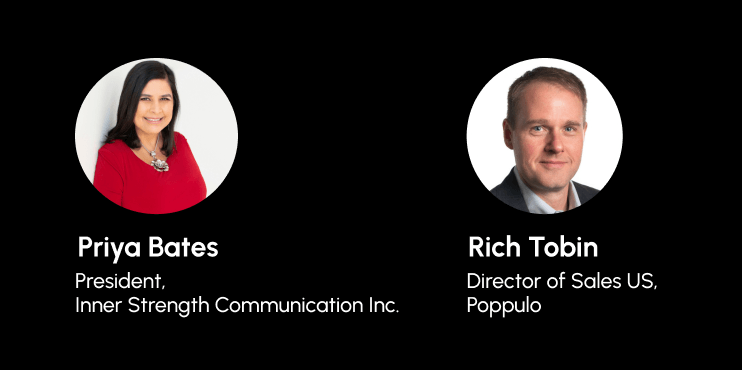
Priya Bates
President, Inner Strength Communication Inc.

Rich Tobin
Director of Sales US, FWI | Poppulo
About this webinar
It’s the unarguable circle: great workplace communication and a great workplace experience create a better employee experience, which in turn delivers a superior customer experience. Of course, the opposite is equally true: poor communication hurts employees, customers, and your bottom line.
But how badly? That’s exactly what we’ve found out. Our research of 500 C-Suite and senior executives reveals the staggering cost to companies when the employee and customer communications experience isn’t what it should be.
Absent or poor internal communication is costing companies with over 5,000 employees anywhere from $5-$50 million in the US and EU, and between £4.5 - £45 million in the UK.
But that’s just the tip of the iceberg—be one of the first to get exclusive insights into these compelling research findings by joining our webinar with communications strategist and IABC Fellow, Priya Bates.
You will learn:
- How companies are approaching employee communication to influence employee experience and customer experience
- How enterprises are adapting to hybrid working and what they expect in 2023
- The impact of employee communication on business outcomes
- How executives rate various communication channels
- The way to avoid costly mistakes around communication and workplace experience, and instead make decisions that are a springboard for long-term success
The exclusive independent research for Poppulo was conducted in September 2022 by the international market research company Censuswide. It surveyed 500 C-Suite and senior executives in companies with over 5,000 employees in the USA, EU and UK.
Access On-Demand Webinars
The Misalignment Tax: Closing the Strategy–Performance Gap with Comms + HR
Employee use of the word “misalignment” to describe leadership increased 143% last year. Nine in 10 leaders say strategic alignment matters, but less than one in 10 employees feel it. That gap has held for seven years and it’s becoming a bigger, more urgent problem. In a time of constant change, eroding trust, and AI-accelerated everything, misalignment spreads faster, slowing decisions, duplicating effort, distorting priorities, and eroding the bottom line. This is the Misalignment Tax—a silent, compounding drain on productivity, performance, and ultimately profitability. Every organization pays it, unseen and unquantified. In this live webinar, Zora Artis and Wayne Aspland of Clear Leaders share what their latest global research reveals about why alignment fails, what it truly costs organizations, and what it takes to turn around. It is a strategic opening for Communication and HR to lead the fix—together. These functions are uniquely positioned to make it happen, but most aren’t doing so yet. This session is about changing that. What You’ll Gain: A Clear Understanding : Why the gap persists, and the two paradoxes that sustain it. The AI Multiplier : How AI amplifies clarity in aligned organizations—and chaos in misaligned ones. A Practical Framework : The leadership conversations required to close the gap, and how Comms + HR can shape them. Tangible Actions : Specific moves Communication and HR leaders can initiate immediately. The Research Behind the Session: Zora and Wayne’s research - their third global study - draws on interviews with more than 50 CEOs, Chiefs of Staff, and senior leaders across communication, HR, strategy, and operations - and points to three conversations that determine whether strategy actually moves, or simply sits on a shelf. It also explores the cross-functional enabling work that must happen before any of them can.
Top Employee Communication Trends & Strategies for 2026
Internal comms is heading into 2026 with more uncertainty about its role than at any point in recent memory. AI is changing the work at speed. Trust is slipping. Managers are stretched thin. Employees are tuning out. And the expectations placed on IC keep widening into work that falls well beyond its traditional scope—often without the structure or support to match. The familiar models aren’t holding, and the function is being pulled into a new order that still isn’t fully defined. 2026 will ask big questions of IC: what it stands for, where it fits, and how it leads through a year marked by uncertainty and shifting expectations. To understand what this means in practice, we’re bringing together four leaders who are working at the sharp end of these changes: Stephanie Cornell, Head of People Communications & Marketing, WPP Annabelle Gordon, Director of Employee Communications, Super Regine Nelson, Director of Internal Communications, Couchbase Stacie Barrett, Former Director of Internal Communications, Domino’s Moderated by Joss Mathieson of Change Oasis, this 60-minute session, including time for your questions, will get into the real pressures facing IC in 2026 and how teams can work through them. Expect to Explore: The shifting identity of internal comms and what it means to play a deeper role in shaping the employee experience Where AI is genuinely changing the work of internal comms, and the risks that emerge when speed increases but understanding doesn’t How IC can work alongside leaders and other functions when old command-and-control habits no longer hold up How IC can rebuild trust and strengthen resilience by creating communication that feels human, transparent, and genuinely meaningful in a year defined by ambiguity The emotional and practical load on IC practitioners, and how to stay steady when you’re communicating through the same uncertainty as everyone else
IC Measurement Masterclass: Ditch Vanity Metrics to Prove Impact
Clicks, opens, and views might look impressive on a dashboard, but they don’t prove whether your communication made a difference. And that doesn’t cut it anymore. Today, especially in the age of AI, internal communicators who can’t demonstrate business impact risk seeing their value questioned by executive leadership. This 45-minute masterclass with Poppulo’s Senior Director of Communications, Andrew Hubbard, will show you how to move beyond vanity metrics and start measuring what really matters: outcomes that align with business goals and prove the strategic value of your internal communications role. Drawing on his leadership at Poppulo, partnerships with leading global companies, and senior comms experience at Rolls-Royce, Santander, and National Grid, Andrew will share hands-on strategies and tactics you can apply immediately to make that impact. What You’ll Learn Why vanity metrics (opens, clicks, views) fall short and what leaders actually care about Practical methods to measure outcomes: understanding, alignment, behavior change, business results How to link comms measurement directly to organizational goals Using internal benchmarks to track progress and demonstrate continuous improvement Quick-win tools like pre and post campaign surveys to capture impact What You’ll Take Away A framework to shift your measurement approach from outputs to outcomes Confidence to link communications directly to business priorities Inspiration from top organizations already proving their impact Practical steps you can apply immediately to strengthen your IC credibility This is your chance to gain the tools and confidence to demonstrate true impact and elevate your role, before AI forces the question.