
Internal Communications Guides, Templates & Playbooks
The Internal Communications Measurement Masterclass & Playbook

Guide
Internal communicators measure plenty. Open rates, click-throughs, attendance, views, and reach—most IC teams have dashboards full of the stuff. What they struggle with is proving that any of it made a difference to the business. And business impact is the only measurement their leaders genuinely care about. It's a gap most IC practitioners feel acutely. Gallagher's 2026 Employee Communications Report found that seven in 10 internal communicators still measure only basic activity metrics, and fewer than one in eight measure business impact. Measurement is the weakest capability in their global readiness model, and teams relying only on activity data are the ones struggling most to demonstrate their value. This is a two-part guide built to close that gap. Part One is the Masterclass. It sets out why outcome measurement matters, the frameworks that make it manageable, and the principles separating measurement that proves impact from measurement that just fills a dashboard. Part Two is the Playbook. It's the templates, the worked example, and the sample dashboard—the practical tools you'll need for a successful comms campaign. Read the Masterclass for the thinking. The Playbook is where you'll find the tools to put it into practice. We hope you find them useful. Tim Vaughan Editorial Director, Poppulo

Latest Guides
Filter By:
The Internal Communications Measurement Masterclass & Playbook
Internal communicators measure plenty. Open rates, click-throughs, attendance, views, and reach—most IC teams have dashboards full of the stuff. What they struggle with is proving that any of it made a difference to the business. And business impact is the only measurement their leaders genuinely care about. It's a gap most IC practitioners feel acutely. Gallagher's 2026 Employee Communications Report found that seven in 10 internal communicators still measure only basic activity metrics, and fewer than one in eight measure business impact. Measurement is the weakest capability in their global readiness model, and teams relying only on activity data are the ones struggling most to demonstrate their value. This is a two-part guide built to close that gap. Part One is the Masterclass. It sets out why outcome measurement matters, the frameworks that make it manageable, and the principles separating measurement that proves impact from measurement that just fills a dashboard. Part Two is the Playbook. It's the templates, the worked example, and the sample dashboard—the practical tools you'll need for a successful comms campaign. Read the Masterclass for the thinking. The Playbook is where you'll find the tools to put it into practice. We hope you find them useful. Tim Vaughan Editorial Director, Poppulo
The Internal Communications Measurement Masterclass & Playbook—Part Two: The Playbook
Many IC teams measure and report on what's easy to count: email open rates, video views, all-hands attendances. Outputs that leadership don’t much care about. They want to know whether communications actually changed anything—whether people understood something important and whether behavior looked different afterward. Leaders want proof of impact, they want to see results. Outputs don't give them that. Outcomes do. Part One of this paper, the Measurement Masterclass, clearly showed why. Here, Part Two gives you the tools to measure outcomes: four templates you can fill in for your own campaigns, plus a full worked example showing all four completed together, so you can see how they fit before you use them yourself. What’s inside: The Know/Feel/Do Framework. Defines what a specific audience needs to know, feel, and do as a result of your communication—specific enough to measure. One template per audience segment. The Outcome/Output/Measurement Plan. For each outcome, sets out the communication tactic you'll use and how you'll measure whether it worked. This is the template you'll use most. The SMART Objectives Worksheet. A short exercise for turning a vague goal into a specific, measurable one, with a number and a deadline attached. The Power/Influence Grid. Maps your audience by power and attitude—champions, supporters, blockers, detractors—so you know where to put your effort. A worked example. All four templates completed end-to-end for a company-wide AI policy rollout, so you can see the whole process applied to one campaign from start to finish. A sample measurement dashboard. A one-page example of how to present outcome data to leadership. Written by Andrew Hubbard, Senior Director of Communications at Poppulo, and Joanna Hall of Afire Consulting.

Poppulo’s AI Jargon Buster
Lost in the AI Lingo? Here’s your cheat sheet to bots, buzzwords & brainy tech, made simple for internal comms pros.
The AI Toolkit for Internal Communications
Internal communication is under real pressure. IC teams are expected to support leaders, shape culture, and deliver relevant, personalized communication to an increasingly diverse audience—all while operating at greater speed and scale than ever before. AI arrives at the right moment. It doesn’t replace communicators; it elevates them. Applied well, AI sharpens the fundamentals of effective communication: diagnosing issues, shaping the narrative, guiding leaders, and delivering messages that connect people to purpose and progress. At its best, AI accelerates drafting, adapts content for different formats, improves accessibility, and surfaces insights about what’s landing. Without governance, though, it can create noise or risk. The opportunity for IC teams is to bring AI in thoughtfully, with governance and human judgment at the center. This guide shows how to do exactly that. Inside, you’ll find practical guidance on when to use AI, where humans remain essential, how to establish guardrails, how to prompt effectively, and how to scale AI responsibly across channels and teams.

The Poppulo Guide for IT & Security Buyers
Clear answers on security, data protection, integrations, deployment, AI governance, and enterprise scalability.
The Strategic Role of Email in Employee Communication
By now it’s become predictable. Every now and then, on a reasonably regular basis, someone will say that email as a workplace communication channel is dead, or at the very least in its death throes. Buried by noise and shiny new tools. But, of course, it’s not. Far from it. Email remains by far the most widely used communication channel in today’s workplace. Not only that, research shows email growth will continue to soar, with an additional half a billion business and personal users by 2025. Despite the obvious downside of email misuse or overuse—think overwhelmed recipients and overloaded inboxes— internal email and newsletter platform plays a critical strategic and tactical role in employee communications and the workplace experience, and that’s not going to change anytime soon. This Poppulo whitepaper by the acclaimed communication professional, Priya Bates , explores this strategic role. It also focuses on email effectiveness and the necessity of an active versus passive approach to email strategy, as well as its role in an omnichannel comms environment.
Subscribe to get the latest resources in your inbox
Access On-Demand Webinars

How Leading Healthcare Organizations Reach Every Frontline Worker
Ask a hospital's communications team whether last week's safety alert reached every person who needed it—nurses, care assistants, porters, techs, cleaners, kitchen staff—and most can't tell you. The message went out, but who read it is guesswork. That blind spot is the real problem, and it starts with the staff. Most of the people keeping a hospital running have no company email and no desk, so an update reaches them through a manager who remembers to pass it on—or it doesn't reach them at all. When that message is a changed protocol or updated equipment guidance, a missed message is a patient-safety risk you never see. What you'll learn During this session, we'll show how healthcare organizations: Reach every clinical and support worker across hospitals, clinics, home visits, and community sites, without relying on email or a shared device. Deliver shift-relevant safety and compliance alerts with read tracking and must-read acknowledgment. Personalize communications by role, location, shift, and language, so people get only what's relevant to them. Use AI to help staff find the right policy or procedure in seconds. Replace scattered, manager-by-manager messaging with communications every employee receives, whatever their shift or location. Support wellbeing and recognition programs that help retain people in demanding roles. Let ward and department leaders communicate locally while central teams keep governance intact. See who opened and acknowledged each critical message. Watch the on-demand recording now.
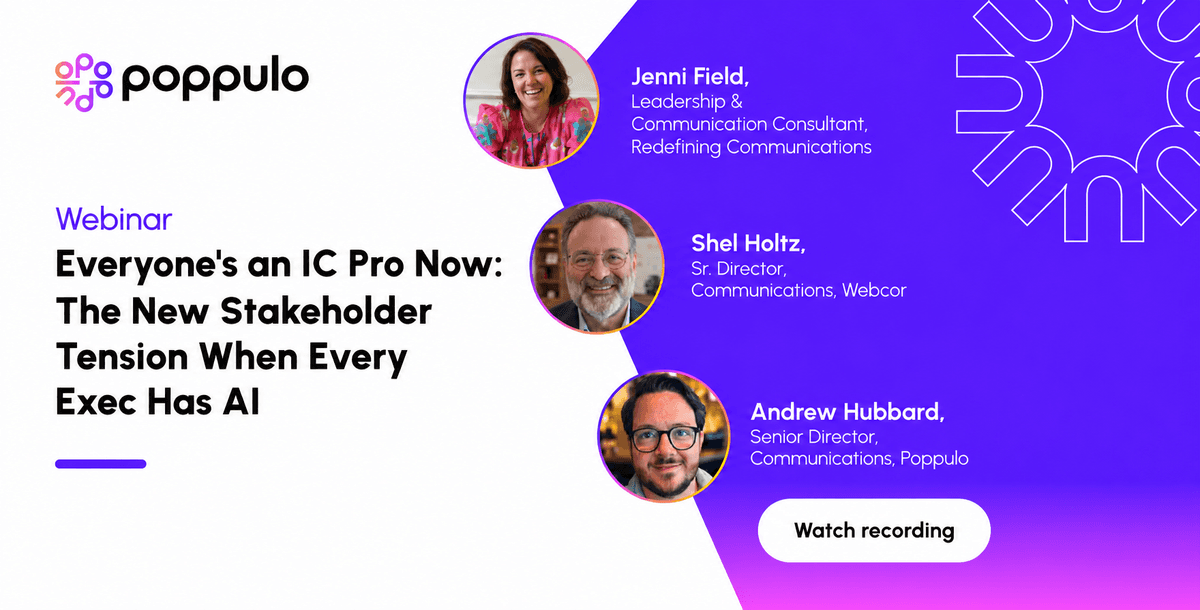
Everyone's an IC Pro Now: The New Stakeholder Tension When Every Exec Has AI
Sign-off used to mean a few comments in the margin. Now a routine leadership announcement comes back carrying six sets of detailed, confident, strangely similar feedback—because somewhere between your outbox and theirs, half your stakeholders ran it through an AI. Executives aren't just reviewing comms work anymore. Armed with the same tools, plenty of them now believe they can do it. Stakeholder management was already the hardest part of the job; it wasn't built for reviewers with an assistant that never runs out of opinions. This session is about easing that tension—running a review process that still works, and keeping the final say where it belongs. What you'll learn: How to recognize AI-assisted feedback and weigh it for what it is—directional input, not a rewrite Ground rules for review cycles when every stakeholder has a co-pilot How to push back on machine-made opinion without damaging the human relationship behind it How to keep the final say with IC—not with the loudest AI-assisted opinion Plus: a live audience poll putting the first real numbers on how far this has spread. Bring your worst example. Who it's for: Internal comms leaders and senior practitioners who own the review cycle—and intend to keep it. Watch the on-demand recording now.
How Leading Professional Services Firms Are Modernizing the Employee Experience
In most professional services firms, information is scattered, and valuable time is wasted trying to find it. Company news, policies, business updates, key documents—all in different places, and rarely in the first place you look. Now there's real risk on top of wasted time. Clients are questioning the value of professional advice at the same time AI is raising the stakes on quality and accuracy. As employees increasingly use AI to accelerate their work, firms need to ensure people are working from approved content, trusted knowledge, and the latest policies—not outdated or unofficial information. Keeping people aligned on standards, governance, and current policy is now part of how a firm can protect what it's spent years building. Join us to see how leading firms are building a modern digital workplace that gives employees one personalized place to find company news, documents, policies, people, and business applications—and see what's happening across the wider firm, so they spend less time searching and more time delivering work that clients trust. What you'll learn During this session, we'll show how professional services firms: Give employees a single place to find news, knowledge, policies, applications, and everyday resources. Keep people aligned on the standards, governance, and quality expectations that protect client work. Reach employees wherever they work, across mobile, Microsoft Teams, and digital signage. Make sure people receive only what's relevant to their role, office, or practice area, in their preferred language. Confirm critical updates are seen and acknowledged, with must-read communications and reporting. Connect colleagues across offices and practices, so local teams see the wider firm without losing their own focus. Use AI to help employees find the right policy, procedure, or precedent in seconds. Integrate with Microsoft Teams and Microsoft 365, so communications and knowledge sit inside the tools people already use. Measure real engagement and reach, not just publishing activity. Watch on-demand recording.