Frontline employees don't necessarily need another AI tool designed around office work. What they need are trusted answers during a shift, and fewer processes pulling them away from customers, equipment, or the shop floor. That gap can sink promising programs.
Key Takeaways
- Begin with a frontline problem, not an AI capability.
- Fix access and knowledge quality before launching AI assistants or automation.
- Prioritize trusted answers, multilingual communication, comprehension, and low-risk workflow support.
- Involve frontline workers and managers in design and testing.
- Preserve human escalation for consequential or sensitive situations.
- Measure reduced friction and employee trust, not AI adoption alone.
When it comes to the frontline employee experience, frontline-first means designing for deskless, shift-based, field, store, and service workers. The test is simple: can the hardest-to-reach worker use the technology safely during frontline work?
With the right tools and approach, yes, they certainly can. This guide gives organizations an eight-step method for building an AI frontline employee experience around real needs. It moves from diagnosing friction and preparing knowledge to prioritizing use cases, co-designing, governing, piloting, training, and measuring.
Let's get started.
How to Use AI to Improve the Frontline Employee Experience
A successful AI employee experience begins with work design and trust. Choose technology after the organization identifies the friction to remove.
1. Start With Frontline Friction, Not AI Features
The right starting point is a prioritized map of where frontline employees lose time, information, or confidence.
What to map:
- Observe shift starts, handovers, policy questions, equipment issues, schedule changes, onboarding, safety updates, and escalation across roles and shifts.
- Ask workers what they cannot find, which repetitive tasks they perform, and where delays harm the customer experience or safety.
- Rank each problem by frequency, employee impact, operational impact, and risk. Name an owner and record a baseline.
This is the same employee-centered logic behind a stronger frontline employee experience. It prevents digital transformation from becoming a vendor feature exercise. AI starts creating real value only when it solves a recurring moment in frontline work.
2. Build the Access and Knowledge Foundation First
AI systems cannot compensate for inaccessible tools or contradictory knowledge systems.
Many organizations treat information technologies as office systems. Frontline workers judge these systems by whether they ease a shift or add obstacles.
Foundation checks:
- Audit email, intranet, mobile, manager cascades, messaging groups, signage, paper, and other existing tools. Identify workers without corporate email, reliable connectivity, company tools or devices, or time to search.
- Remove duplicate and outdated content. Assign owners, review dates, source-of-truth rules, and escalation contacts using disciplined knowledge management practices.
- Support mobile, shared-device, offline, multilingual, and no-device access. Natural language processing and an effective intranet search engine should lead employees to approved sources, not merely plausible text.
Generative artificial intelligence can make poor training data sound authoritative. Be sure to govern, map, measure, and manage risk throughout the lifecycle, not just after launch.
3. Prioritize High-Value, Low-Risk Frontline Use Cases
The best early use cases reduce everyday effort without making consequential decisions about employees.
Trusted answers in the flow of work
AI agents and AI assistants should provide real-time knowledge support for policy, benefits, procedures, products, equipment, and frontline operations. Require citations to approved content plus an “I still need help” route.
Relevant multilingual communication
AI-powered translation, summaries, audio, video, and role-based updates can support a diverse frontline workforce and improve customer experience by surfacing relevant insights instantly. Maintain one approved meaning across languages, and require human review for safety, compliance, and employment-policy content.
Faster learning and comprehension
AI agents can deliver step-by-step instructions for complex tasks, personalized training, transcripts, chapters, quizzes, and recommendations inside frontline workflows. Design training for short, paid breaks and supervised practice. A 30-60-90 day frontline onboarding model helps managers distinguish content completion from competence and reduce high turnover or employee turnover caused by unclear starts.
Administrative and workflow support
Use AI agents for low-risk form guidance, request routing, reminders, status updates, scheduling, and inventory data entry. AI-powered predictive analytics can also flag equipment risk: McKinsey reports predictive maintenance can reduce downtime by 30% to 50%. These tools improve operational efficiency, inventory levels, and business continuity, but grievances, accommodations, health disclosures, and discipline remain human-led.
Feedback analysis
AI agents can group themes from surveys or idea submissions, helping organizations see patterns across sites. Preserve anonymity thresholds, validate interpretations with workers, and never infer individual sentiment from passive human behavior. A closed-loop employee pulse survey must show employees what changed.
4. Co-Design With Frontline Employees and Managers
Co-design exposes assumptions that an HQ pilot will miss.
Who and how to involve:
- Recruit frontline workers across roles, sites, shifts, languages, tenure, and accessibility needs, including skeptics as well as early adopters.
- Test real scenarios where the tools will be used. Record confusing answers, inaccessible interactions, missing content, and unsafe recommendations.
- Give frontline managers a defined role without making them the only adoption channel. Show participants which feedback changed the system.
Participation is not a one-time survey. Be sure to center workers' voices when redesigning jobs around human capabilities and AI technology.
5. Set Data, Content, and Human-Escalation Guardrails
Guardrails matter because frontline AI may touch personal, operational, and safety-critical data.
Governance decisions:
- Define what data AI systems may access and prohibit sensitive employee conversations, location, performance, health, and HR data unless a lawful, necessary use is approved.
- Tell employees when they are interacting with AI. Show sources, confidence limits, privacy rules, and a route to a person.
- Require human oversight for safety, employment, performance, disciplinary, health, or legal decision-making. Define human review, incident reporting, correction, audit, retention, quality control, and vendor review.
- Assign ownership across HR, Internal Communications, IT, Legal or Data Protection, frontline operations, and content owners.
The common barriers are not only technical. Trust collapses when new systems obscure accountability or connect multiple systems without clear permissions. Workers need to know which systems record an interaction, which tools can act, and which business owner will correct an error.
GDPR-Compliant Internal Communications: What IT and Privacy Teams Should Actually Look for in a Platform
6. Pilot Across Roles, Sites, Languages, and Shifts
A credible pilot tests working conditions, not an ideal demo environment.
Pilot requirements:
- Choose one bounded use case with measurable friction, manageable risk, and a clear business case.
- Include several shifts, locations, languages, and device conditions. Test low bandwidth, shared devices, gloves, noise, accessibility, personal-device restrictions, and limited interaction time.
- Compare AI-supported and current journeys. Track incorrect or unanswered questions, escalation, time saved, confidence, and stop conditions for harmful behavior.
- Ask frontline managers and workers whether the pilot creates more predictable schedules or simply moves administrative work elsewhere.
Do not scale from an HQ-only trial. Most companies need evidence across frontline roles before AI adoption can support a more agile workforce rather than deepen unequal access.
7. Build AI Literacy Into the Rollout
AI literacy gives employees enough understanding to use tools critically and address concerns without hype.
Training priorities:
- Explain how AI works at a practical level, what it can and cannot do, how it uses data, and when AI agents can automate tasks or complete tasks.
- Teach workers to ask useful questions, check sources, spot weak answers, and report errors. Train managers without turning adoption into coercion.
- Provide paid training on every shift. Reinforce judgment, empathy, collaboration, problem-solving, customer care, and situational awareness.
Large language models predict outputs; they do not understand frontline reality. Workers and frontline managers must remain able to challenge AI agents, pause automation, and escalate decisions. That is how AI supports future business resilience.
This balanced framing prepares an agile workforce for the AI revolution and the future of work without pretending emerging technologies make human judgment obsolete in future jobs.
8. Measure Employee Outcomes, Then Scale
High usage does not prove that AI improved the employee experience.
Measures that matter:
- Segment access, answer quality, successful resolution, time-to-information, escalation, repeat questions, and correction time by site, shift, language, role, and device.
- Ask whether employees trust answers, understand data use, and can reach a human. Watch for work intensification, off-hours contact, burnout, and exclusion.
- Pair employee measures with onboarding speed, rework, service consistency, safety acknowledgment, and operational efficiency
Use a rigorous internal communication measurement system and scale only when evidence shows lower friction without lower trust.
How Poppulo Supports a Frontline-First AI Employee Experience
AI becomes useful when trusted knowledge and AI-assisted content reach employees through channels that fit frontline work. Poppulo's AI features are designed to do precisely this.
Relevant capabilities:
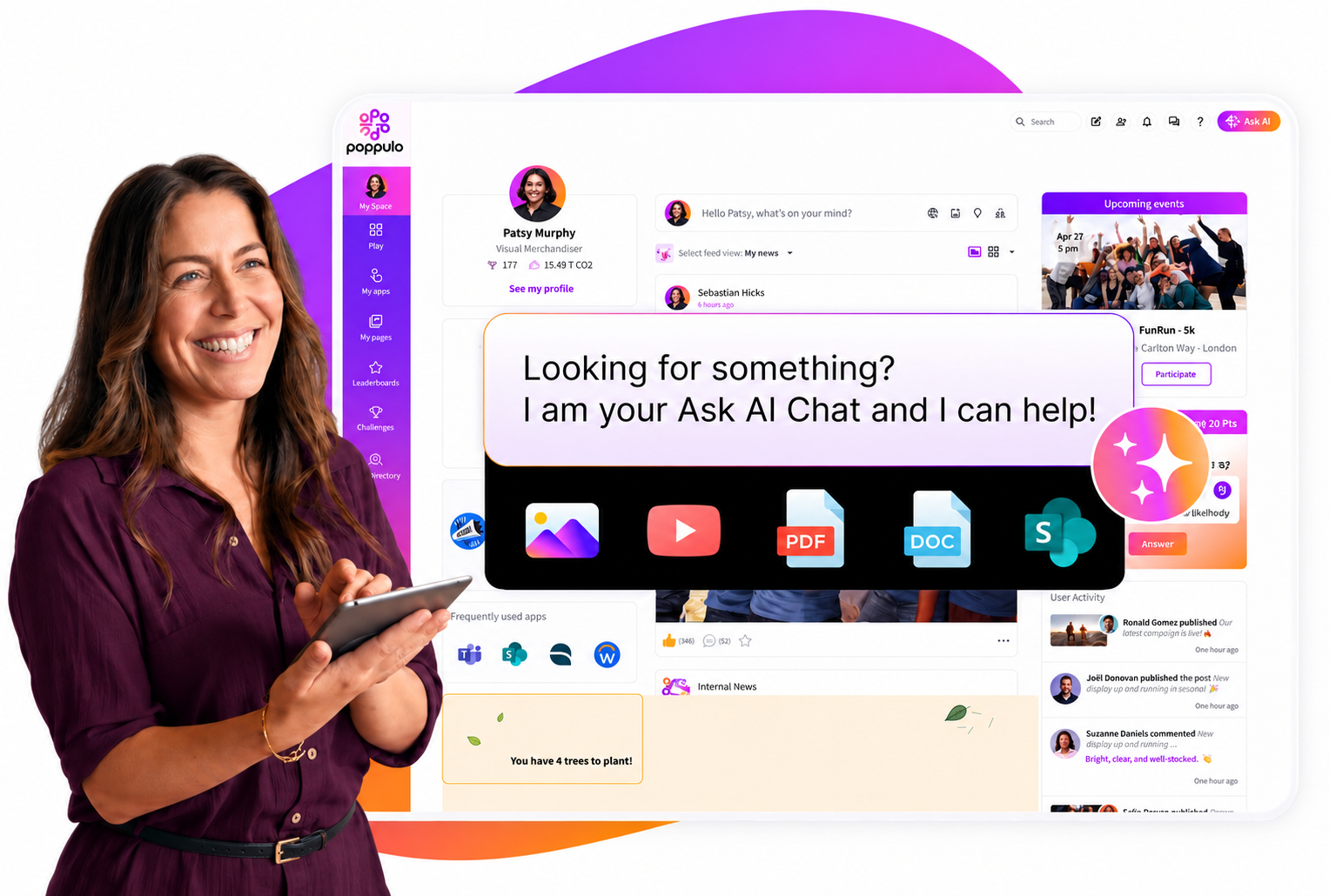
- Specialized AI agents provide natural-language answers sourced from internal company content.
- AI-powered search finds posts, documents, intranet pages, and Microsoft 365 content quickly.
- Translation, dubbing, transcription, summaries, and chapters improve multilingual comprehension.
- Mobile, offline, no-email onboarding, and digital signage expand access to frontline employees.
- Company-guided content generation and compliance checks support governed communication.
- Analytics by department and location help managers monitor reach and adoption.
What truly makes the difference, however, is the platform's AI search feature: it turns frontline knowledge into instant, on-the-job answers. Instead of searching through documents, intranet pages, or old messages, frontline workers can simply ask a question in natural language and receive a relevant answer based on approved company knowledge, with links back to the source.
For example, a store associate could ask, “What is the procedure for handling a damaged online return?” and the AI search can immediately surface the latest approved guidance—helping the employee act confidently while reducing interruptions for managers and support teams.
A real frontline-access example: Euromaster
Euromaster shows what accessible participation can look like. Its 2,700 frontline workers work across 450 centers, and nearly two-thirds lacked professional email.
Participation results:
- 70% of employees use the Poppulo Experience Platform.
- Frontline employees generate 90% of platform content.
- The organization recorded 994 monthly active users in 2025.
With the Poppulo Experience Platform, internal communications are built with frontline connection in mind.
Final Thoughts
AI should make frontline work easier to navigate without making employees feel watched, excluded, or unable to reach a person. Test every investment against the hardest-to-reach employee: access, trust, and human decision-making determine whether AI's potential becomes real value.
Ready to learn more about how the Poppulo Experience Platform can connect governed AI-powered knowledge, multilingual communication, and frontline-ready delivery in one workplace experience? We've already partnered with global leaders like Coca-Cola CCEP, Primark, and L'Occitane Group to enhance their frontline communications, and we'd love to do the same for your organization, too.
Book a free personalized demo to see the difference the Poppulo Experience Platform can make.
AI Employee Experience FAQs
Here are the questions that come up most often when discussing AI in the frontline experience.
What is the difference between AI employee experience and workforce automation?
AI employee experience uses artificial intelligence to help employees find information, learn, and complete work with less friction. Workforce automation focuses on process efficiency. Automation can automate tasks and routine processes without improving how jobs feel, whether schedules become more predictable, or whether employees receive meaningful support.
Who should own a frontline AI employee experience program?
Ownership should be shared across HR, Internal Communications, IT, operations, and Legal or Data Protection. One executive sponsor remains accountable, while named operational, content, data, and technology owners manage daily decisions. That structure keeps business needs, worker trust, and technical risk connected.
Can frontline employees use workplace AI on personal devices?
It depends on organization policy, consent, security, compensation, data privacy, and local law. Organizations should never make a personal device the only route. Shared devices, kiosks, or digital signage preserve access for workers who cannot or do not want to use their own phone.
What makes an AI tool genuinely frontline-ready?
A frontline-ready tool supports no-email access, mobile use, low bandwidth, multiple languages, accessibility, role-aware content, approved sources, and human escalation. Test it during real shifts, on actual devices, with real-time pressure. Vendor claims cannot prove readiness for your workforce.