
The deeper employees identify with a company, the more personally they experience its failures. That changes what leaders owe them in a crisis.
Ask someone what they do and listen closely to the answer. "I’m an animator" tells you one thing. "I work at Disney" tells you another.
The second answer means the company has become part of how that person explains who they are. Companies spend years trying to build this type of connection.
They ask people to believe in the mission, take pride in the brand, wear the logo, and stay long enough that where they work becomes part of how they understand themselves.
When it works, that shared identity is one of the most valuable assets a company has. It also creates an obligation most leaders never think about until they are in the middle of a crisis.
You can’t spend years asking employees to make your identity part of theirs and then act surprised when company failures land on them personally. That’s what makes communication with employees during a crisis different from communication with almost anyone else.
An investor can sell the stock. A customer can pick another brand. A reporter can file a story and move on.
Sure, your employees can technically quit, but it’s typically not that simple. At least for now, most have to come back to work tomorrow. They’ll try to process their own emotions while sitting next to colleagues who are angry or embarrassed. They’ll field questions from customers, and from friends and family who saw the same headlines they did.
And quietly, they’ll start reconciling what they’re watching with what they believed about the organization before any of this started. “Did I misjudge this company? Are these the people I thought they were? What does it say about me that I am still here?”
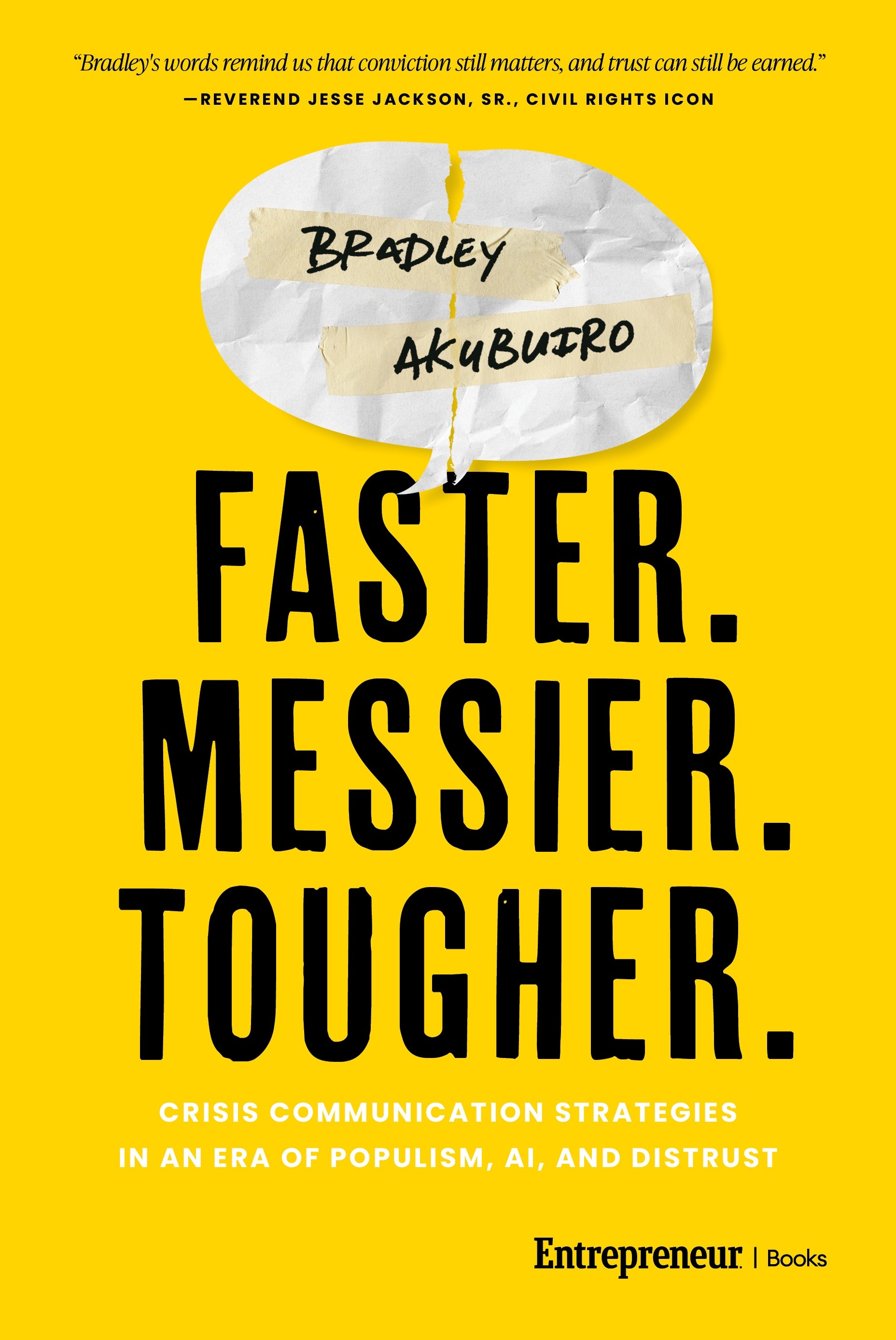
Bradley Akubuiro's latest book, Faster, Messier, Tougher—Crisis Communication Strategies in an Era of Populism, AI, and Distrust
Rarely can a town hall or leadership email truly answer questions like those. And with divided attention during a crisis, leaders too often reduce internal communication to speed, frequency, and how many people opened the email. It’s a fundamental misunderstanding of the job.
Those things matter, but they are also table stakes. The harder job is holding the relationship between employees and the institution together at the exact moment the institution has given people a reason to question it.
I saw what strong identity actually looks like early in my career at the aerospace company, Pratt & Whitney, where I met machinists who had spent twenty or thirty years building jet engines. More than a few of them had the company’s eagle logo tattooed on their arms.
You don’t tattoo a company logo into your skin because you’re "an engaged employee." You do it because the brand has become part of who you are. The eagle stood for their craft, their calling, their colleagues, and decades of their lives.
Every employer would love to build some version of that. But it’s easy to miss the implication: the deeper the connection, the more there is to lose. When the company does something that shakes that belief, the employees who identified most strongly with it don’t just feel let down by management.
They often feel something closer to betrayal, because the institution they defended and folded into their own identity has broken the terms of the relationship they thought they had.
People respond to betrayal differently than they respond to bad news. They stop saying where they work. They stop recommending the place. They stop defending it when someone else criticizes it. In many cases, they go from being your most loyal ambassadors to your most effective critics.
Theranos is an extreme example, but worth revisiting. Elizabeth Holmes —the company’s founder—demanded extraordinary loyalty while denying employees the transparency that loyalty depends on. When lab technician Tyler Shultz raised legitimate concerns, leadership treated him as a threat to the company rather than someone trying to protect it.
A company that demanded total loyalty turned one of its own people into the witness who helped end it. Loyalty is not obedience. It’s a relationship, and like every relationship it runs on reciprocity.
Reassurance doesn’t repair that kind of damage. What repairs it is evidence that your institution is still behaving like the one employees believed they joined.
That’s a harder thing to deliver than a well-worded statement. Employees can tell the difference between a company trying to shape their reaction and one working to keep faith with them. In a crisis, that difference is fundamentally what they are watching for.
So yes, supply employees what they need to know. And do it fast. But also ask yourself, what do my employees need from us in order to keep wearing the company’s identity as part of their own? Sometimes that means an apology.
Sometimes it means showing that leaders understand the human cost of what happened, inviting employees into the solution, or admitting plainly that the company failed to live up to the identity it asked people to believe in.
There’s a demanding standard that comes with being a leader of people during a moment of crisis. I address it in my book, Faster. Messier. Tougher.: Crisis Communication Strategies in an Era of Populism, AI, and Distrust. The standard for leaders is whether their employees are better off for being associated with this company than they would have been without it.
In calm times, that is a culture question. In a crisis, it becomes a test. The strongest employee relationships are not proven while the company is winning. They are proven when employees have a reason to question the association and they still decide it is one they are proud to keep.
That’s the relationship internal communication exists to protect. Not the message, but the bond behind it.

- Bradley Akubuiro is Partner and Head of the Corporate Communications Practice at Bully Pulpit International (BPI), where he leads corporate reputation and crisis management for some of the world’s most notable brands. Previously, he was Chief Spokesperson and Head of Global Media Relations for Boeing, guiding the aerospace giant during the 737 MAX crisis and COVID-19. He has also led global media relations and public affairs for the Fortune 50 company formerly named United Technologies, advised Reverend Jesse Jackson Sr., and served as a governance reform consultant in post-conflict Liberia.
An internationally recognized expert, Bradley has been quoted by outlets such as Forbes, Bloomberg, ABC News, Axios, and The Boston Globe in the US, and internationally in publications including The Economic Times of India, The Star of South Africa, The Globe and Mail (Canada), and the Irish Independent. His columns have been featured in Forbes, Business Insider, and Inc. Magazine where he is a regular columnist. He is the author of Faster. Messier. Tougher. Crisis Communication Strategies in an Era of Populism, AI, and Distrust. In 2022, Bradley was named 40 Under 40 by both PRWeek and Crain’s Chicago Business. He serves on the boards of The Institute for Public Relations and The 19th News, and Northwestern University’s Medill School where he is also an adjunct lecturer. Bradley is driven by a belief that communication is a vehicle for systemic change