The best Dussehra employee engagement ideas turn the festival’s theme of victory into meaningful ways for employees to contribute, connect, learn, and recognize one another. Decorations can create a festive atmosphere, but real engagement comes from giving employees an active role in the celebration.
Key Takeaways
- Dussehra falls on Tuesday, October 20 in 2026, so most workplace activities should run during the preceding workweek.
- Dussehra celebrations at work should be voluntary, culturally respectful, and adaptable to different regional traditions.
- Every activity should include a way for remote, frontline, and shift-based employees to participate.
- Employee recognition, team building, and employee voice can make the celebration more meaningful than decoration alone.
- Measure participation and representation across the workforce, not just attendance at one Dussehra event.
Dussehra or Vijayadashami is celebrated in different ways and formats across India. These 10 Dussehra office celebration ideas below combine cultural activities with employee recognition, team connection, learning, and community action.
Each idea can be adapted for office-based, remote, hybrid, frontline, and multi-location teams, while giving local employees room to shape the celebration around their own context.
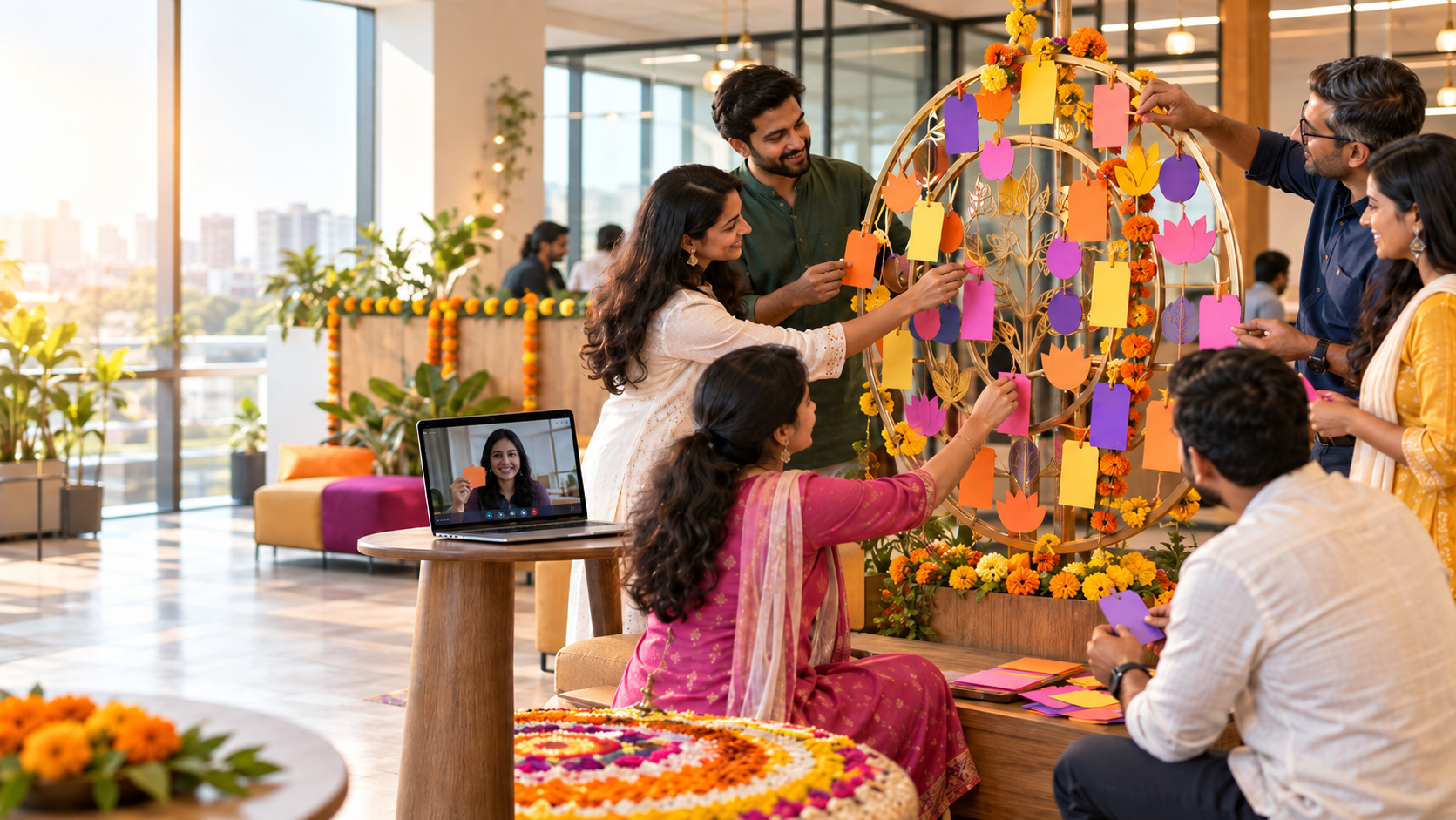
10 Dussehra Office Celebration Ideas
The strongest Dussehra ideas combine a recognizable festive element with a clear purpose. That purpose should be visible in the way the activity is run, made accessible, and measured.
1. Create a Ten Obstacles Employee-Idea Challenge
Use the Ravana motif to turn employee voice into action by asking teams to identify ten workplace obstacles worth fixing.
How to make it work:
- Ask each team to submit one recurring obstacle, such as a slow approval, unclear handoff, duplicated form, or inaccessible update.
- Allow anonymous submissions and asynchronous voting so hierarchy, location, and shifts do not limit participation.
- Ask senior leaders to publish which issues will be addressed, which will not, and why.
- Track submissions, teams represented, decisions, owners, and completed actions.
The value comes from visible follow-through. Assign owners and next steps to the issues selected for action.
2. Run a Collaborative Rangoli and Decoration Challenge
Turn rangoli and festive décor into a team-building activity by giving employees a shared theme, clear creative rules, and room to interpret it in their own way.
How to make it work:
- Give teams a theme, budget, workspace, and guidelines for reusable or low-waste materials.
- Let remote employees create digital designs or patterns that office teams can incorporate into the final display.
- Offer a non-competitive option for employees who want to participate without being judged.
- Track participating teams, locations represented, employee reactions, and materials reused.
Keep walkways and exits clear, avoid open flames, and offer non-religious themes such as collaboration, service, or everyday courage.
3. Host a Regional Dussehra Story Exchange
Dussehra traditions vary significantly across India. For example, Delhi is known for Ramlila and Ravana Dahan, Mysuru Dasara centers on the victory of Goddess Chamundeshwari over Mahishasura and its grand Jamboo Savari procession, while Bastar Dussehra focuses on Maa Danteshwari and local tribal traditions. A regional story exchange gives employees space to share these distinct traditions instead of treating Dussehra as one uniform celebration.
How to make it work:
- Invite employees to share a short story, photo, object, song, craft, or memory connected to their region or family.
- Accept video, audio, written, and live contributions in preferred languages, with captions or short translations where needed.
- Ask employee volunteers to review cultural context before publication.
- Track regions, languages, formats, and first-time contributors.
Avoid asking one employee to represent an entire state, faith, or community.
4. Create a Dussehra Culture Quiz
A Dussehra culture quiz can introduce employees to the many ways the festival is understood and celebrated across India. Done well, it becomes a quick cultural-learning activity without turning religious knowledge into a test.
How to make it work:
- Create eight to ten questions covering regional celebrations, names, crafts, food, performances, and traditions across Indian culture.
- Keep the quiz mobile-friendly, asynchronous, and open for several days so different shifts and locations can participate.
- Explain each answer rather than showing only a score, and add translations where useful.
- Track completions, locations represented, and optional feedback on what employees learned.
Use reliable sources and ask Indian employees to review the questions for context and accuracy. Avoid presenting one regional tradition as the standard way to celebrate Dussehra.
5. Build an Everyday Victories Recognition Wall
Turn Dussehra’s theme of victory into employee recognition by inviting teams to recognize employees for everyday wins and meaningful contributions.
How to make it work:
- Ask employees to recognize someone who helped a customer, solved a problem, supported a teammate, or demonstrated a company value.
- Accept nominations through both physical and digital channels, with a private option for employees who prefer not to post publicly.
- Encourage managers to highlight contributions from operational, support, remote, and night-shift teams that may otherwise be overlooked.
- Track contributors, recipients, locations, and recognition coverage.
Gallup and Workhuman’s research shows that recognition works best when it is authentic, equitable, and personalized. Skip generic praise and ask employees to name the specific contribution and why it mattered.
6. Run a Values-Based Team Puzzle
Dussehra’s victory-over-obstacles theme can translate naturally into a collaborative workplace challenge. A values-based puzzle turns fun games into a practical team-building exercise, giving employees a way to solve problems together while reinforcing behaviors such as integrity, courage, collaboration, and service.
How to make it work:
- Create an escape-room-style puzzle or clue trail around themes such as integrity, courage, collaboration, inclusion, or customer service.
- Use realistic workplace scenarios, such as resolving a customer issue, improving a handoff, or responding to an ethical dilemma.
- Provide equivalent physical and digital versions, with an asynchronous option for distributed teams.
- Track participation, completion, cross-functional representation, and the discussions generated.
Reward teamwork and completion instead of speed alone. Timed competition can disadvantage employees using translation, assistive technology, or slower connections.
7. Organize a Community-Giving Drive
Dussehra is also a useful moment to connect celebration with service. A community-giving drive can channel employee participation into volunteering, skills-based support, educational assistance, or other practical local needs.
How to make it work:
- Invite employees to nominate credible local organizations or causes, then complete the necessary due diligence.
- Offer different participation routes, such as paid volunteering time, skills-based support, educational materials, or project assistance.
- Let individual offices support locally relevant needs within shared company guidelines.
- Track participation, volunteer hours, items contributed, completed projects, locations, and partner feedback.
Make no-cost participation clearly available. Do not publish, compare, or rank individual donations.
8. Hold an Inclusive Festive Food Exchange
Food is one of the easiest ways to bring people together during a Dussehra office celebration. A festive food exchange can also highlight regional variety by giving employees space to share dishes, ingredients, recipes, and food memories connected to their own traditions.
How to make it work:
- Invite employees to share a dish, recipe, ingredient, or short food memory connected to their region or family.
- Provide catered options so participation does not depend on employees cooking or spending their own money.
- Run more than one sitting where shifts make a single lunch inaccessible.
- Label ingredients, allergens, dietary requirements, and vegetarian or vegan options clearly.
- Include remote employees through recipe cards, short videos, or a meal allowance where policy permits.
Track participation by location and shift, regional representation, and whether dietary needs were adequately covered.
9. Celebrate the Tools and Skills Behind the Work
Vijayadashami traditions in parts of India include honoring tools, instruments, books, and learning. A workplace version can use that idea to recognize the skills, processes, resources, and people employees rely on to do their work well.
How to make it work:
- Ask each team to showcase one tool, skill, process, or colleague that helps them do their work well.
- Use short demonstrations, photos, audio notes, or how-to posts so operational, technical, creative, frontline, and support roles can all contribute.
- Pair teams that rarely see each other’s work, such as corporate and plant teams or sales and operations.
- Track participating teams, skills highlighted, useful resources shared, and cross-team follow-ups.
Keep the activity focused on learning and appreciation rather than recreating a religious ceremony at work.
10. Hold an Opt-In Traditional Dress and Textiles Day
Traditional dress can add a visible festive element to the workplace, but the activity becomes more meaningful when employees can also share the story behind a garment, textile, craft, or regional style. Keeping participation optional ensures the focus stays on cultural exchange, not appearance.
How to make it work:
- Invite employees who want to participate to share the origin, craft, textile, pattern, or story behind what they are wearing.
- Give remote employees and non-participants equivalent ways to contribute through photos, audio, or short written stories.
- State clearly that traditional dress is optional and regular workwear is equally appropriate.
- Track voluntary participation and the range of regions or textile traditions represented.
Avoid best-dressed contests based on expense, authenticity, gender expectations, or religious clothing.

How to Coordinate Dussehra Engagement Across Remote and Hybrid Teams
Dussehra office celebrations across multiple locations work best when teams share a common structure but have room to adapt activities to their workforce, region, and operating realities.
1. Set the cultural and participation guardrails
Every Dussehra celebration at work should start with clear participation guardrails. Keep activities voluntary, involve employees in cultural input, plan for accessibility, and account for safety, food requirements, and reasonable budgets in advance.
Local teams can then adapt Dussehra activities for employees to reflect their workforce and regional context without forcing every location into the same celebration format.
Avoid mandatory prayer, compulsory traditional dress, or manager pressure to participate. Employees should be able to join festive celebrations without being expected to disclose their beliefs or cultural identity.
2. Give every employee an accessible route to participate
A central office event cannot be the only way to take part in a Dussehra employee engagement campaign. Remote employees, frontline teams, mobile workers, night shifts, employees without corporate email, and people working across different languages all need a practical route to participate.
Combine live Dussehra activities with asynchronous options such as digital submissions, quizzes, employee recognition posts, photos, audio, or short written contributions. For remote and hybrid teams, virtual celebrations can also create shared participation without requiring everyone to join at the same time.
Where digital access is limited, provide manager-supported or physical participation during paid work time so employees are not excluded because of how or where they work.
3. Use one campaign structure to connect locations
A shared campaign structure can connect Dussehra office celebration ideas across locations without removing local flexibility.
With the Poppulo Experience Platform, organizations can target content by location or language, collect employee-generated stories, run quizzes and challenges, recognize contributions, and track participation within the same campaign environment. Mobile access through branded mobile apps can also help reach employees who do not regularly use corporate email.
Tip: The platform should support the Dussehra campaign, not become the focus of it. Use only the features that make participation easier and measurement clearer.
4. Measure Dussehra employee engagement without turning culture into a leaderboard
Track Dussehra employee engagement by location, shift, role, language, and activity type to understand who participated and where access gaps remained across office, frontline, remote, and hybrid teams.
Look beyond total participation. Review contributor diversity, employee recognition coverage, survey responses, repeat participation, and follow-through on ideas generated during the Dussehra celebration.
Avoid publicly ranking teams or locations when employees have different schedules, workforce sizes, or access conditions. HR teams should use participation data to improve future festive celebrations, strengthen inclusion, and make it easier for more employees to take part.

5. Close with employee feedback and follow-through
End the Dussehra event by asking employees what worked, what felt accessible, and what could improve future celebrations.
Use a short anonymous survey to gather feedback on cultural respect, cultural diversity, participation barriers, preferred formats, accessibility, and the overall employee experience. Make sure remote employees and frontline teams have the same opportunity to respond.
If employees raised workplace ideas or commitments during the activities, assign clear owners and follow-up dates. Then close the loop by sharing the main themes, actions taken, and next steps without exposing individual feedback.
Final Thoughts
The strongest Dussehra office celebrations give employees an active role in creating the experience. Choose a focused set of ideas that fit your workforce, then prioritize contribution, employee recognition, cultural learning, and accessible participation across locations and teams.
At Poppulo, we’ve already partnered with global leaders such as Euromaster, Coca-Cola CCEP, AXA, and Primark connect employees across roles and locations. Explore a personalized demo to see how the platform can support multilingual campaigns, challenges, recognition, employee-generated content, and participation measurement while leaving cultural decisions in the hands of local teams.
Dussehra Employee Engagement Ideas FAQs
When should companies hold a Dussehra celebration in 2026?
Dussehra falls on Tuesday, October 20, 2026. Most companies can plan Dussehra office celebrations during the preceding workweek or keep asynchronous festive activities open across several days. HR teams should confirm timing against local calendars, site operating needs, shift schedules, and employee preferences before launch.
How can companies include remote and frontline employees in Dussehra activities?
Give remote employees and frontline teams participation options that do not depend on corporate email or one live event. Mobile-friendly quizzes, recognition posts, photo or audio submissions, local team activities, translated content, and paid-time participation can all help engage employees across different work settings.
For remote and hybrid teams, virtual celebrations and asynchronous activities can support team bonding without requiring everyone to participate at the same time.
How can a Dussehra office celebration remain inclusive?
Make participation voluntary, involve employees in shaping cultural content, and account for regional and cultural diversity. Provide non-religious ways to join and avoid compulsory prayer, traditional dress, food, or personal disclosure.
Local cultural review should happen before content is published so festive celebrations reflect employees respectfully across regions and backgrounds.
Do Dussehra employee engagement activities need a large budget?
No. Employee recognition, storytelling, quizzes, team-building activities, employee ideas, and shared commitments can all run with limited material cost.
A low budget should not mean unpaid employee labor, personal spending, or inaccessible activities. Protect paid participation time and fund any required materials centrally.
How should companies measure Dussehra employee engagement?
Track participation and representation across roles, shifts, languages, locations, and activity types. Review employee recognition distribution, qualitative feedback, repeat participation, and completion of promised follow-up actions.
Event attendance alone does not show whether Dussehra activities strengthened engagement, team spirit, or employees’ sense of belonging.