When a safety, policy, production, or technology update reaches the factory floor after it takes effect, the failure is bigger than an unread message. The communication system simply does not match how frontline work happens. In this article, we'll cover how to fix that.
Key Takeaways
- Map coverage by plant, shift, role, and employment type.
- Remove email, identity, device, language, and connectivity barriers.
- Build a shift-aware mix of direct and shared communication channels.
- Target short, visual, actionable messages by relevance and urgency.
- Equip supervisors to add context without making them the sole relay.
- Measure reach, understanding, action, and trust by frontline cohort.
- Communication reveals disconnects, but cannot fix unsafe conditions, understaffing, scheduling, or management.
The frontline gap is the disconnect between what an organization believes manufacturing employees receive and what reaches them across plants and shifts. And it's happening in businesses around the world.
This frontline employee communication guide for manufacturing gives Internal Communications leaders eight practical steps to close it. The model reflects rotating shifts, limited desk availability, restricted devices, multilingual teams, temporary employees, and manager workload. Internal communication must become part of each plant's operating system.

How to Improve Frontline Employee Communication in Manufacturing
Closing the gap requires an operating model. Identify who is excluded, then redesign reach, delivery, relevance, voice, and measurement.
1. Map where the frontline gap exists
Manufacturing companies must find which workforce groups cannot reliably receive, understand, or respond before adding a channel.
Build the baseline:
- Audit plants by shift, role, language, status, device, email availability, and manager.
- Compare HQ's assumed flow with how frontline employees receive safety alerts, training, benefits, and company news.
- Check whether overnight frontline workers, contractors, temporary employees, and new starters have day-shift parity.
- Measure delivery, confirmed receipt, comprehension, response time, and participation.
Follow one priority message to the frontline workers expected to act. Standardized handovers expose communication breakdowns: where did it wait or disappear? Name every gap and owner. Email opens are not a proxy for frontline reach, as Poppulo's frontline employee communication study shows.
Examples of frontline employees can include operators, assemblers, technicians, warehouse frontline workers, and supervisors. The frontline service industry usually covers retail, healthcare, hospitality, and transport.
2. Remove identity, device, connectivity, and language barriers
A channel fails when frontline employees and workers cannot authenticate, connect, or read comfortably.
Design realistic access:
- Enable no-email onboarding, simple authentication, shared terminals or kiosks, offline availability, and physical displays.
- Place kiosks in high-traffic areas and test for gloves, noise, weak connectivity, and limited reading time.
- Translate and localize important updates rather than asking frontline staff to interpret them.
- Include contractors and temporary frontline workers whenever critical information affects their job or safety protocols.
Mobile apps help, but mobile-first does not mean personal-phone-only. Some employees' phones are prohibited; others reject work technology. Offer reliable channels: kiosks, signage, shared devices, and print. Explain how sensitive information is protected.
Success means every frontline workforce segment, including deskless employees and deskless workers, has a realistic path to essential information. Companies communicating across shifts should test with actual frontline workers.
3. Build a shift-aware channel system
Companies communicating across plants must assign every channel a job and fit delivery into the manufacturing day.
Define the system:
- Use push notifications or SMS for urgent alerts, huddles for context, signage for reminders, and a governed intranet or Microsoft Teams for connected employees.
- Schedule communication around shift starts, handovers, breaks, toolbox talks, training, and team meetings.
- For example, pair a direct alert with a huddle when the cost of missing it is high.
- Repeat messages for the workers affected instead of publishing only during HQ hours.
Short huddles align frontline teams on company priorities, while a digital record gives frontline workers continuity. Organizations communicating through every channel create overload and poor communication. A stronger global internal communication model separates availability from effectiveness.
4. Target messages by role, plant, shift, language, and urgency
Relevance protects attention. Most frontline workers ignore communication channels carrying irrelevant messages.
Target with discipline:
- Segment by location, department, production line, role, shift, language, manager, and employment type.
- Classify content as immediate, required, locally operational, recognition, or optional company news.
- Specify who must know, who must act, who needs awareness, and who needs nothing.
- Let central teams protect consistency while frontline teams prevent a purely top down cascade.
Require Who acts? and By when? before important announcements. A quality-change example belongs with affected frontline employees and supervisors, not all employees. This reduces internal communication challenges such as delay and uneven reach.
5. Make every important message easy to understand and act on
When communicating in busy plants, frontline communications should reduce cognitive load for frontline employees.
Build an actionable message:
- Lead with what changed, who it affects, what frontline employees must do, when, and where to get support.
- Use plain language, short paragraphs, annotated images, diagrams, and brief audio or video.
- Separate mandatory action from background and explain the business reason.
- Use acknowledgement when receipt must be demonstrated; use a quiz, supervisor check, or observation when understanding matters.
Ask frontline workers to explain the action after one read. Acknowledgement is the bare minimum. Instructions stay in governed systems, especially in high-pressure situations or key areas with compliance issues.
6. Make supervisors context-builders, not communication bottlenecks
Supervisors translate decisions into action, but manufacturing companies should not rely on them to relay every corporate message.
Equip the relay:
- Give supervisors advance notice, talking points, likely questions, escalation contacts, and visuals.
- Deliver frontline communications directly so frontline employees have a source they can revisit.
- Let supervisors add line-level business context and clarification.
- Integrate communication into existing routines and create clear escalation paths.
Train supervisors and test whether they explain the policy consistently. Do not blame them when internal comms arrive late. During technology change, involve supervisors and frontline workers early.
7. Close the loop on employee voice and recognition
Frontline employees stop contributing when questions, ideas, and feedback disappear into an organizational void, weakening employee engagement.
Create visible participation:
- Offer pulse surveys, anonymous reporting, employees' ideas, moderated discussions, team member sessions, and manager conversations.
- Account for language, literacy, shifts, temporary employees, and fear of retaliation.
- Publish what was heard, what will change, what cannot change, and why.
- Recognize useful ideas, safe behavior, local expertise, knowledge sharing, and worker engagement.
Asking for employee feedback is not two-way communication. Give each route an owner and deadline so frontline workers feel heard. This builds trust and employee engagement.
Frontline employees need to understand organizational goals, belong, share ideas, trust leaders, and receive recognition. Pulse surveys test these areas. Providing employees with career communication also gives frontline employees the visibility offered to desk-based colleagues. The right frontline engagement benchmarks can help you gauge this.
The employee experience and business case are strong, but technology alone cannot create an engaged workforce or a positive employee experience.
8. Measure whether communication reached, landed, and changed anything
Publication is an input. The business question is whether the right frontline workers received, understood, and acted.
Use four measurement layers:
- Reach: activation, deliverability, unique reach, acknowledgement, and coverage by plant, shift, language, and role.
- Understanding: short knowledge checks, manager observation, employees' questions, and repeated misunderstanding themes.
- Action: completion, response time, process adoption, feedback submission, or escalation behavior.
- Trust: relevance, confidence in leadership information, psychological safety, and belief that feedback receives a response.
Review critical campaigns weekly, plants monthly, and strategy quarterly. Compare internal communication with safety, quality, adoption, productivity, well-being, and retention without claiming causation. Aggregate engagement can conceal a shift, so compare cohorts first.
How Poppulo Supports Connected Manufacturing Teams
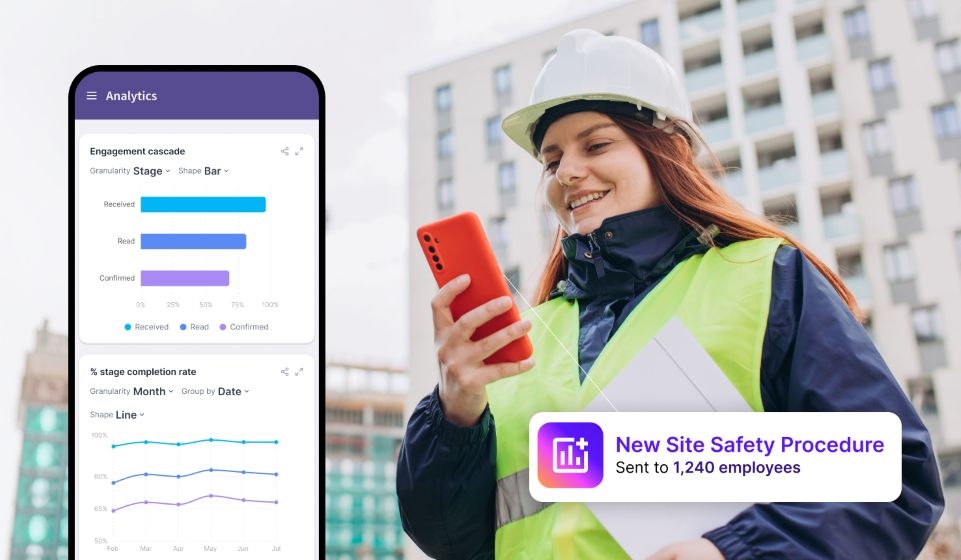
To avoid or resolve frontline gaps that may form, there is a digital solution that can help. The Poppulo Experience Platform provides an internal comms layer that reaches frontline employees without assuming email or desk availability. To help achieve this, the platform offers:
- ID or QR onboarding
- Mobile apps with offline access
- Signage and multi-channel communication from one workflow
- Ability to segment frontline communications by role, plant, and language
- Push notifications, acknowledgement tracking, and surveys
- Advanced analytics that show engagement by location
These capabilities keep frontline workers connected and support frontline employee communication; they do not guarantee safety, compliance, or productivity.
Manufacturing Success Story: Intech
Intech needed to connect office and frontline employees across nine sites, many without email access. To solve this, they partnered with Poppulo and introduced a platform complete with a branded app, translation, TV widgets, and content from employees.
Within two months:
- More than half (60%) of employees had joined, including 35% of frontline employees.
- Some sites reached more than 85% adoption.
- Of 500-plus items, 48% came from users.
This example shows how access and participation both can be enhanced significantly with the right digital tools.
Final Thoughts
It's simply a fact: the frontline gap persists when companies expect shop floor employees to adapt to desk-based communication. Companies communicating effectively need access, shift-aware delivery, targeting, and cohort measurement. Communication alone cannot replace fair conditions or capable management. A targeted, more two-way approach is needed.
That's where the right platform comes in. The Poppulo Experience Platform makes employee communication accessible, targeted, two-way, and measurable. In fact, we've already partnered with global leaders like Coca-Cola CCEP, BBGR, and Intech, and we'd love to do the same for your organization.
Book a free personalized demo to see how manufacturing companies can support frontline staff and stay ahead of communication risks.
Frontline Communication in Manufacturing FAQs
These are the questions that come up most often during discussions of frontline employee comms in manufacturing.
Is the frontline gap the same as the manufacturing skills gap?
No. The frontline gap concerns communication, culture, recognition, voice, and access; the skills gap concerns technical capability. They overlap when frontline workers cannot access training, as research shows, but they are not the same thing.
Who should own closing the frontline gap for effective communication?
Accountability is shared. Internal Communications owns architecture; plant leaders integrate communication with work; HR owns people practices; EHS and Quality own governed requirements; IT supports identity, access, security, and integration; executives remove barriers.
How can manufacturers tell whether the problem is the channel or the culture?
For example, failed access, late updates, and uneven reach signal a channel problem. Fear, low trust, absent follow-through, unequal recognition, or top-down messages contradicted locally signal culture. Most organizations have both.
How should manufacturers address privacy when employees use personal devices?
Offer voluntary, governed access where legally appropriate. Explain data collection; involve HR teams, IT, legal, works councils, and representatives for employees; and provide kiosk, shared-device, or signage alternatives. This is not legal advice, and there are security risks.
Can a communication platform replace shift huddles?
No. Digital access provides consistency, persistence, targeting, and measurement. Shift huddles provide local context, discussion, and immediate clarification. The strongest employee communication system gives each channel a defined role.