In India's multilingual workplaces, a common working language doesn't guarantee a common understanding. A company-wide message may be written in English, discussed in Hindi, and acted on by employees who are more comfortable reading Tamil or Marathi.
Quick Takeaways
- Identify employees' preferred languages for workplace communication through direct feedback, and not on assumptions about state, surname, role, or seniority.
- Use a shared working language for cross-team collaboration and regional languages where language barriers affect understanding and participation.
- Prioritize translation of safety instructions, HR policies, and compliance-related information where misunderstanding carries greater risk.
- Establish clear translation and review processes to maintain consistent messaging across languages while accounting for cultural differences.
- Measure whether employees understand and act on messages, rather than relying solely on delivery rates and readership metrics.
The challenge is deciding which languages to use, for whom, and when. Should every internal communication be translated? When is a shared language sufficient? And how can organizations maintain consistent messaging while accommodating different language preferences? This guide explores these decisions and offers a practical approach to multilingual internal communications in India.
Why Language Choice Matters in Indian Workplaces
Language barriers can affect how employees understand instructions, participate in discussions, and respond to important workplace communication. These challenges exist even within a single location. For example, a manufacturing plant in Tamil Nadu may employ Tamil-speaking workers, employees from northern and eastern India, and managers who primarily communicate in English.
A 2025 study on language choices in corporate India found that while participants preferred English for official communication, they favored regional languages for informal conversations. A majority also wanted regional languages included in formal workplace communication. Similarly, the IAMAI-Kantar Internet in India 2024 report found that 57% of urban internet users preferred accessing online content in Indic languages.
While these findings do not establish the language preferences of every workforce, they highlight why organizations need to look beyond their official working language. The right language choices can improve communication clarity, amplify employee participation, and help ensure critical information reaches people in a form they can confidently understand and use.

How to Choose Languages for Internal Communications in India
These five steps can help organizations make informed language choices across their workforce.
1. Map Employees’ Language Preferences and Communication Access
Start by asking employees which languages they prefer for written and spoken communication. Preferences may differ depending on the format, and employees who speak English comfortably may still prefer reading important information in their native language.
Collect the following information to build an employee language map:
- Language preferences: Preferred languages for written updates, spoken briefings, and video content.
- Language proficiency: Other languages employees can comfortably understand and use for workplace communication.
- Communication access: Availability of corporate email, mobile devices, shared screens, and other internal communication channels.
- Workforce details: Job roles, locations, shifts, and employment types, including contract workers.
Use this information to group employees by their communication needs and identify which languages and channels are required for each audience. This helps reveal where a shared working language is sufficient and where additional language support may be necessary.
Planning note: Include frontline employees and contract workers who may not have access to corporate email but still need critical information about safety, pay, benefits, or operational changes.
2. Define Where a Shared Working Language Helps
For many Indian businesses, English serves as a shared working language supporting collaboration and information sharing across a multilingual workforce. However, its effectiveness depends on whether employees can understand the information and participate confidently.
A study of Cummins India found that adopting English as a common corporate language helped improve coordination across its Indian operations and global network while supporting employee inclusion. The study also highlights the influence of English proficiency on workplace opportunities, underscoring the importance of considering employees' language skills when establishing a common language.
For example, there's a significant difference between a quarterly business update and an announcement about changes in shift timings at a manufacturing plant. English may work well for the leadership discussion, but employees on the factory floor may need the shift instructions in Hindi, Marathi, or another regional language. The message hasn't changed, but the language needed to make it useful has.
Questions to test a shared-language decision:
- Can affected employees explain the message accurately in their own words?
- Can they ask questions without depending on one bilingual colleague?
- Can frontline employees participate in meetings, not merely listen?
- Does the language improve cross-region coordination without hiding local risks?
Tip: Keep the shared language for the work it genuinely simplifies. Add other languages where the cost of misunderstanding, silence, or exclusion is too high.
3. Prioritize Additional Languages by Audience and Message
Every internal communication need not be translated into every language. Prioritizing translation based on the audience and the consequences of misunderstanding helps communication teams focus their efforts where they matter most.
Use the following framework to determine the level of multilingual support required for different types of workplace communication.
| Message category | Affected employees and language decision | Consequence and review level |
|---|---|---|
| Safety and urgent operational instructions | Provide reviewed versions in the languages employees need, supported by spoken or visual reinforcement where appropriate. | Misunderstanding can affect safety or operations. Use qualified review and approved urgent-message templates. |
| Onboarding, benefits, and HR changes | Translate explanations for affected groups and provide a clear route for questions. | Ambiguity can affect pay, benefits, or compliance. Review policy terms and local terminology carefully. |
| Leadership and business updates | Use the shared language where it works; add translated summaries, captions, or subtitles for groups that need them. | The main risk is uneven understanding and weak alignment. Review names, dates, targets, and decisions across versions. |
| Local updates, recognition, and feedback | Let local teams publish in languages that increase relevance and participation. | The risk is lower, but unclear ownership can create inconsistent facts. Use lightweight local review. |
The matrix should be applied audience by audience. A benefits update may require Marathi and Hindi at one site, Tamil and Telugu at another, and an English master version across both. This decision changes with the workforce, not with a national list.
4. Make Multilingual Communication Accessible and Effective
A translated message can still be difficult to understand. An unfamiliar technical term, unreadable text on a mobile screen, or poorly synchronized subtitles can create new communication barriers. That's why the format and presentation of multilingual content deserve as much attention as the language itself.
When planning multilingual communication, consider:
- Everyday terminology: Are translated words familiar to employees, or would commonly used workplace terms be easier to understand?
- Readability: Can employees comfortably read the language and script on mobile devices, digital signage, or other workplace screens?
- Audio and subtitles: Do voiceovers and subtitles accurately convey the original message?
- Mixed-language communication: Would a combination of English and regional-language terms make the message more natural and accessible?
- Two-way communication: Can employees ask questions, share feedback, and participate in discussions in a language they feel comfortable using?
For example, an employee onboarding video may be available in several regional languages, but lengthy subtitles can be difficult to follow on a mobile screen. Shorter captions, familiar workplace terminology, and an option to ask questions in a preferred language can make the same content easier to understand and act on.
Planning note: Test formats with employees before rolling them out, particularly when misunderstandings could affect safety or operations.
5. Validate the Language Mix With a Pilot
Before rolling out multilingual internal communications across the organization, test your approach with a small, representative group of employees. A pilot helps identify language barriers, translation issues, and communication gaps that may otherwise go unnoticed.
For example, test an important HR announcement across employees from different locations, job roles, and shifts. Share the message in their preferred languages and through the communication channels they typically use. Use employee feedback to assess four things:
- Message clarity: Can employees explain the key information and any required actions in their own words?
- Translation quality: Are any terms confusing, unfamiliar, or inconsistent across language versions?
- Channel effectiveness: Did employees receive and access the message without depending on their managers or colleagues?
- Employee participation: Were employees comfortable asking questions or raising concerns in their preferred language?
Use these findings to refine your language choices, translation process, and communication channels before expanding the program.
Planning note: Let employees update their language preferences easily, as it can change due to a new role, location, or increased proficiency in another language.
How to Manage Consistent Messages Across Languages
Consistency in multilingual internal communications means ensuring that employees receive the same essential information, whether they're reading an announcement in English, Hindi, Tamil, or another language. Elements like dates, decisions, eligibility criteria, and required actions must remain consistent and accurate, even when the wording changes to suit local language and cultural differences.
Build your translation and review process around four practices:
- Maintain one approved source: Create a master message with a designated owner and version number so every translation follows the same approved information.
- Standardize key terminology: Maintain a shared glossary of safety instructions, HR policies, benefits, product names, and other recurring terms to ensure consistent quality across languages.
- Match reviews to message risk: Use qualified human reviewers for safety instructions, compliance-related information, and sensitive HR announcements. Routine updates can follow a simpler review process.
- Keep translations synchronized: When the original message changes, update all affected language versions and communication to prevent employees from receiving conflicting information.
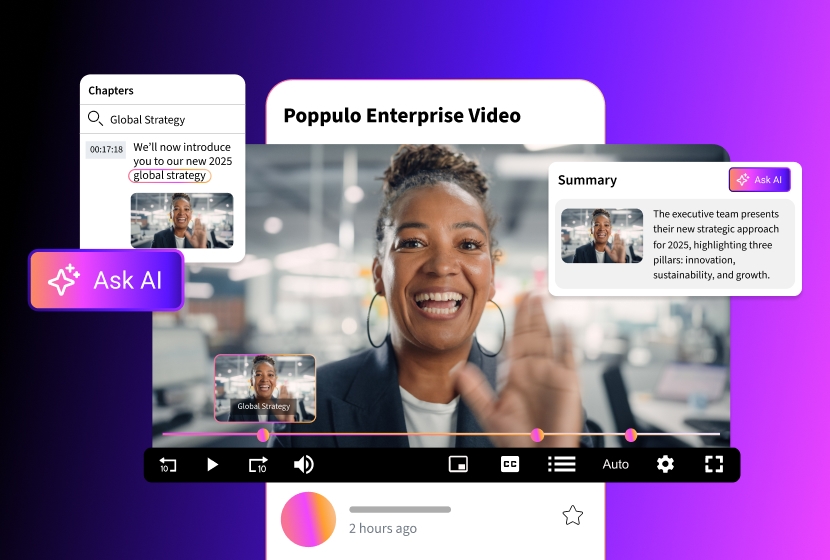
Technology can make this process easier to manage at scale. Poppulo Experience Platform's AI featuressupport translation into more than 50 languages, along with multilingual transcripts and subtitles. Its modern intranet also offers editable translations, custom dictionaries, and content tailored to employees' language preferences.
These capabilities can reduce manual effort while giving communication teams greater control over multilingual content. Human review should remain part of the process for critical or sensitive messages.
How to Reach Employees Through Channels They Can Use
The choice of communication channels matters just as much as the choice of languages, particularly in India's multilingual workforce, where office-based and frontline employees may have very different access to workplace communication.
Choose channels based on where and how employees work.
- Email, newsletters, and intranet: Share detailed updates, policies, and company news with desk-based employees who regularly access these channels.
- Mobile apps and push notifications: Reach frontline and deskless employees who work across locations or don't have corporate email accounts.
- Workplace digital signage: Display important announcements, reminders, and visual instructions in factories, warehouses, retail stores, and shared spaces.
- Manager and supervisor briefings: Reinforce critical information through spoken communication and give employees an opportunity to ask questions in their preferred language.
Poppulo's multichannel communication platform supports targeted communication across web, branded mobile apps, newsletters, SharePoint, Microsoft Teams, and workplace screens. Its audience-targeting capabilities help communication teams deliver relevant content based on employee groups, locations, and communication needs, reducing the reliance on blanket company-wide messages.
How Tata Realty Improved Communication Across Its Workforce
Following the merger of three geographically and culturally distinct companies, Tata Realty needed to connect employees who had previously relied on fragmented communication channels. With up to 40% of its workforce using only mobile phones, the company introduced a centralized, mobile-friendly communication platform with Poppulo.
Within the first 24 hours, 70% of employees had registered on the platform, with overall registration eventually reaching 99%. The results show how the right communication channels can help organizations reach employees across locations and job roles.
How Tata Realty brings together employees from three merged companies into a cohesive communication platform
How to Put Multilingual Internal Communication Into Practice
A manufacturing plant in Tamil Nadu with Tamil, Hindi, and English-speaking employees needs to announce revised shift timings across three shifts, including to contract workers without corporate email access.
Here's how the communication team could manage it:
Step 1. Prepare the message
Approve one source covering revised timings, effective dates, reporting locations, and affected employees.
Step 2. Translate and review
Create Tamil, Hindi, and English versions, checking that all instructions remain accurate and consistent.
Step 3. Choose the channels
Deliver targeted updates through mobile apps, workplace screens, and supervisor briefings.
Step 4. Enable feedback
Give employees a local contact to clarify instructions in their preferred language.
Step 5. Verify understanding
Check whether employees across shifts know when and where to report, and correct any confusion.
How to Measure the Effectiveness of Multilingual Internal Communications
High readership doesn't always mean effective communication. Open rates, views, and read receipts tell you whether employees have accessed a message, but they don't confirm whether employees understood the information or acted on it.
To evaluate the effectiveness of multilingual internal communications, track five key measures:
- Delivery: Did the message reach the intended employees through accessible communication channels?
- Readership: How many employees opened, viewed, or watched the content?
- Acknowledgment: Did employees confirm receipt of important information where required?
- Understanding: Can employees explain the key information or required actions correctly?
- Action: Did employees complete the expected action, such as following an updated safety procedure or meeting a new reporting deadline?
Compare results across languages, locations, job roles, and shifts to uncover communication gaps that overall engagement metrics may hide. For example, if a message receives high readership but employees in one language group repeatedly ask for clarification, the problem may lie in the translation, terminology, or format.
Also measure how efficiently your multilingual communication process operates. Track translation and review times, delays between publishing different language versions, and corrections made after release. These insights can help communication teams improve both the accuracy and timeliness of future messages.
Final Thoughts
Effective multilingual internal communications depend on how well organizations make information understandable, accessible, and actionable for employees across languages. The real measure of success is whether people can engage with important communication confidently, regardless of the language they use.
Start with employee language preferences, prioritize messages where understanding matters most, and measure what employees learn and do. With the Poppulo Experience Platform, organizations can simplify this process through AI-powered translation, targeted content delivery, and multichannel communication.
We've partnered with global leaders like Coca-Cola CCEP, Primark, and L'Occitane Group to strengthen employee communications across locations and teams.
Request a free demo to explore how Poppulo Experience Platform can help you reach, engage, and connect your multilingual workforce.
Multilingual Internal Communications in India FAQs
Should Companies Use Hinglish in Internal Communications?
Yes, Hinglish can support effective communication when employees naturally use a mix of Hindi and English in everyday workplace conversations. It can work particularly well for informal updates, employee engagement activities, and team discussions. However, safety instructions, HR policies, and compliance-related information require precise language and careful translation to avoid misunderstandings. Consider employees' reading preferences and familiarity with the terminology before using Hinglish.
Should Employees Be Able to Choose More Than One Communication Language?
Yes. In a multilingual workplace, employees may prefer their native language for certain updates, English for cross-team collaboration, and another language for spoken communication. Allowing employees to select primary and secondary language preferences can improve accessibility and support different communication needs. Where possible, tailor content delivery to these preferences to avoid unnecessary duplicate messages.
How Should Companies Handle Questions Submitted in Different Languages?
Organizations should provide multilingual support so employees can ask questions and share feedback in a language they're comfortable using. Bilingual employees or designated local representatives can help address routine queries, while complex policy or compliance questions may require professional translation services or specialist review. Maintain a shared record of frequently asked questions and approved responses to ensure consistent communication across language groups.
Does a Multilingual Intranet Interface Mean All Content Is Translated?
No. A multilingual intranet may support different languages for navigation, published content, documents, and video subtitles, but these features don't necessarily apply to every type of content. Some platforms offer automatic translation, while others require manual translation or additional tools. Check which content formats are supported, whether employees can select their preferred language, and how translated versions are updated when the original content changes.