Size doesn't have to mean anonymity. Quite the opposite. Even at large, global companies, personalized communication can thrive with the right strategy and tools.
Key Takeaways
- Start with the business outcome, then map the employee groups that can influence it.
- Keep purpose, facts, deadlines, and policy consistent while adapting context and required action.
- Choose channels, formats, and timing around working conditions, not head-office habits.
- Use inclusive defaults so incomplete employee records never cause missed communication.
- Measure reach, understanding, and action separately, then improve by group.
Personalization gives employees messages that are relevant and timely without hiding the priorities everyone shares. But scaling upward can change the overall approach. The goal is not a unique message for every person; it's a repeatable process for deciding who needs what, in which format, through which channel, and when.
The six-step method below turns that principle into a campaign your internal comms team can pilot and improve. Just follow the steps and see the results.

1. Map Audiences Around a Communication Goal
Personalization starts with the outcome, not the employee directory. Define the point employees should understand and how they should act, then identify the groups whose roles, locations, or working conditions change what they need.
For a safety rollout, the goal might be “employees can recognize and report the new hazard by Friday.” Map each group against five attributes: role, location, language, work pattern, and channel access. A practical internal communications plan also names the HR, IT, or local owner responsible for maintaining each attribute.
Don't let missing attributes exclude people. Set an inclusive default for every rule, such as the global version in the company’s primary language, a manager briefing, or visible workplace signage. Flag incomplete profiles for correction, but never make complete records a prerequisite for receiving an essential message.
Your first matrix can be simple:
- Goal: The understanding or action the campaign must create.
- Groups: The employees affected in distinct ways by that goal.
- Variables: The role, site, language, shift, and channel details that change delivery.
- Owner: The team accountable for each field and its review cadence.
- Fallback: The version and channel used when an attribute is missing.
This is the foundation of an employee-centric experience: relevance built on deliberate choices, not more communications.
2. Set Clear Rules for Shared and Targeted Content to Engage Employees
Personalization works only when your team agrees on what must remain common. Divide content into three layers: company-wide priorities, required information for affected groups, and optional content based on interests.
Essential messages should remain visible in a personalized feed or newsletter. Pin them, place them in a fixed priority block, repeat them through a reliable channel, or require acknowledgment when the risk warrants it. Personalization should reduce noise around the priority, not filter the priority away.
Finally, separate targeting from permissions. Targeting decides which relevant messages employees should receive. Permissions decide which employees are legally or operationally allowed to see confidential information. Never use a personalization rule as a security control.
3. Adapt One Core Internal Comms Message for Each Audience
A scalable campaign has one source of truth and several useful expressions. Keep the purpose, verified facts, deadlines, approved policy, and escalation route consistent. Adapt the detail, required action, example, language, and format.
Create reusable blocks for the shared facts, then add local examples and action blocks. This helps internal comms teams save production time without making messages sound generic. Use approved glossaries for translation, ask a fluent reviewer to check safety-critical or sensitive language, and give middle managers a short briefing pack with the “why,” talking points, likely questions, and a feedback route.
Stories create context and help employees make sense of change. Use leadership stories to communicate purpose, local stories to connect policy with practice, employee stories to create personal relevance, and client stories to show how clients benefit. Video stories can engage differently from text stories, but every format needs a meaningful point. Stories should simplify complexity, not ignore facts or what clients expect. Limit stories to what supports action: one video story can outperform several stories when time is short.
4. Match Channels and Timing to Working Conditions & Employee Experience
The right channel is the one employees can access when messages matter. A strong internal communications channel strategy coordinates touchpoints instead of duplicating the same messages everywhere.
Use each communications tool for a defined job:
- Email: Detailed updates and links for employees who work in their inbox.
- Intranet: The durable source for policy, FAQs, and updates.
- Mobile app: Timely alerts, short content, feedback, and information away from a desk.
- Workplace screens: High-visibility reminders in stores, factories, and shared spaces.
- Team briefings and town halls: Context, questions, and two-way communication when trust or judgment matters.
The channel list is not a maturity model. Use the fewest communication tools that reliably create reach and reinforcement. Too much frequency produces noise, so give each message one clear focus, coordinate reminders, and stop once the action is complete. Relevant messages engage employees more effectively than a high volume of generic communications.
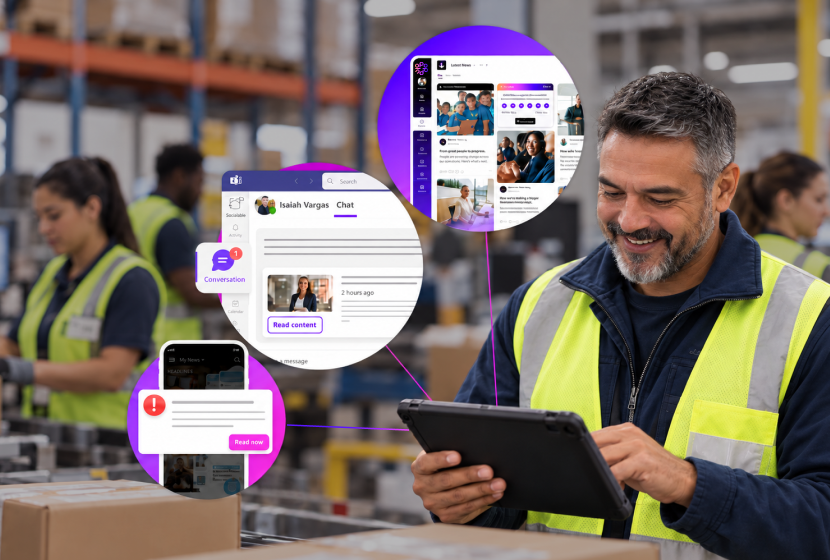
For frontline workers without corporate email, mobile matters. For example, the Poppulo Experience Platform supports mobile access, push notifications, translated content, and targeted delivery.
5. Govern Employee Data, Local Publishing, and AI Assistance
Internal communications governance makes personalization dependable. Use only the employee data needed for a clear communications purpose, explain how it shapes delivery, restrict access, and test every group before publication. Include a preview account for each major segment so the team can see exactly which messages employees will receive.
Corporate and local responsibilities should be explicit:
- Corporate comms: Own the source facts, shared priorities, templates, and enterprise publishing standards.
- Local communicators: Adapt examples, timing, and channel choices without changing approved policy.
- HR and IT: Maintain source data, access rules, integrations, security tools, and controls.
- Operational managers: Deliver team context, listen for confusion, and help leaders communicate clearly.
This solution also reduces tool sprawl. A bloated internal comms stack costs more, complicates security, and increases support tickets. Audit authoring tools, translation tools, analytics tools, and channel tools together because every extra tool adds an integration, permission set, and support path. When one platform can coordinate targeted communications, delivery, and measurement across existing tools, internal communication teams can simplify maintenance, save effort, and focus their expertise on clarity and engagement.
Done well, the solution helps the organization create a consistent employee experience. Leaders communicate with clarity, departments act on messages delivered through the right communications tools, and comms save time without weakening company culture. The communications strategy can improve employee engagement, but engagement matters only when it helps employees act. These communications matter.
Additionally, AI can create first drafts, variants, summaries, and translations, but it should not own meaning or risk. Human reviewers must check facts, policy, cultural context, accessibility, and sensitive language. General best practices for AI in internal communications include transparent use, clear ownership, training, and continuous monitoring.
6. Test the Campaign and Measure the Effects
When it comes to your overall pilot, you need to test the operating model, not merely the creative. Choose one campaign and include representative office and frontline groups, at least two locations or languages, managers, and the team members who manage records and channels.
Before launch, test group membership, fallback rules, links, translation, accessibility, delivery timing, manager workload, and the feedback route. Then measure five distinct outcomes:
- Reach: Was the message delivered to the intended employees?
- Readership: Did they open, view, or complete the format?
- Acknowledgment: Did they confirm receipt where required?
- Understanding: Can they explain the change or answer a short question?
- Action: Did they complete the intended behavior by the deadline?
These layers stop open rates from masquerading as impact. Best practices for measuring beyond opens and clicks will generally include segment-specific metrics, call-to-action completion, timing analysis, and continuous optimization. Use them wisely!
Final Thoughts
As we've covered in this article, maintaining personalization doesn't have to be complicated. Start with one communication goal, build a segment and message matrix, define inclusive defaults, and pilot the campaign in real-world office and frontline conditions. Keep shared priorities prominent, then improve relevance through context, channel, timing, and feedback. It's all right there.
Once the matrix is ready, test it on one campaign. And if you're ready to back up your internal communication strategy with the right digital tools, Poppulo can help. We've already worked with global leaders like Coca-Cola CCEP, Primark, and L'Occitane Group to personalize their internal communications, and we'd love to discuss ways we can do the same for you.
To explore how the Poppulo Experience Platform can support targeted, localized, mobile, and measurable communications, request a tailored demo today.
Personalized Internal Communications FAQs
These concise answers clarify the operating choices that often surface once a pilot is underway.
What Is the Difference Between Segmentation and Personalization?
Segmentation groups employees by shared attributes such as role, location, language, or access. Personalization uses those groups, plus content, channel, timing, or preference rules, to adapt the communication experience. Segmentation defines who is similar; personalization decides what should be different for them.
Can You Personalize Internal Communications Without AI?
Yes. Teams can use employee attributes, distribution lists, templates, reusable content blocks, channel rules, and editorial judgment. AI may save time, but the solution depends first on sound governance and human expertise.
How Often Should You Review Audience Segments?
Review segments after reorganizations, acquisitions, site changes, system migrations, or major workforce shifts. Otherwise, use a monthly or quarterly check based on record reliability and risk. Do not forget that essential-message groups need the most frequent validation.