Choosing the right internal communications platform directly impacts how well employees stay informed, aligned, and engaged, especially in distributed and frontline-heavy organizations. In short: your choice matters. Blink and Poppulo are both popular options for internal communications, but they are built with different philosophies, strengths, and long-term outcomes in mind.
But which one is right for you? To answer that question, our team conducted in-depth research and analyzed verified G2 user reviews to help you make an informed decision. This comparison is designed for internal communication, HR, and employee experience leaders who want clarity on which platform delivers sustainable engagement, measurable impact, and enterprise readiness.
What Is Poppulo?
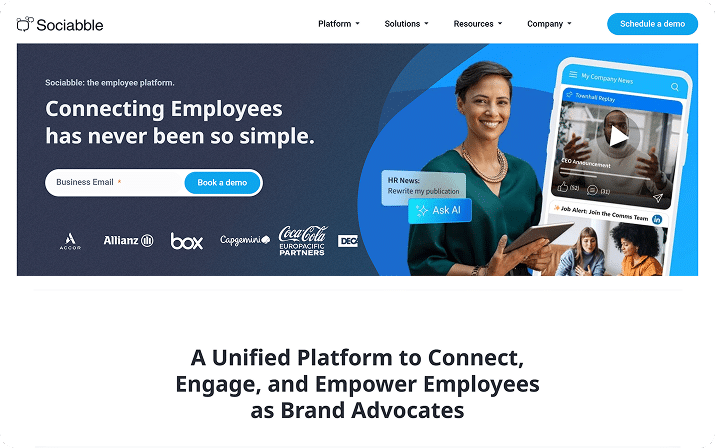
Poppulo is an all-in-one internal communications, employee engagement, and advocacy platform designed for organizations that want to inform, engage, and mobilize their entire workforce from a single hub.
The platform goes well beyond basic news delivery by combining targeted communications, engagement mechanics, analytics, and employee voice features in one cohesive experience.
Key Poppulo Features
- Centralized internal communications hub with targeted news and alerts
- Mobile-first experience built for frontline and deskless employees
- Advanced content targeting by role, location, language, and interest
- Built-in engagement tools including reactions, comments, challenges, and gamification
- Native employee advocacy and social sharing capabilities
- Robust analytics dashboards to measure reach, engagement, and adoption
- Integrations with Microsoft 365, Teams, Google Workspace, Slack, and HR systems
What Is Blink?
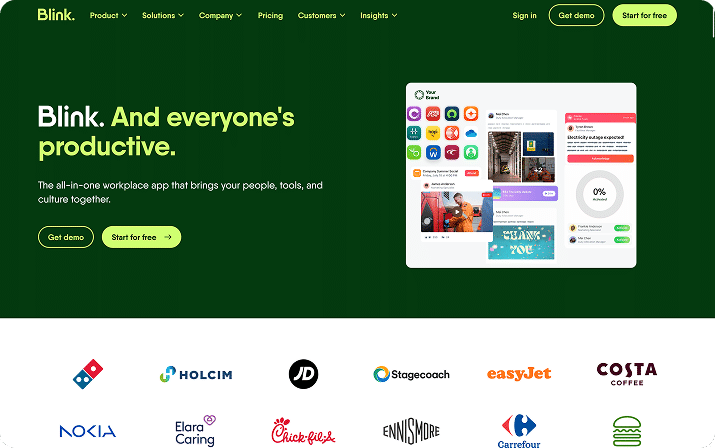
Blink is an internal communications platform primarily focused on fast, simple communication for frontline and deskless teams. It emphasizes ease of use and quick deployment, often appealing to organizations that want a lightweight alternative to email or intranet tools.
Blink positions itself as a single app for frontline workers to access updates, resources, and basic collaboration features.
Key Blink Features
- Mobile-first internal communications app
- News feed for company updates and announcements
- Basic content sharing and notifications
- Simple document access and links
- Messaging and limited engagement features
- Fast onboarding and straightforward user experience
Poppulo vs Blink: Feature-by-Feature Comparison
In this section, we'll break down the most important internal communications capabilities, based on real user feedback and practical use cases.
1. Communication Reach and Targeting
Bottom line: Poppulo offers deeper, more precise targeting, while Blink prioritizes simplicity.
Poppulo allows communicators to target messages based on detailed employee attributes such as department, location, role, language, and custom groups. This ensures employees receive relevant information without noise, which is critical for large or global organizations.
Blink focuses on broad distribution and simplicity. G2 reviewers frequently highlight how easy it is to push updates quickly, but note limitations when it comes to advanced segmentation and content governance.
Why it matters: As organizations scale, poor targeting leads to message fatigue and lower trust in internal channels.
2. Employee Engagement Capabilities
Bottom line: Poppulo is designed to drive interaction, not just information consumption.
Poppulo includes built-in engagement mechanics such as reactions, comments, challenges, leaderboards, and recognition features. These tools encourage two-way communication and help internal teams measure how content resonates with employees.
Blink users consistently praise its speed and ease of use, but G2 reviews point to missing engagement features, limited interaction options, and difficulty sustaining long-term participation beyond basic reading.
Why it matters: Internal communications only work when employees actively engage, not when they passively scroll.
3. Analytics and Measurement
Bottom line: Poppulo provides enterprise-grade analytics, while Blink offers limited insight.
Poppulo delivers advanced dashboards that track reach, engagement rates, active users, and content performance over time. This allows internal comms teams to prove impact and continuously optimize their strategy.
Blink users frequently mention insufficient reporting depth and limited visibility into engagement trends. While basic metrics are available, they often fall short for organizations that need data to justify investment or improve outcomes.
Why it matters: Without analytics, internal communications become a cost center instead of a strategic function.
4. Platform Breadth and Scalability
Bottom line: Poppulo supports long-term growth, Blink is best for narrower use cases.
Poppulo combines internal communications, engagement, and employee advocacy in a single platform. This reduces tool sprawl and allows organizations to evolve from basic communications to full employee activation without switching vendors.
Blink is often described in G2 reviews as effective for quick rollout, but users also mention feature gaps, limited extensibility, and challenges when needs become more complex.
Why it matters: Switching platforms later is costly in both budget and employee trust.
5. Integrations and Ecosystem
Bottom line: Poppulo fits more naturally into enterprise tech stacks.
Poppulo integrates deeply with Microsoft 365, Teams, Google Workspace, Slack, and HR systems, enabling communications to live within existing workflows.
Blink offers fewer integrations and is more self-contained. Some users report friction when trying to connect Blink with other workplace tools or scale usage across regions.
Why it matters: Adoption increases when internal communications align with how employees already work.
6. Employee Advocacy
Bottom line: Poppulo supports employee advocacy natively, Blink does not.
Poppulo allows internal communications teams to turn selected content into shareable posts, enabling employees to amplify company messages on their personal social networks. Advocacy is embedded in the same platform employees already use, which lowers friction and increases participation.
Blink focuses strictly on internal communication. Verified G2 reviews highlight missing features and limited sharing capabilities, with no structured way to support employee advocacy or measure external impact.
Why it matters: Organizations that connect internal communication with advocacy extend message reach, reinforce alignment, and activate employees beyond internal channels. Poppulo supports this end-to-end flow, while Blink remains internal-only.
7. Frontline Employee Communication
Bottom line: Both platforms target frontline teams, but Poppulo offers more structured engagement and control at scale.
Poppulo is built with frontline and deskless employees in mind, offering a mobile-first experience, targeted push notifications, multilingual content delivery, and structured content segmentation by role, location, and department. This ensures frontline workers receive relevant updates without information overload.
Blink is also designed for frontline communication and is frequently praised on G2 for its ease of use and quick access to updates. However, users also report challenges such as overwhelming feeds, limited search functionality, and occasional navigation friction when locating older content or shared files.
Why it matters:
Frontline employees need fast, relevant, and easily accessible communication. While both platforms are mobile-oriented, Poppulo provides stronger targeting, governance, and engagement tools to sustain long-term adoption across distributed workforces.
Poppulo vs Blink: Which One Should You Choose?
Both platforms can be effective, but they serve different organizational goals.
Choose Blink if:
- You need a fast, simple internal communications app
- Your primary audience is frontline workers with basic communication needs
- You prioritize speed of deployment over long-term depth
Choose Poppulo if:
- You want to move beyond announcements to real employee engagement
- You need advanced targeting, analytics, and governance
- You support a global or hybrid workforce
- You want one platform for communications, engagement, and advocacy
Trusted by global organizations across industries, Poppulo is built for companies that see internal communications as a strategic driver of alignment, culture, and performance.
Conclusion
When it comes to internal comms platforms, Blink does deliver simplicity and speed, which makes it appealing for organizations with straightforward internal communication needs. However, its limitations in engagement, analytics, and scalability often surface as organizations grow or expectations increase.
Poppulo, meanwhile, stands out as the more comprehensive internal communications platform, combining targeted messaging, measurable engagement, and long-term scalability in one solution. It empowers organizations not only to inform employees, but to truly engage and activate them.
Ready to learn more?
Book a demo to see how Poppulo can help your organization connect, engage, and inspire your workforce.