It's clear AI has enormous potential for employee advocacy, but there's always that nagging doubt: how do we maintain brand control in the face of artificial intelligence? The best strategy is a hybrid approach; one that uses the technology but doesn't take out the human element.
Key Takeaways
- Start with trusted information. Give AI access to content approved for external sharing, rather than relying on general knowledge or unrestricted internal documents
- Protect the facts, not the wording. Employees should be free to express their perspectives while respecting approved claims, product information, and confidentiality rules
- Make approval proportionate to risk. Routine posts can follow a lighter process, while sensitive announcements and new claims require additional review
- Keep employees in control. AI can suggest, draft, and improve content, but employees should always decide what appears on their personal profiles
The most effective approach to AI in employee advocacy combines clear governance with room for individual expression. This guide walks through six practical steps to introduce AI into your advocacy program, from choosing suitable use cases and establishing brand guidelines to training employees and measuring results.

1. Choose Where AI Can Help Your Advocacy Program
AI can make employee advocacy more accessible by removing some of the work involved in finding ideas, writing posts, and adapting corporate content.
For employees who are already active on social media, artificial intelligence can help them develop ideas more quickly. For those who rarely post, it can provide the starting point they need to participate.
The key is choosing tasks where AI supports employees rather than replacing their judgment.
Here are five useful applications:
| AI Use Case | How It Helps Employees |
|---|---|
| Topic suggestions | Identify relevant company updates, industry trends, and subjects connected to an employee's expertise |
| First drafts | Turn an idea or approved article into a suggested LinkedIn post |
| Content personalization | Adapt a message for different roles, audiences, and writing preferences |
| Translation | Prepare localized drafts for employees in different markets |
| Writing feedback | Suggest clearer wording, stronger openings, and improvements to structure |
For further insights, our webinar 'Employee Advocacy in the Age of AI' outlines how to adapt these use cases across different profiles—ranging from leadership to subject matter experts—and identifies the content strategies driving success today.
For example, an employee in Sales might use AI to turn a company announcement into a post explaining why the news matters to customers. A technical expert could use the same announcement to discuss its implications for their industry.
Both contribute to brand visibility, but they offer different perspectives.
This distinction matters because employee advocacy isn't simply about distributing corporate content through employee networks. Its value comes from the expertise, credibility, and relationships employees bring to the conversation.
Set Boundaries for AI Usage
Before introducing AI tools, establish which activities are permitted. You might allow employees to generate content ideas, rewrite approved messages, and improve drafts while restricting the use of confidential information or unpublished company announcements.
Make one distinction particularly clear: permission to generate content is not permission to publish it. Employees should retain control over their accounts, their opinions, and their decision to participate. The same principle applies whether they use a standalone writing assistant or an AI-powered employee advocacy platform.
For a broader introduction to building participation, explore our employee advocacy resources.
2. Give AI Sources Approved for External Sharing
An AI assistant is only as useful as the information it can safely draw upon. Without clear sources, generative AI may produce convincing statements that are inaccurate, outdated, or inconsistent with your corporate messaging.
The NIST Generative AI Profile identifies inaccurate outputs, information integrity, and data privacy among the risks organizations should address when deploying generative AI. For employee advocacy programs, that means establishing a reliable source of information before expanding AI-assisted content creation.
Build an Approved Content Library
Start with materials that employees are already authorized to share publicly:
- Published company announcements and press releases
- Approved product descriptions and positioning statements
- Public customer stories with the appropriate permissions
- Published research, articles, and industry insights
- Brand guidelines and approved terminology
- Current links to company resources
Assign an owner to each category and establish when its content should be reviewed. For example, Product Marketing might maintain product descriptions, while Corporate Communications owns company announcements and Legal reviews sensitive claims.
An important distinction: an employee's ability to access an internal document does not mean its contents are suitable for external publication. AI tools should not be given unrestricted access to internal communications, customer information, or confidential business data simply because those materials could help generate more detailed posts.
Tell AI What to Do When Information Is Missing
One of the most useful instructions you can give an AI assistant is also one of the simplest:
If the approved sources do not contain enough information to support a statement, flag the missing information instead of inventing an answer. This helps employees identify what needs checking before they publish.
It also gives your communications team a way to identify recurring gaps in approved content. If employees repeatedly need the same information, adding it to the source library may be more useful than reviewing individual posts.
3. Define Brand Rules and Personalization Boundaries
Brand control doesn't have to mean controlling every word employees publish. In fact, if every employee shares the same AI-generated content with minor variations, the result can feel more like coordinated advertising than authentic advocacy.
A better approach is to distinguish between information that must remain consistent and the personal expression that makes each contribution valuable.
| What Must Stay Consistent | What Employees Can Personalize |
|---|---|
| Product names and official terminology | Opening sentences and hooks |
| Approved facts, figures, and claims | Vocabulary and writing style |
| Confidentiality and disclosure requirements | Personal opinions and professional perspectives |
| Customer references and permissions | Examples from their own experience |
| Legal or regulatory wording | Post structure and emphasis |
These boundaries give employees the confidence to create content in their own voice without accidentally changing important facts.
Create a Reusable AI Prompt
Rather than asking employees to become prompt-writing experts, give them a practical template they can adapt. For example:
Example AI Prompt
Using the approved source material below, draft a LinkedIn post for [audience]. My role: [job title] My perspective: [what I personally find interesting or relevant] My preferred tone: [conversational, analytical, practical, etc.] Keep all product information, statistics, and claims accurate. Do not introduce facts or personal experiences that I haven't provided. If information is missing, flag it rather than inventing it. Suggest a post of approximately 120 to 180 words that I can review and personalize before publishing.
The prompt provides enough direction to produce a useful draft while leaving the employee responsible for adding genuine personal input.
Show One Announcement Through Two Employee Perspectives
Consider a hypothetical software company announcing a new reporting feature.
The approved announcement states:
The new reporting dashboard allows administrators to compare campaign performance across departments. It will be available to customers from November 15.
A salesperson and a product specialist could share that information in very different ways.
Sales Perspective
"One question worth asking when reviewing a communications campaign: can you tell which teams it's reaching? Our new reporting dashboard, available from November 15, will allow administrators to compare campaign performance across departments.
For organizations managing communication across multiple teams, that comparison could be a useful starting point for more informed conversations about what's working."
Product Specialist Perspective
"Company-wide averages can hide important differences between teams. That's one reason department-level reporting is worth paying attention to.
Our new reporting dashboard will let administrators compare campaign performance across departments, starting November 15. I'm interested in how teams will use these comparisons to investigate differences in communication performance."
Both posts preserve the approved facts. Yet each brings a different professional perspective and addresses a different audience. Neither invents customer feedback, personal experiences, or product capabilities.
That last point is essential. AI can help employees articulate their experiences, but it should never manufacture those experiences on their behalf. This nuance requires governance right from the implementation of an employee advocacy pilot.
4. Match Approval Requirements to the Content
Requiring communications teams to approve every employee post might feel like the safest approach. In practice, it can become difficult to sustain as participation grows.
The alternative isn't to eliminate approval. It's to introduce different levels of review based on the content's risk.
Establish a Risk-Based Approval Workflow for Your Employee Advocacy Platform
A practical governance model might look like this:
| Content Type | Permitted Personalization | Review Requirement |
|---|---|---|
| Approved article or company news | Personal introduction and commentary without new factual claims | Employee reviews before publishing |
| Original thought leadership | Employee's own expertise, opinions, and examples | Employee review, with escalation for sensitive claims |
| New product or performance claims | Personal wording without changing the underlying facts | Product Marketing or designated content owner |
| Customer stories | Commentary within approved permissions | Customer-reference owner when new details are introduced |
| Financial, legal, or sensitive announcements | Only changes explicitly permitted by policy | Authorized Corporate Communications or Legal reviewer |
This is a proposed model, not a universal approval standard. Organizations in regulated industries may require additional controls even for routine content.
The objective is to direct human review toward the decisions where it adds the most value.
Define Who Is Responsible
An effective process identifies three distinct responsibilities.
- The content owner maintains the accuracy of approved information and decides when it needs updating.
- The designated reviewer handles exceptions, sensitive claims, or changes that fall outside the established rules.
- The employee reviews the final post and decides whether it represents something they genuinely want to share.
Approval should also be reconsidered when a draft introduces new facts, changes the meaning of an approved claim, or includes previously unpublished information.
AI can assist with identifying possible issues, but automated checks shouldn't be treated as proof that a post is accurate or compliant. This approach reflects the emphasis on defined oversight responsibilities and risk management in NIST's guidance on generative AI.
5. Train Employees to Review and Localize Their Posts
Even the best employee advocacy platform cannot replace employees' understanding of their own expertise and professional relationships. Training should therefore focus less on mastering AI technology and more on recognizing what makes a post worth sharing.
Employees need to understand how to assess a draft, make it their own, and identify situations that require additional review.
Introduce a Five-Question Prepublication Check for All Employee Advocacy Matters
Before publishing AI-assisted employee posts, encourage participants to ask:
- Is it accurate? Can I verify every factual statement against an approved source?
- Does it sound like me? Would I naturally use these words when speaking to a colleague or customer?
- Have I added something useful? Does the post contain a perspective, explanation, or observation that contributes to the discussion?
- Is everything appropriate to share? Have I checked confidentiality, customer permissions, and company policies?
- Would I stand behind it? Am I comfortable responding to questions about what I've published?
These questions are easy to remember and work across different levels of social media experience. They also help prevent over-automation, where employees share suggested posts without meaningfully reviewing them.
Make Localization Part of the Process
For multinational advocacy programs, translation deserves particular attention. An English-language post may be factually correct but sound unnatural when translated directly into French, German, or Spanish.
AI can produce an initial localized version, but employees or designated local reviewers should check terminology, cultural context, and the meaning of important claims. Consider a product announcement describing a feature as "available now." If availability differs between markets, translating that phrase accurately isn't enough. The underlying message may need to change.
Localization is therefore both a language task and a governance decision.
Pro tip: Run short practical training sessions using real approved content. Ask employees to compare an initial AI draft with a version they have personalized, then discuss which changes improve the post and which introduce unnecessary risk.
6. Pilot the Workflow and Measure Quality & Employee Advocacy Impact
Once your content sources, brand rules, and review responsibilities are defined, start with a small group of volunteers. Include employees from different departments, seniority levels, and markets. This gives you a better understanding of how the workflow performs across different audiences and communication styles.
Test several content types rather than relying exclusively on preapproved company announcements. For example, your pilot could include routine content sharing, an original thought leadership post, and a translated announcement.
Measure Participation Alongside Content Quality of Corporate Messaging
Reach and engagement matter, but they don't tell you whether your AI-assisted advocacy program is working as intended.
A useful measurement framework combines adoption, efficiency, quality, and business outcomes.
| Measurement Area | Example Metrics | What You Learn |
|---|---|---|
| Participation | Active ambassadors, repeat contributors, posts shared | Whether employees find the process accessible |
| Efficiency | Draft preparation time, review time, approval delays | Whether AI reduces work or creates additional steps |
| Content quality | Factual corrections, policy exceptions, sampled post quality | Whether brand safeguards are working |
| Visibility | Impressions, engagement, website traffic | How content performs across employee networks |
| Business contribution | Qualified website visits, attributable leads, relevant conversations | Whether advocacy supports wider business objectives |
Compare these measures with your existing program where possible. If more employees are posting but corrections and review times are increasing, the problem may lie in your source material or instructions.
If participation improves but employee posts become increasingly similar, you may need to give ambassadors more freedom to develop their own perspectives. And if employee-shared content generates significant organic reach without meaningful engagement, examine whether the content addresses the interests of its intended audience.
Successful advocacy programs should create value for both the organization and the employees participating in them. Use feedback from your pilot to refine the process before you scale advocacy programs across the business.
How Poppulo Experience Platform Supports AI-Assisted Advocacy
There can be no doubt: AI is changing what an employee advocacy platform can help organizations achieve. Beyond distributing company content, the opportunity is to support employees as they develop their professional presence, contribute original perspectives, and participate more confidently.
The Poppulo Experience Platform brings employee advocacy into a broader employee experience environment.
- Its advocacy capabilities support organizations in making content available to employees and helping them participate in social sharing. Employee recognition, rewards, notifications, and an approved media library lay the groundwork for employee sharing.
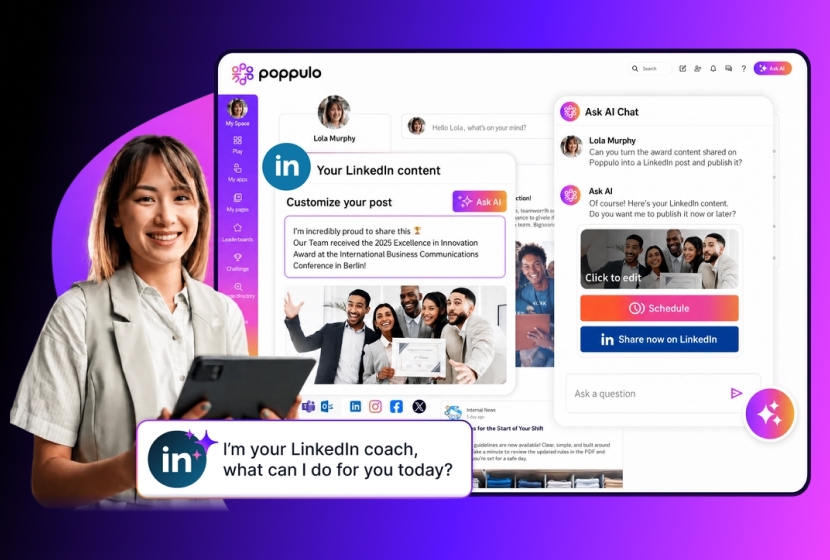
- AI-assisted capabilities can also support content drafting (including images), personalization, and writing guidance, including LinkedIn coaching, instant translation, and AI-assisted search.
For communications and marketing teams, the objective is to establish a common foundation of approved information while allowing employees to express their expertise in ways that feel natural to them. For employees, it's about having relevant content and practical writing support without losing ownership of their professional identity. Together, these abilities combine to make an extremely effective employee advocacy platform.
Final Thoughts
AI creates an opportunity to make employee advocacy more accessible without turning employees into another corporate distribution channel. The organizations that benefit most will be those that protect the accuracy of company information while giving people the freedom to express what they genuinely think.
Start with one governed workflow, test it with a small group of employees, and improve the experience based on their feedback. At Poppulo, we know this because we've seen it in action. We've already partnered with industry leaders like Coca-Cola CCEP, Primark, and L'Occitane Group to enhance communications and empower advocacy, and we'd love to do the same for your organization.
To explore how AI-assisted content creation and employee advocacy can work together, sign up for a free demo and discover the Poppulo Experience Platform.
AI in Employee Advocacy FAQs
Introducing AI into employee advocacy raises practical questions about responsibility, content accuracy, and the role employees should play. Here are four considerations worth addressing in your program guidelines.
What Should You Do if an Inaccurate Post Has Already Been Published?
Ask the employee to correct or remove the inaccurate information according to your company's escalation policy. Involve the appropriate communications, legal, or product owner when necessary. Then investigate whether the mistake originated from an outdated source, unclear instructions, or an AI-generated claim so the same issue is less likely to recur.
How Often Should You Update Your AI Instructions?
Review them whenever product messaging, company policies, or approved claims change. Recurring factual errors and employee feedback are also reasons to revisit your instructions. Assign someone responsibility for maintaining them, rather than relying on individual employees to notice outdated guidance.
Can AI Help Employees Respond to Comments?
Yes. AI can suggest responses to routine questions and help employees explain complex subjects more clearly. Employees should review every suggestion before replying. Sensitive questions involving customers, confidential information, legal matters, or company commitments should follow an established escalation process.
Can the Same AI Workflow Support Executive Advocacy?
Yes, although executive advocacy often requires closer coordination between leaders and their communications teams. AI can help prepare drafts, suggest relevant topics, and adapt content to a leader's communication style. The executive or their authorized team should validate the message and follow agreed review and publishing permissions.