Employee net promoter score (eNPS) measures how willing employees are to recommend your organization as a workplace. The score helps start the conversation; employees’ explanations help you decide what to do next.
Key Takeaways
- Employee net promoter score, or eNPS, measures willingness to recommend your organization as a workplace. It does not explain the whole employee experience.
- Calculate eNPS by subtracting the percentage of detractors from the percentage of promoters. Passives still count in the total valid responses.
- Interpret the score alongside participation, respondent mix, comments, and your previous results.
- A useful survey reaches office and frontline employees and explains how their feedback will be protected and used.
- Improvement starts with a specific workplace issue, an accountable owner, and progress employees can see.
For HR teams and Employee Experience leaders, eNPS offers a short starting point for listening across locations, languages, and roles. But there's a little more to it than that. And ensuring a good eNPS can have tangible benefits for your company.
This guide explains how to calculate it correctly, interpret results, and turn employee feedback into a practical action plan. You’ll also find survey questions and examples you can adapt for your workforce.
Let's get started.
What Is Employee Net Promoter Score?
Employee net promoter score summarizes responses to a single question about recommending your employer. It adapts customer Net Promoter Score, which asks about recommending a business, to the employment experience.
The standard eNPS question is:
“On a scale of 0 to 10, how likely are you to recommend our organization as a place to work?”
Label the endpoints clearly: 0 means not at all likely; 10 means extremely likely. Bain’s employee Net Promoter approach pairs a short feedback request with action on workplace issues.
That recommendation question gives you a directional signal of employee sentiment. Someone might value their colleagues but hesitate to recommend the organization because schedules are unpredictable or career opportunities are unclear. Their rating alone won’t reveal which issue matters.
Employee satisfaction and employee engagement need more specific questions. For example, does someone have a manageable workload, receive useful recognition, or see opportunities to develop? Broader employee engagement surveys can explore those experiences alongside the recommendation rating.
Treat eNPS as a starting point for investigation. It is not an engagement diagnosis, a performance rating, or a prediction that a particular employee will leave.

How to Calculate Employee Net Promoter Score
To calculate employee net promoter score, divide valid ratings into three groups, then subtract the percentage of detractors from the percentage of promoters.
| Rating | Category | Treatment in the Calculation |
|---|---|---|
| 9–10 | Promoters | Included in the promoter percentage and total responses |
| 7–8 | Passives | Included in total responses |
| 0–6 | Detractors | Included in the detractor percentage and total responses |
These are scoring categories, not descriptions of someone’s personality or commitment. A rating of 6 doesn’t establish that an employee is disengaged, just as a 10 doesn’t prove they actively promote the company.
The eNPS formula follows the Net Promoter Score calculation.
eNPS = Percentage of Promoters − Percentage of Detractors
Here’s a hypothetical example with 200 valid responses:
- 110 promoters: 110 ÷ 200 × 100 = 55%
- 50 passives: 50 ÷ 200 × 100 = 25%
- 40 detractors: 40 ÷ 200 × 100 = 20%
Your eNPS score is 55 − 20 = +35. Report it as a score of +35, not 35%.
Passives don’t appear in the subtraction, but they stay in the denominator. Removing them would change the result incorrectly. Blank or invalid recommendation ratings should not count as valid responses, even if the employee answered another question.
Pro tip: Keep the category counts with your score. They make the calculation easy to audit and show whether a change came from more promoters, fewer detractors, or a different balance of responses.
What Is a Good Employee Net Promoter Score?
A positive employee net promoter score means promoters outnumber detractors among valid respondents. Zero means the two groups are equal in size, while a negative score means there are more detractors. The possible range is −100 to +100.
Those mathematical meanings don’t establish a universal good eNPS score. A result of +35 is a useful baseline, but it doesn’t tell you whether employees have manageable workloads, fair opportunities, or confidence in leadership.
Before deciding whether a result represents progress, check:
- Participation: How many eligible employees answered the recommendation question?
- Respondent mix: Did the same locations, roles, and shifts participate across survey rounds?
- Survey conditions: Were wording, timing, channels, and privacy arrangements comparable?
- Workplace context: Were results collected during a restructuring, leadership change, or busy seasonal period?
For example, a higher company score deserves closer inspection if office participation rose while night-shift participation fell. The average may reflect a different set of respondents, rather than an improved experience across the workforce.
External benchmarks need similar care. Check their year, population, and method before using them, and avoid importing customer NPS thresholds into employee surveys. Your own comparable results and employees’ explanations usually offer a more practical starting point for decisions.
How to Run an eNPS Survey Employees Can Trust
A trustworthy eNPS survey makes it easy to share honest feedback and explains what will happen afterward. Start with a short questionnaire that connects the rating to something your team can investigate:
- Recommendation: “On a scale of 0 to 10, how likely are you to recommend our organization as a place to work?”
- Reason: “What is the main reason for your rating?”
- Improvement: “What one change would most improve your experience at work?”
Keep comment questions optional. If a theme needs deeper investigation later, choose relevant follow-ups from an employee feedback question bank, rather than adding every possible topic to this survey.
The American Association for Public Opinion Research’s survey best practices recommend simple, neutral questions, attention to language needs, and testing before launch. For your organization, that could mean asking a small group from different roles and languages to check whether the questions and response options make sense.
An email invitation may work for office teams but miss employees without company accounts. Reaching frontline employees means choosing accessible channels, providing translated questions where needed, and allowing time to respond across shifts. Test mobile or shared-device access before launch, including on the night shift.
Before launch, confirm whether responses are anonymous or confidential. Anonymous responses cannot be linked to an individual; confidential responses may be identifiable but have restricted access. Your invitation should accurately explain the setup, who can see ratings and comments, and how results will be shared.
Small groups and detailed comments can reveal identities even when names are removed. Agree on appropriate reporting safeguards with your privacy team and avoid circulating identifiable comments. Managers can explain how to participate and send neutral reminders, but should not watch employees answer or ask for favorable ratings.
How to Improve Employee Net Promoter Score
Improving employee net promoter score starts with understanding the experiences behind the ratings and making changes employees value. The five steps below connect survey feedback to decisions, delivery, and follow-up.
1. Identify the Reasons Behind the Ratings
The reasons behind eNPS ratings show you where to investigate. Review comments across all three categories, then group recurring themes such as workload, management, pay, recognition, development, and communication.
Suppose several employees write, “I like my team, but I never know my shifts far enough ahead.” That points toward scheduling predictability. An engagement campaign won’t answer the concern on its own.
Where reporting safeguards allow, check whether the theme appears across locations and business units or is concentrated in particular roles. Avoid assuming the most frequently mentioned issue is the only important one: a less common safety or discrimination concern may require prompt handling through the appropriate process.
2. Prioritize Changes With Clear Ownership
A useful action plan turns a feedback theme into a change someone has the authority to deliver. Choose a small number of priorities based on their importance, feasibility, and the people affected.
Here’s a hypothetical plan for a multi-site employer:
| Feedback Theme | Proposed Action | Owner | Deadline | Evidence of Progress |
|---|---|---|---|---|
| Late shift schedules | Pilot earlier schedule publication at one site | Site operations manager | Within 6 weeks | Publication timing and staff feedback |
| Unclear career paths | Publish role requirements and hold development conversations | HR partner | Within 8 weeks | Guidance available and conversations completed |
| Missed local updates | Test a shift briefing with a persistent written update | Local communications lead | Within 4 weeks | Access checks and employee understanding |
Each owner should confirm resources, dependencies, and a realistic review date before the plan is announced.
To turn employee feedback into change, the action needs to address the issue employees raised. If the concern is pay or staffing, involve the leaders responsible for those decisions. Communications can explain the process, but cannot substitute for a substantive response.
3. Make Communication Relevant and Accessible
Relevant communication helps employees understand decisions and find information that affects their work. It is especially useful when feedback identifies missed updates, unclear responsibilities, or uncertainty about available support.
For example, office employees might receive career guidance through an intranet update, while plant employees also need a shift briefing and an accessible place to revisit it. Both groups need the same eligibility rules and a clear contact for questions.
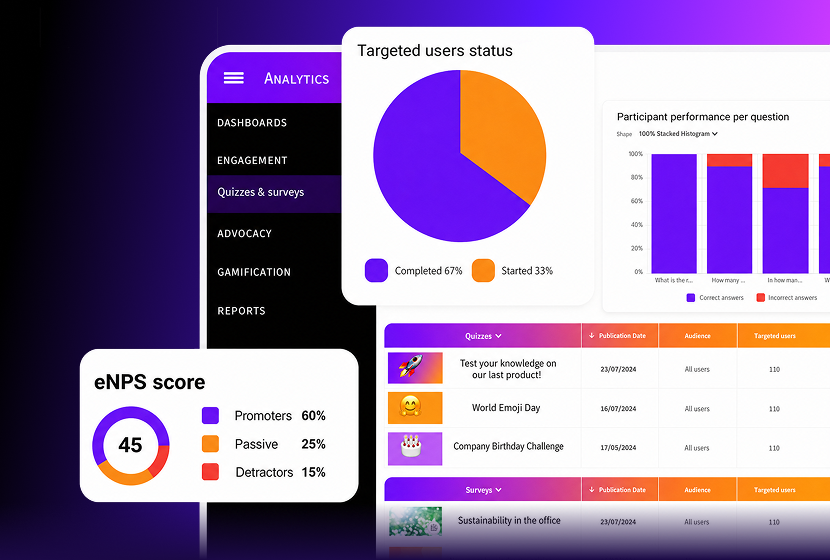
Poppulo Experience Platform’s surveys and eNPS capabilities support feedback collection, audience targeting, and direct access to results. Relevant communication features can help teams share follow-up updates; availability and deployment depend on your configuration and license. Communication supports the response, while issues such as workload and working conditions still need their own owners and actions.
4. Show Employees What Changed
Employees should be able to connect their feedback with a decision or a visible change. A follow-up update can explain what you heard, what is happening, and what needs more time.
For the scheduling pilot, an update might say:
“You told us that late schedules make it difficult to plan outside work. From June 3, the North Plant will test publishing schedules two weeks ahead. The site operations manager will review the pilot with staff after six weeks and share the next steps.”
Use dates and commitments only after the owner has agreed to them. Share the update through routes that reach office and frontline teams, including shifts that weren’t present for the announcement.
Pro tip: Give delayed actions a new update date. “We’re still reviewing this” is more useful when employees know who is reviewing it and when they’ll hear back.
5. Review Progress Alongside Other Evidence
To track progress, check whether the agreed change happened and whether it helped employees. The next eNPS result is one part of that review.
For the scheduling example, check publication timing and ask whether employees feel better able to plan outside work. Your review should include:
- Participation: Are office and frontline employees represented in the responses?
- Comment themes: Is unpredictable scheduling still being raised?
- Relevant engagement questions: Has the experience you set out to improve changed?
- Action completion: Are schedules actually being published when promised?
Exit interviews can provide another perspective on workplace issues, although departing employees don’t represent everyone still working there. Use them to identify questions worth investigating, rather than treating them as a substitute for current employee feedback.
Retention data may add context, but a change in turnover doesn’t establish that your survey or action plan caused it. Keep those measures separate and consider other workplace changes. If the eNPS rises while the scheduling problem persists, the action still needs attention.
Final Thoughts
Employee net promoter score gives you a starting point for listening, and employees’ explanations help you decide what to do next. Choose one meaningful improvement, agree on an owner and deadline, and tell employees when they’ll receive a progress update. That gives your next survey something concrete to evaluate.
Ready to learn more about how you can improve your eNPS with the right digital tools? Then you're ready to learn more about the Poppulo Experience Platform. At Poppulo, we've already partnered with industry leaders like Coca-Cola CCEP, Primark, and L'Occitane Group to improve employee engagement and communications, and we'd love to help your organization achieve the same positive results.
Sign up for a free demo, and discover the difference that the Poppulo Experience Platform can make for your company.
Employee Net Promoter Score FAQs
These questions cover practical decisions about survey timing, comparisons, incentives, and advocacy.
How Often Should You Measure eNPS?
Space eNPS surveys around your ability to act and report progress. Quarterly measurement is one option. Repeated requests without follow-through risk survey fatigue. A focused employee pulse survey can check a specific improvement between rounds, provided each request serves a clear purpose.
Can You Compare eNPS Across Countries?
You can compare results cautiously when wording, translations, timing, collection methods, and participation are sufficiently comparable. Local working conditions and response patterns still matter. Review country-level trends and comments before treating a difference as evidence that one location has a better employee experience.
Should You Reward Employees for Completing an eNPS Survey?
Any participation incentive needs careful review for pressure, bias, and privacy implications. Never reward favorable ratings or make managers compete for positive scores. Clear invitations, accessible participation, and time to respond are useful starting points. An incentive should not undermine the survey’s voluntary and honest nature. You don't want to buy employee loyalty or customer loyalty.
Does a High eNPS Mean Employees Will Share Company Content?
No. Willingness to recommend an employer differs from willingness to share company content on personal social accounts. Advocacy participation depends on factors such as relevance, confidence, and individual preference for engaged employees. Assess it separately and keep participation voluntary, regardless of an employee’s recommendation rating.