The franchise problem is an interesting one: how do you keep a brand intranet universal, while still allowing room for local control? That's what we're here to discuss.
Key Takeaways
- Define ownership before choosing franchise intranet software: head office should own network-wide standards, while franchise owners and authorized contributors publish within clear boundaries.
- Map access separately from targeting, because owners, managers, and frontline employees may need different rights even at the same franchise location.
- Match web, mobile, and workplace-screen access to real working conditions, including an alternative for people who cannot use smartphones on shift.
- Pilot one campaign across representative locations, then measure activation, reach, task completion, contributions, and overdue reviews by location rather than relying on a network average.
In this guide, you will learn how to design a corporate/local ownership matrix, follow one retail campaign from head office to local execution, and build a location-level pilot scorecard. The result is a practical governance model for internal communications that you can use to assess franchise intranet software against the way your network actually operates and improve franchise communication.

What Is a Franchise Intranet?
A franchise intranet is a shared digital hub connecting headquarters, franchise owners, multi-location operators, managers, and local employees with relevant news, resources, and ways to participate. Unlike a standard intranet designed around one employer and hierarchy, it must reflect the decentralized nature of franchise businesses.
The common experience does not require an identical homepage for everyone. Within the same franchise network:
- Franchise owners can receive commercial updates and access a franchise directory.
- Managers can find company news, training materials, standard operating procedures, and approved brand assets.
- Frontline employees can see local updates and resources through channels they can use.
Granular permissions and user groups can support these different experiences within a shared hierarchy. For multi-location businesses, this modern intranet solution is less a static homepage than a governed route to communication, essential documents, knowledge sharing, and other tools.
Owners and their employees are separate audiences. Franchisees may need commercial announcements and operational manuals, while frontline employees need shift-relevant updates and training resources. Keeping those boundaries explicit helps the entire franchise network stay on the same page without exposing employer-specific HR information to the wrong people.
Intranets still exist because the need has evolved, not disappeared. They now help people navigate a more complex mix of audiences, resources, and access routes.
How to Govern a Franchise Intranet Across Corporate and Local Teams
Effective intranet governance turns franchise communication into five repeatable decisions. The steps below follow a hypothetical spring promotion: head office publishes approved marketing assets, every location adds permitted details, frontline teams retrieve the current version, and franchisees share feedback.
1. Map Audiences and Access Boundaries for Entire Franchise Network
Start with people, not channels. Map corporate staff, franchise owners, individual franchisees, multi-location operators, regional managers, store managers, and frontline employees by employer, role, franchise location, language, and device access. Include remote teams, time zones, and the new hire journey through the first shift.
Then assign responsibility for account creation, a move to a new location, and deactivation. Head office may define identity rules, but franchisees need a reliable process for starters and leavers. Keep access rights separate from content targeting: permission to publish a local update does not create permission to see corporate finance content, and membership in a campaign audience does not grant editing rights.
For the spring campaign, the marketing team can target all store managers with the launch pack while local managers receive publishing rights only for their own locations. This distinction limits compliance risk and unnecessary phone calls to head office.
2. Assign Corporate and Local Content Ownership
An ownership matrix makes governance visible. It gives every content type an owner, defines acceptable local changes, and prevents approval rules from spreading to low-risk updates. This reflects the hybrid model in our recent guide to global internal communications: central direction paired with clearly scoped local execution.
- Brand guidelines: Head office marketing owns them, and the brand lead approves them for owners and managers. No local changes are permitted, and the content is reviewed quarterly.
- Campaign materials: Head office marketing owns them, while selected locations may change the address, dates, and local offer. The campaign lead approves the changes, and the material is reviewed when the campaign closes.
- Network announcements: Corporate communications owns them, with translation as the only local change. The managing director or a delegate approves them for the entire network when they are issued.
- Local updates: The franchise owner or manager has full local ownership and approves updates for one or more locations. Review them monthly.
- Employer-specific HR information: The employing entity owns the content and may add local policy details. HR or compliance teams approve it for that entity's employees and review it on the policy review date.
For the promotion, corporate marketing owns the creative concept, approved marketing materials, and brand standards. Each location may add opening hours and an approved offer, but cannot alter the logo or core claim. The same rule can support future marketing campaigns. Requiring approval only where content warrants it protects brand consistency without slowing routine local communication.
3. Organize Shared Resources and Local Spaces
Put authoritative resources in a structured library instead of burying them in a news feed. Campaign news should link to the current resource, while a named owner manages version control, review dates, and retirement. That discipline prevents outdated materials from competing with approved brand assets and saves time for franchise operations. It also helps onboarding stay consistent, supporting a more consistent customer experience across locations.
In the campaign journey, the launch post links to one live pack containing marketing materials, display instructions, and a manager briefing. When head office revises an image, the resource owner replaces or versions it at the source, so franchisees do not have to search old emails for the current version.
Edenred offers a transferable governance example, as shown by its own franchise intranet, powered by the Poppulo Experience Platform. Its headquarters sets editorial direction and major campaigns, while local teams adapt content and manage communities. Franchise businesses can apply the same principle to balance a common company culture with local relevance.
4. Match Channels to Frontline Working Conditions
Channel choice should follow access conditions. Office teams may use the web, while frontline employees and deskless workers may need mobile devices or workplace screens. If personal phones are unavailable or inappropriate, specify how people retrieve details and respond, such as a break-room computer, manager briefing, QR code on a screen, or shared device.
L'Occitane Group used local administrators and different access routes for office, retail, and industrial populations when implementing its intranet powered by the Poppulo Experience Platform. Retail staff could use store laptops or opt into a mobile app, while industrial staff could use break-room laptops. The practice for a franchise network is to design several usable routes, not assume mobile access alone will reach frontline employees.
For the spring campaign, screens create workplace visibility, the mobile route carries full instructions and feedback, and the web experience holds the campaign pack. Managers also cover the change in shift briefings, giving every location a way to act without weakening the source of truth.
5. Pilot a Campaign Across Representative Locations in the Franchise Network
Pilot the complete intranet journey before expanding franchise intranet software across the whole network. Include corporate and franchise-operated locations where relevant, different locations with different device access, a multi-location operator, new franchisees, and at least one site that usually struggles to reach frontline employees.
Test sign-in, correct audience visibility, resource retrieval, local publication, feedback, and account removal. Ask a manager to find the campaign pack, add permitted local details, publish to the right audience, and share feedback. Ask a frontline employee to locate the instructions and complete the intended action. Assign an owner and due date to every issue before expansion.
The pilot checklist is short:
- Confirm account creation, transfer to a new location, and removal.
- Check that user groups see only relevant corporate and local content.
- Retrieve the current campaign pack through each promised access route.
- Publish a compliant local version and test two-way communication.
- Record issues by location, device, role, and owner.
How to Measure Franchise Intranet Success by Location
Measure whether the franchise intranet supports real work, not simply whether content received views. A compact scorecard should let head office identify gaps while giving franchisees useful evidence about their own teams.
- Activation: Who signed in from the eligible population? Compare results by location, role, and access route.
- Repeat use: Who returned after launch? Review this by week, location, and owner or employee audience.
- Target-audience reach: Did the intended group receive the update? Separate results by campaign, role, and language.
- Resource-finding task: Could users find the current version? Compare completion and time by location.
- Local contributions: Which locations publish or share ideas? Break contributions down by location and content type.
- Overdue reviews: Which resources passed their review date? Identify the responsible owner and risk level.
Keep views, acknowledgments, understanding, and completed actions separate. A view shows exposure; an acknowledgment records confirmation; a short question can test understanding; and a completed action shows execution. Analytics dashboards can support location-level comparison, but investigate access, relevance, training, or identity problems before treating a low-performing franchisee as disengaged.
For the campaign, compare pack retrieval and correct local publication with feedback volume and action completion. Network averages can hide a franchise location where nobody activated an account or where outdated materials remain in use.
How Poppulo Experience Platform Supports Corporate and Local Teams in Franchise Communication
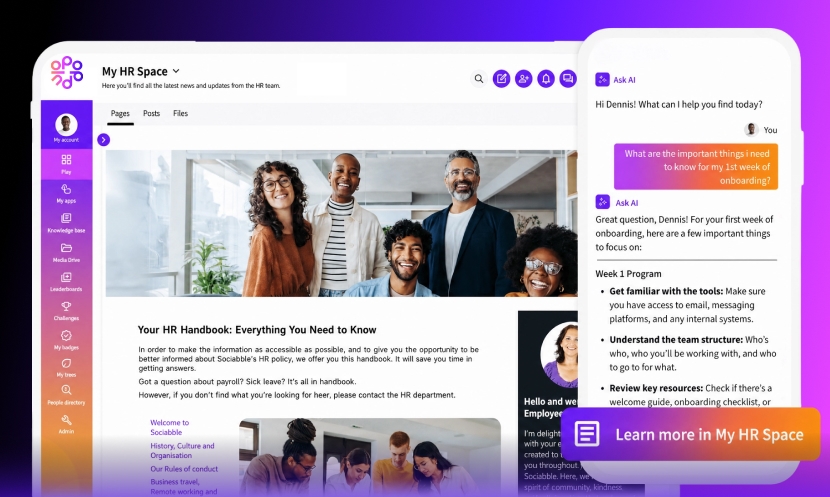
Your company's approach to intranet is critical, but none of it will help if you don't have the right digital tools to empower your strategy. The Poppulo Experience Platform connects the governance decisions above to an intranet solution built for corporate direction and local publishing:
- Intranet and Multichannel Communication support scoped administration, audience targeting, and personalized homepages, so franchise businesses can define who publishes, who sees what, and where each audience begins.
- Sites and Pages support persistent, structured knowledge with granular permissions, audience targeting, automatic versioning, and reviewable resources. That gives franchise operations a centralized platform for brand guidelines, operational manuals, onboarding checklists, compliance updates, and other essential documents instead of a trail of attachments.
- A Branded Mobile App gives authorized users mobile access to communication, knowledge, and participation.
- Workplace Digital Signage puts company news and priority updates on screens for teams who may not use phones during work.
- Analytics provides visual and exportable reporting with segmentation and filters. During evaluation, ask to demonstrate your pilot scenarios, audience boundaries, location views, and content lifecycle.
Thanks to these features, the Poppulo Experience Platform serves as franchise intranet software that's capable of adapting to your own operating model and needs.
Final Thoughts
A successful franchise intranet starts with governance: clear audience boundaries, explicit ownership, reliable resources, and access routes that fit frontline work. Those choices help franchise businesses protect brand standards while giving franchisees room to communicate locally. Agree on the ownership matrix before configuring the pilot.
At Poppulo, we've already partnered with global leaders like Coca-Cola CCEP, Primark, and L'Occitane Group to connect corporate governance with relevant local communication, and we'd love to do the same for your organization.
Book a free personalized demo to test corporate governance, local publishing, and frontline access against your franchise network requirements.
Franchise Intranet FAQs
These answers clarify how a franchise intranet fits alongside the systems and budget decisions franchise businesses already manage.
How Does a Franchise Intranet Differ From Franchise Management Software?
A franchise intranet focuses on communication, knowledge access, brand resources, and participation across the network. Franchise management software typically handles commercial administration such as agreements, royalties, sales reporting, and operational workflows. The systems can coexist, with each assigned a clear purpose and audience.
Does a Franchise Intranet Replace Microsoft 365?
Not necessarily. Microsoft 365 collaboration and document tools can remain part of the workplace. Assess who has an account, how frontline teams gain easy access, and whether each system is meant for collaboration, governed publishing, or knowledge retrieval. The right model may connect existing tools rather than replace them.
What Should a Franchise Intranet Budget Include?
Budget for franchise intranet software, implementation, content preparation, identity administration, contributor training, integrations, launch communication, and ongoing ownership. Cost depends on scope, audience size, channels, and services, so compare proposals against the same governance and pilot requirements instead of a headline license figure.