TL;DR
- Internal communication tools are software platforms that help organizations share information, align teams, and gather feedback across email, mobile, digital signage, intranet, and chat — ideally publishing once and measuring engagement everywhere.
- The stakes are high: only 20% of employees were engaged in 2025, costing the global economy ~$10 trillion (Gallup, 2026), and 47% of digital workers can't easily find the information they need (Gartner).
- No single channel reaches everyone. A distributed, hybrid, and frontline workforce needs a multichannel ecosystem, not one tool.
- The 16 categories that matter in 2026: employee experience platforms, internal email/newsletters, digital signage, intranets, instant messaging, video conferencing, collaboration, recognition, feedback, project management, cloud storage, scheduling, social intranets, AI communication tools, multilingual tools, and analytics.
- What to prioritize: multichannel reach, segmentation, built-in analytics, two-way feedback, frontline coverage, integrations, AI assistance, and security.
- Don't pick one "best" tool — build the right ecosystem. Platforms like Poppulo combine multichannel publishing, cross-channel analytics, AI, and digital signage to reach every employee, not just inboxes.
Internal communication tools are the software platforms organizations use to share information, align teams, and gather feedback across every channel an employee touches — internal communications email software, mobile apps, digital signage, intranet, and chat. The best of them let you publish a message once and deliver it everywhere, then measure whether it actually landed.
That last part matters more than ever. According to Gallup's 2026 State of the Global Workplace report, only 20% of employees worldwide were engaged in 2025 — the lowest level since 2020 — and that disengagement cost the global economy an estimated $10 trillion in lost productivity, roughly 9% of global GDP. A separate Gartner survey found that 47% of digital workers struggle to find the information they need to do their jobs. Poor internal communication isn't a soft problem. It's a measurable drag on performance, and the right toolset is how you reverse it.
The workplace has changed dramatically. With people split across offices, homes, warehouses, shop floors, and the field, no single channel reaches everyone. Employees access company messaging through digital signage, mobile apps, the intranet, or collaboration platforms like Slack and Teams. That means your internal communications software has to be flexible, integrated, and comprehensive.
This guide explores 16 essential internal communication platforms — their key features, advantages, and drawbacks — to help you build the right ecosystem for your workforce.
Why Multichannel Communication Is Non-Negotiable
The most effective internal communication platforms offer multichannel delivery: publish once, distribute everywhere — email inboxes, mobile screens, digital signage, intranet homepages, and even Slack or Teams channels. This ensures every employee receives the right message, on the right device, at the right time.
Multichannel isn't just a logistical necessity — it's a human one. Ensuring every employee can access key company messages isn't simply about reach. It's about respect. When people feel informed, included, and heard, they're far more likely to feel like they belong.
And belonging isn't a soft metric — it's a powerful driver of wellbeing, engagement, and performance. As behavioral economist and wellbeing expert Jan-Emmanuel De Neve emphasized during a Poppulo webinar, a strong sense of workplace belonging is one of the most important predictors of employee wellbeing. When employees feel well, they don't just thrive personally — they contribute more fully, innovate more freely, and stay longer.
That's why internal communication must be two-way. It's not enough to push messages out across every channel. Organizations also need to open up listening loops — through surveys, pulse checks, frontline feedback tools, and open forums that let every voice be heard. Good communication makes people feel informed. Great communication makes them feel they matter.
The Power of Analytics
It’s not just about sending messages—it’s about knowing if they land.
In a world saturated with digital noise, internal communications teams can no longer operate on instinct. To understand what's resonating with employees — and what's not — measurement is essential. As management thinker Peter Drucker is often credited with saying, what gets measured gets managed. In internal comms, what gets measured also gets improved. Clear insight into how employees engage with your content — opening emails, clicking links, reading intranet articles, watching embedded videos — lets you refine strategy, optimize timing, segment audiences, and build trust through relevance.
Poppulo's analytics suite is purpose-built for this. It provides rich, real-time dashboards across email, mobile, digital signage, and intranet, so communicators can see exactly what's working and where to improve. With data visualizations, content performance heatmaps, and behavior-based insights, Poppulo helps internal comms teams move beyond "we sent it" to "we know what worked." In a time when employee attention is fragmented and precious, data isn't a nice-to-have — it's your compass.
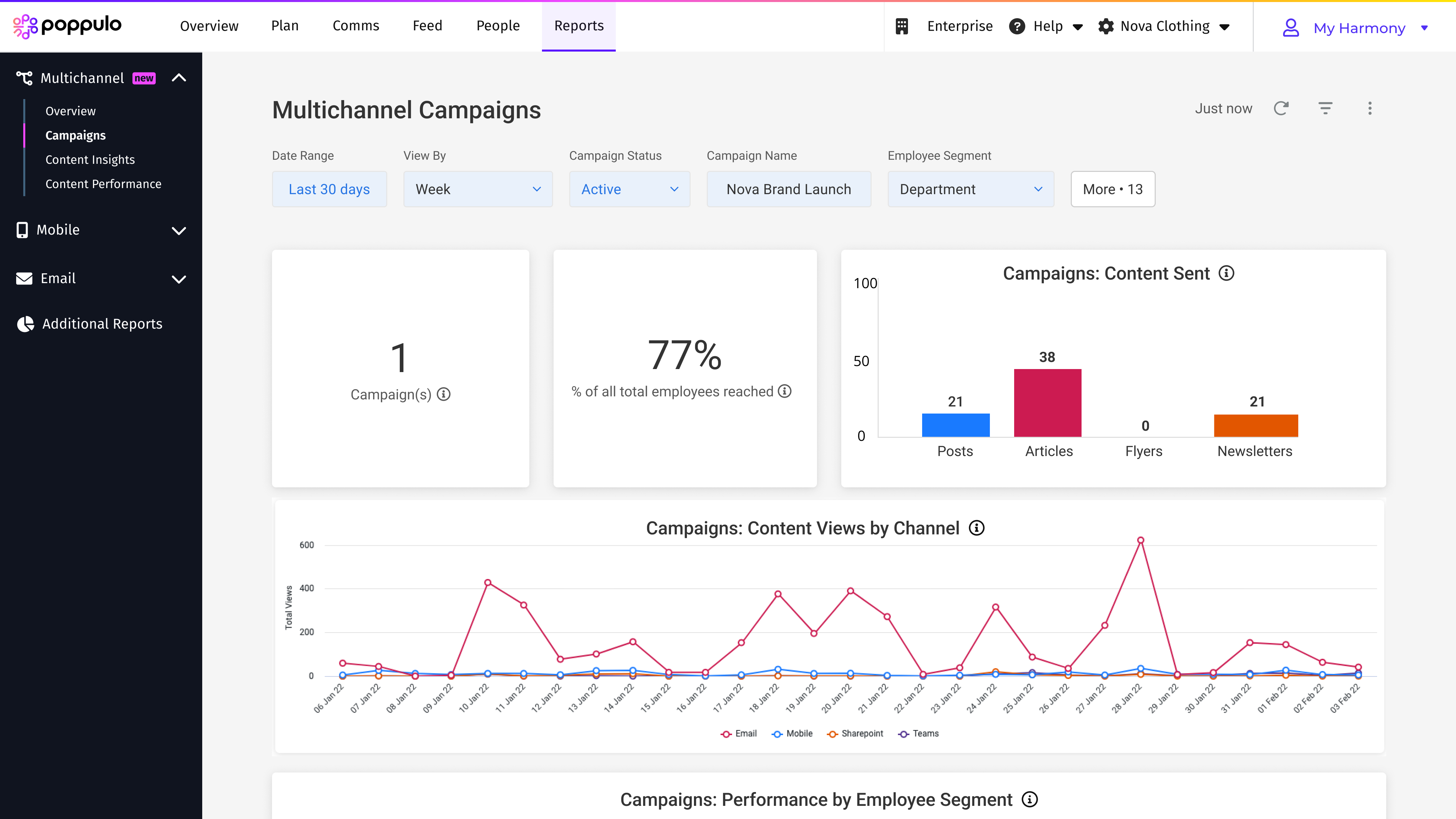
Poppulo’s Analytics
Embracing AI in Internal Comms
Modern internal communication software is increasingly powered by AI. From drafting content and recommending publish times to personalizing messages based on employee behavior, AI can supercharge your communications without sacrificing the human touch. McKinsey's November 2025 State of AI report found that 88% of organizations now use AI in at least one business function — up from 78% a year earlier — making AI a baseline expectation rather than a differentiator. The advantage now goes to teams that embed it into real workflows, including internal communications.
See here how Poppulo CEO Ruth Fornell outlining how AI is already transforming internal communications.
What to Look for in an Internal Communication Tool
Before comparing specific tools, it helps to know what separates effective internal communication software from the rest. The strongest platforms share a common set of capabilities:
- Multichannel reach — delivers to email, mobile, digital signage, intranet, and chat from one place
- Audience segmentation and personalization — targets messages by role, location, language, or behavior
- Built-in analytics — measures reach, opens, clicks, and engagement across every channel
- Two-way communication — supports surveys, polls, and feedback, not just broadcasts
- Frontline coverage — reaches non-desk and non-wired employees, not just inboxes
- Integrations — connects with your HRIS, intranet, Slack, Teams, and collaboration stack
- AI assistance — speeds up drafting, scheduling, translation, and personalization
- Security and compliance — protects sensitive internal content at enterprise scale
Use these criteria as a scorecard as you work through the 16 tool categories below.
The 16 Best Internal Communication Tools for 2026
1. Employee Experience & Internal Comms Platforms
Top tools : Poppulo, Simpplr, Firstup, Haiilo, Staffbase,
Think of these as your company's mission control for internal communication. Built for enterprise-wide messaging, they deliver everything from leadership announcements to HR policies across email, mobile, digital signage, and intranet. They're the foundation of scalable, measurable communication.
Pros:
- Designed for top-down, multi-channel communication
- Centralizes messaging across email, digital signage, mobile, and intranet,
- Includes advanced analytics to measure reach and engagement
Cons:
- Typically, more complex than chat or video apps
- Best suited for mid-to-large enterprises with distributed workforces
2. Internal Email Newsletters
Top tools: Poppulo, ContactMonkey, Mailchimp, Staffbase,
While chat and video dominate daily interactions, internal email remains one of the most effective vehicles for strategic, top-down messaging that cuts through the clutter — especially for executive communications, HR updates, and company-wide storytelling.
Pros:
- Powerful for reaching email-enabled employees at scale
- Personalization and targeting options
- Supports branded, media-rich content
Cons:
- Doesn’t reach non-wired/frontline workers unless extended to mobile
- Easy to overuse or overlook without strong content strategy
3. Digital Signage
Top tools: Poppulo, ScreenCloud, Rise Vision
Not every employee checks their inbox, has Slack, or logs into the intranet. But every employee passes through a break room, a warehouse corridor, a factory floor, or a shared space. That's where digital signage becomes a game-changer — and where Poppulo's digital signage is a powerhouse.
Pros:
- Ideal for reaching non-wired employees in physical locations
- Eye-catching and hard to miss
- Great for reinforcing critical info, safety reminders, or culture initiatives
Cons:
- Requires hardware setup and screen infrastructure
- Needs regular content updates to avoid becoming static or ignored
4. Intranets
Top tools: PoppuloSharePoint, Unily, Jive
A modern intranet is more than a file repository — it's the backbone of your internal knowledge hub, centralizing onboarding materials, executive announcements, and everyday resources so employees can self-serve information.
Pros:
- Centralized home for important content and links
- Encourages self-service and reduces email traffic
- Customizable to reflect company culture
Cons:
- Needs regular upkeep to avoid becoming outdated
- Adoption can lag without engagement strategy
5. Instant Messaging
Top Tools: Slack, Microsoft Teams, Poppulo (when integrated)
When you need an answer now, messaging apps are essential. They replicate the quick, informal interactions of an in-person office.
Pros:
- Enables real-time collaboration and updates
- Creates group and cross-functional channels
- Reduces reliance on email for fast communication
Cons:
- Can lead to overload without clear boundaries
- Important info may be lost in chat threads
6. Video Conferencing
Top Tools: Zoom, Google Meet, Microsoft Teams
Video conferencing humanizes digital communication. Whether for check-ins, all-hands meetings, or 1:1s, seeing one another builds trust and connection.
Pros:
- Ideal for hybrid and remote cultures
- Enhances engagement through face time
- Offers screen sharing and breakout tools
Cons:
- Can contribute to burnout if overused
- Relies on internet and tech literacy
7. Collaboration Platforms
Top Tools: Asana, Trello, Monday.com
Projects succeed when everyone knows what's next. Collaboration tools clarify priorities, track ownership, and give teams visibility into progress.
Pros:
- Visual dashboards keep everyone aligned
- Encourages transparency and accountability
- Integrates with communication tools
Cons:
- Setup and onboarding take time
- Can overwhelm with notifications and task noise
8. Employee Recognition Tools
Top Tools: Poppulo, Bonusly, Kudos, Nectar
Recognition is rocket fuel for morale. These platforms let peers and managers celebrate wins in real time, building a culture of appreciation.
Pros:
- Encourages positive feedback loops
- Reinforces company values
- Boosts engagement and retention
Cons:
- Can feel shallow if not backed by culture
- Needs regular participation to gain traction
9. Feedback Tools
Top tools: Officevibe, Culture Amp, SurveyMonkey
Feedback platforms turn internal comms from broadcast into dialogue. They give employees a voice and give leaders the insight to lead better.
Pros:
- Anonymous channels support honesty
- Tracks trends over time
- Great for engagement and pulse surveys
Cons:
- Requires action or trust erodes
- Too many surveys can lead to fatigue
10. Project Management Tools
Top tools: Basecamp, Wrike, ClickUp
From marketing launches to IT rollouts, project tools keep teams organized and timelines visible.
Pros:
- Clarifies deliverables and deadlines
- Supports collaboration and documentation
- Offers dashboards and reporting
Cons:
- Some tools can be overly complex
- Adoption may require process change
11. Cloud Storage
Top tools: Google Drive, Dropbox, OneDrive
Secure cloud storage lets employees access the documents they need, when they need them, wherever they work.
Pros:
- Centralized document access
- Real-time co-editing and version tracking
- Secure and backed up
Cons:
- Can lead to clutter without organization
- Permissions must be managed carefully
12. Scheduling Tools
Top tools: Calendly, Doodle, Microsoft Outlook
These tools make scheduling seamless across teams and time zones — no more calendar Tetris.
Pros:
- Avoids endless email ping-pong
- Syncs with calendars
- Ideal for internal and external coordination
Cons:
- Limited functionality in free tiers
- Less effective for complex team planning
13. Social Intranets
Top tools: Poppulo, Workvivo, Yammer (Viva Engage), Jive
Social intranets take culture beyond the kitchen, blending communication with community through polls, posts, shout-outs, and shared stories.
Pros:
- Encourages connection and transparency
- Great for celebrations, DEI, and engagement
- Supports multimedia and user contributions
Cons:
- Needs champions to stay active
- Can become noisy if unmoderated
14. AI-Powered Communication Tools
Top tools: Poppulo, Intercom, Drift
These tools put automation to work — answering routine questions, personalizing communication, and helping internal teams scale their output.
Pros:
- Automates FAQs and simple queries
- Available 24/7
- Supports knowledge management
Cons:
- Still needs human oversight
- Can lack tone and empathy
15. Multilingual Communication Tools
Top tools: Poppulo, Smartling, Transifex
A global workforce needs global-ready comms. These tools ensure everyone understands key messaging in their own language. Poppulo's AI-driven automatic language translation is already transforming multilingual communication in the workplace, with customers reporting greater accuracy than traditional translation services.
Pros:
- Makes communication inclusive
- Supports local compliance
- Enhances understanding across regions
Cons:
- Automated translations are advised to have human review
- Localization can require planning
16. Communication Analytics
Top tools: Poppulo, Staffbase, Google Analytics (for internal sites)
Analytics close the loop between effort and impact. They show what's working, what's not, and where to go next.
Pros:
- Tracks engagement by channel and message
- Informs content and campaign strategy
- Justifies investment in internal comms
Cons:
- Requires goal setting and interpretation
- Can become overwhelming without focus
How to Choose the Right Internal Communication Platform
The goal isn't to pick a single "best" tool — it's to assemble the right ecosystem for your workforce. Start with three questions:
- Who are you trying to reach? If a large share of your people are frontline or non-wired, prioritize digital signage and mobile alongside email. A primarily desk-based workforce may lean more on intranet, chat, and email.
- Can you measure it? Choose platforms with built-in analytics so you can prove impact and improve over time — rather than stitching together numbers from disconnected tools.
- Will it scale and integrate? Look for multichannel publishing, segmentation, AI assistance, and clean integrations with your existing stack so the system grows with you.
The most successful organizations combine a purpose-built platform like Poppulo with the right mix of messaging, collaboration, and feedback tools to meet employees wherever they are — on any device, in any role, in any language.
Conclusion: Building a Communication Ecosystem That Works
Internal communication isn't just a function — it's the connective tissue of your organization. It shapes culture, builds trust, and drives results. But as the workplace becomes more dispersed and dynamic, relying on one tool or one channel isn't enough.
The best organizations don't treat internal comms as a broadcast. They treat it as a conversation, a strategy, a system — one that delivers clarity, celebrates people, invites feedback, and grows with the business. This list of 16 tools isn't about choosing the single best one. It's about building the right ecosystem for your workforce. Because when communication works, everything else works better.
Frequently Asked Questions
What are internal communication tools?
Internal communication tools are software platforms that help organizations share information, align teams, and collect feedback across channels such as email, mobile apps, digital signage, intranet, and chat. The strongest platforms let you publish once, distribute across every channel, and measure engagement.
Which communication channels can Poppulo's platform manage?
Poppulo supports multichannel delivery across email, mobile apps, digital signage, and the intranet, so communicators can reach both desk-based and frontline employees from a single platform — and can integrate with tools like Slack and Microsoft Teams.
What types of analytics does Poppulo offer for measuring impact?
Poppulo provides real-time dashboards across email, mobile, digital signage, and intranet, including content performance heatmaps, data visualizations, and behavior-based insights, so teams can track reach and engagement by channel and message.
Can Poppulo support multilingual communication for global teams?
Yes. Poppulo offers AI-driven automatic language translation that helps global organizations deliver messaging in employees' own languages, with customers reporting higher accuracy than traditional translation services. A human review step is still recommended for sensitive content.
What makes the Poppulo platform stand out from other internal comms tools?
Poppulo combines multichannel publishing, advanced cross-channel analytics, AI-assisted content and translation, and dedicated digital signage in one platform — making it well suited to enterprises with distributed and frontline workforces that need to reach everyone, not just inboxes.
Who benefits most from using the Poppulo platform?
Mid-to-large enterprises with distributed, hybrid, or frontline workforces benefit most, along with internal communications, HR, and IT teams responsible for reaching every employee and proving the impact of their messaging.
What are the top AI tools transforming internal communications in 2026?
AI capabilities now span content drafting, optimal send-time recommendations, behavior-based personalization, automatic translation, and analytics. With 88% of organizations using AI in at least one business function (McKinsey, 2025), AI is becoming standard inside leading internal comms platforms rather than a separate category.