Learn how to reduce turnover in manufacturing with clearer onboarding, timely change updates, supervisor support, and employee feedback across shifts.
Key Takeaways
- Make essential information accessible across shifts, languages, and device restrictions
- Give supervisors consistent talking points and employees a direct route to approved information
- Respond visibly to feedback, with an action owner and a date for the next update
- Measure communication access and understanding separately from employee turnover
The basics of reducing turnover in manufacturing are relatively simple: identify a communication gap linked to departures, improve the routine around it, and test the change at one plant. The specifics, however, are slightly more involved, but still very doable if you take it step by step.
The six practices below cover onboarding, operational updates, supervisor conversations, feedback, and career growth. When communication is done right, it supports retention, alongside competitive compensation, predictable scheduling, safety, and better working conditions.
How to Identify Communication Gaps Behind Avoidable Employee Turnover
In a nationally representative study of 717 U.S. voluntary leavers, Gallup found that 42% said their manager or organization could have done something to prevent their departure. That's a sobering figure. So where do you start, in the face of labor statistics like that?
The first step in fixing this is identifying the underlying problems that cause departures. When you conduct exit interviews, ask for the incident behind the general complaint. However, “Communication was poor” might mean an overtime change arrived too late, a training application went unanswered, or a new hire could not find help on nights.
Use three questions to clarify the issue:
- What information, answer, or support was missing?
- When and where did you expect to receive it?
- Would clearer communication have helped, or did the underlying decision need to change?
When prioritizing employee turnover, look beyond recruitment costs and onboarding costs. Include the time experienced employees spend training replacements and the institutional knowledge you need to preserve through documented procedures and handovers.

6 Ways to Reduce Turnover in Manufacturing Through Better Communication
Effective internal communication in manufacturing needs to fit the plant’s operating rhythm. Employees need to receive updates, revisit details, and ask questions during work. Each practice below gives HR, Internal Communications, or Operations a specific responsibility.
1. Give Every Shift Access to Essential Information
An announcement is accessible only if employees can use it when needed. Check whether the night shift can open the link and reach the shared device.
Map each shift’s practical access before choosing channels:
- Briefings: Reserve time for essential updates and questions at shift start or handover
- Mobile access: Check connectivity, language preferences, and personal-device policies
- Shared devices: Confirm availability, sign-in access, and a suitable place to read
- Workplace screens and print: Show the essential message and where to find the full guidance
For a hypothetical benefits deadline, a screen shows the date and HR contact; a kiosk provides application instructions. Supervisors repeat the deadline during briefings. Employees without smartphones still have a next step.
The plant manager owns access arrangements, with IT resolving technical barriers and Communications preparing formats. Include time to read and respond during work.
2. Set Clear Expectations and Support New Hires in Career Growth
Your onboarding process should answer “What do I do next, and who can help?” on every shift, including when HR is off-site.
HR owns the core guidance; supervisors explain it for the role. A first-shift reference should cover the schedule, trainer, help contacts, essential procedures, and next check-in. Written instructions complement supervised practice.
Consistency starts during the hiring process. The working hours, training commitments, and progression opportunities described to job seekers should match what new employees encounter at the plant.
Extend frontline employee onboarding with check-ins during the first week and around days 30, 60, and 90, adjusted to the role. Ask: “Which part of the job are you still having to guess about?”
If night-shift recruits cannot identify their backup trainer, update the contact list and confirm the handover with that trainer.
3. Reduce Uncertainty Around Workplace Changes
A change announcement should tell employees how their next shift will differ. The Operations owner confirms the facts, and Communications turns them into a change management communication plan with consistent timing and instructions across shifts.
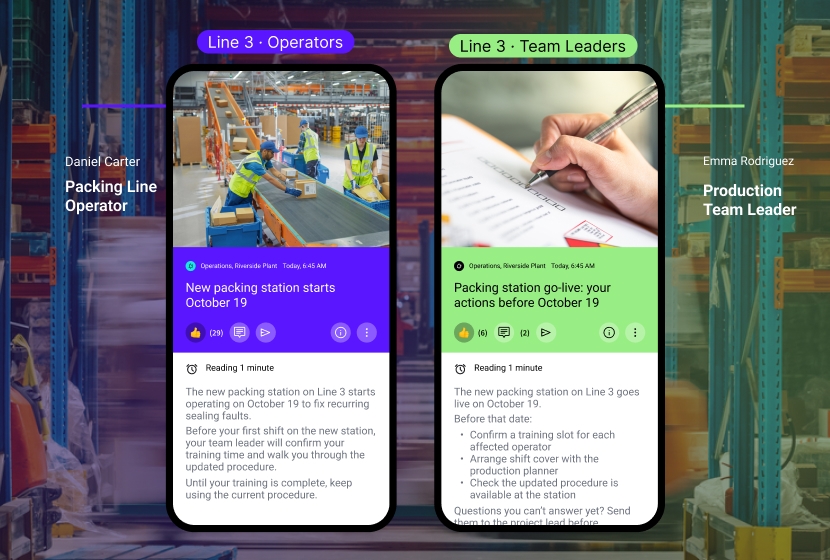
For a hypothetical equipment upgrade, an operator message could say:
The new packing station starts operating on October 19 to address recurring sealing faults. Before your first shift on the station, your supervisor will confirm your training time and the updated procedure. Continue using the current procedure until training is complete and you are authorized to use the new equipment.
The supervisor version needs different detail:
Confirm each affected operator’s training slot before October 19. Arrange cover with the production planner, check that the updated procedure is available, and send unanswered questions to the project lead before the next briefing.
Both messages preserve the facts while giving each audience a useful action. If staffing implications remain undecided, say what is under review and when the next update will arrive. All of this can help minimize employee turnover in the manufacturing industry, and other industries as well.
4. Equip Supervisors to Answer Questions and Discuss Employee Concerns
Supervisors need context to explain decisions and support to handle questions. Asking them to forward an announcement leaves interpretation to each manager across staggered shifts.
Communications prepares the approved message, likely questions, links, and an escalation contact. Operations confirms instructions; HR handles employment terms and individual circumstances.
Encourage managers to check understanding through a practical question, such as “Where would you go if your training slot conflicts with your assignment?” Employees also need direct access to approved information, so the supervisor is not their only route to an answer.
Pro tip: Give unanswered questions a response deadline. If a supervisor cannot answer immediately, they should be able to tell the employee who will respond and when.
5. Show Employees What Happens After They Give Feedback
Feedback becomes useful when employees can see what happened after they raised a concern. Combine accessible employee surveys with conversations, so participation does not depend on one channel or confidence speaking in a group.
Ask about a specific experience: “Did you receive your revised schedule early enough to arrange transport?” This identifies a decision more clearly than a broad company culture question. Explain who can see responses; promise anonymity only when the process supports it.
HR should coordinate the response, with the relevant operational owner accountable for action. A hypothetical follow-up might read:
You told us that Friday schedule updates arrive too late to organize transport. The production planner will trial publishing next week’s schedule by Wednesday at noon for the next four weeks. We will review late changes and ask whether the earlier notice helped at the end of the trial.
If a change is not feasible, explain the constraint and any alternative. Publish survey results with the decision, owner, and review date. Connect employee engagement questions to the concern you are addressing. Reward employees for continued engagement, and encourage employees to reach out if their concerns are still not being met.
6. Recognize Contributions and Explain Career Progression
Employees should be able to see which contributions are valued and how to qualify for growth opportunities. HR owns progression criteria, while supervisors connect those criteria to individual development conversations.
Specific frontline recognition can acknowledge work that leaders might otherwise miss. In a hypothetical post, thanking the night maintenance team for documenting a recurring fault tells colleagues what was useful. Invite nominations across shifts rather than relying on who happens to work near senior managers.
Career development needs equally concrete communication. An internal vacancy should state the required skills, available training, application route, deadline, and selection criteria. If qualification requires supervised practice, explain how employees on each shift can access it.
Discuss progress during check-ins and performance reviews. Be honest about limited progression; announcing inaccessible career growth undermines credibility and can hurt employee morale.
How to Test Your Communication Improvements at One Plant
A 90-day pilot lets you test the routine at a manageable scale. Choose one retention-related gap, such as unclear first-month support for night-shift hires. Treat it as a learning window, tracking employee turnover separately over a suitable timeframe.
Agree on your expansion criteria before the trial begins. For the night-shift example, these could include recruits finding their trainer, supervisors completing check-ins, and unanswered questions receiving a response within the agreed deadline. A plant with high turnover is not automatically the best starting point if its staffing problems would prevent the trial from running.
How to Measure Communication Improvements and Employee Retention
Communication measures show whether your approach is reaching employees and answering their questions. Retention measures show whether employees stay over a defined period. Review both, but avoid treating message readership as proof of comprehension or a reduction in voluntary turnover.
Track three early indicators by shift and role:
- Reach: Unique employees reached, divided by the eligible audience, using a defined channel metric
- Understanding: Responses to a practical question about the update or available support
- Follow-through: Concerns answered and agreed actions completed by their due dates
For workplace screens, exposure estimates cannot establish who read or understood the message. Missing data should remain visible rather than being counted as successful reach.
For voluntary turnover rates, divide voluntary departures during the period by average headcount for the same employee population, then multiply by 100. Measure new-hire retention separately: the share of a starting cohort still employed at a milestone such as day 90. Only include cohorts that have had time to reach that milestone together with their business leaders.
Compare manufacturing turnover within consistent plants, roles, and periods. Record pay changes, staffing levels, seasonal demand, and scheduling changes alongside the pilot. If voluntary attrition among salaried workers falls while compensation also rises, report both changes; the comparison alone cannot establish communication’s contribution toward retention efforts.
Support Plant Communication With the Poppulo Experience Platform
An effective communication strategy can be rendered useless if you don't have the right digital tools to put it into action. The Poppulo Experience Platform can support your frontline communication routine across plants and shifts:
- Employees can access news and resources through a mobile app without a corporate email or device.
- Targeting and multilingual communication help teams deliver relevant information.
- Local channels, surveys, recognition, and audience reporting support the practices described above and boost engagement.
With this in mind, you can focus your pilot on onboarding guidance, local updates, or feedback responses, all of which will help reduce turnover in the long run, promoting skill development, stronger team cohesion, and better workplace culture, while avoiding the hidden costs of miscommunication.
Final Thoughts
Better communication gives employees reliable information, consistent conversations, and a visible response to their concerns. Its contribution to retention depends on addressing the actual issue, including operational changes when needed. Choose one plant-level gap, run a measured pilot, and use the findings to decide what to expand. If done right, the results can improve work-life balance, career growth, and even customer satisfaction, all while reducing the attrition rate and overall turnover.
When it comes to the digital tools you use to accomplish this, the Poppulo Experience Platform can do all of this and more. We've already partnered with industry leaders like Coca-Cola CCEP, BBGR, and Pierre Fabre, and we'd love to achieve the same results for your organization.
Ready to learn more? Request a Poppulo Experience Platform demo focused on your plant’s needs.
Manufacturing Employee Retention FAQs
These are the questions that come up most often when discussing employee retention in the manufacturing sector.
What Is the Difference Between Turnover and Retention?
Turnover measures departures relative to a defined workforce during a period. Retention measures how many employees in a starting group remain at a later point. The rates are not automatically complements because turnover calculations may include departures among people hired after the retention cohort was established.
Can Better Communication Replace Higher Pay?
No. Communication helps employees understand compensation, benefits, and progression, and gives employers a way to hear concerns. It cannot make uncompetitive pay competitive or resolve unsafe conditions. Investigate compensation, scheduling, supervision, and job satisfaction alongside communication when deciding how to improve retention.
How Should Temporary Workers Be Included in Retention Reporting?
Report temporary workers as a separate cohort, with a clear definition of whose employment or assignment you are measuring. Distinguish planned assignment endings from early departures. Mixing these events with permanent employees’ voluntary departures can distort the pattern your pilot is intended to address.
How Soon Can You Assess Whether the Approach Is Working to Reduce Manufacturing Turnover?
You can begin checking access, understanding, and response times during the pilot. Retention outcomes need enough observation time and comparable employee groups, particularly for 90-day new-hire retention. A smaller number of departures during a short trial is an early observation, not proof of a lasting effect or of a productive workforce.