First in our industry to be responsible AI certified
Learn more →
Employee wellbeing during a crisis – What behavioral science can teach us
Watch On-demand

Speakers

Lindsay Kohler
Lead Behavioral Scientist at scarlettabbott, scarlettabbott

Jo Hooper
Founder, Mad and Sad Club
About this webinar
Covid-19 has radically changed the workplace, but the issues that affect employees and their wellbeing remain the same. In this timely webinar, Lindsay Kohler, Lead Behavioral Scientist at scarlettabbott, and Jo Hooper, Mental Health at Work expert, will explore the behavioral and psychological issues people face not only during the current coronavirus crisis, but throughout the entire employee experience lifecycle.
Take-aways:
- Understand the key issues facing your employees and the key indicators to look out for
- Discover how your employees react psychologically and respond behaviourally to crisis environments
- Practical examples of how you can apply lessons from behavioral science so employees feel connected and empowered to reach out if they need to
- Opportunity to receive a dedicated employee mental health action plan.
Access On-Demand Webinars
How Leading Healthcare Organizations Reach Every Frontline Worker
Ask a hospital's communications team whether last week's safety alert reached every person who needed it—nurses, care assistants, porters, techs, cleaners, kitchen staff—and most can't tell you. The message went out, but who read it is guesswork. That blind spot is the real problem, and it starts with the staff. Most of the people keeping a hospital running have no company email and no desk, so an update reaches them through a manager who remembers to pass it on—or it doesn't reach them at all. When that message is a changed protocol or updated equipment guidance, a missed message is a patient-safety risk you never see. What you'll learn During this session, we'll show how healthcare organizations: Reach every clinical and support worker across hospitals, clinics, home visits, and community sites, without relying on email or a shared device. Deliver shift-relevant safety and compliance alerts with read tracking and must-read acknowledgment. Personalize communications by role, location, shift, and language, so people get only what's relevant to them. Use AI to help staff find the right policy or procedure in seconds. Replace scattered, manager-by-manager messaging with communications every employee receives, whatever their shift or location. Support wellbeing and recognition programs that help retain people in demanding roles. Let ward and department leaders communicate locally while central teams keep governance intact. See who opened and acknowledged each critical message. Watch the on-demand recording now.
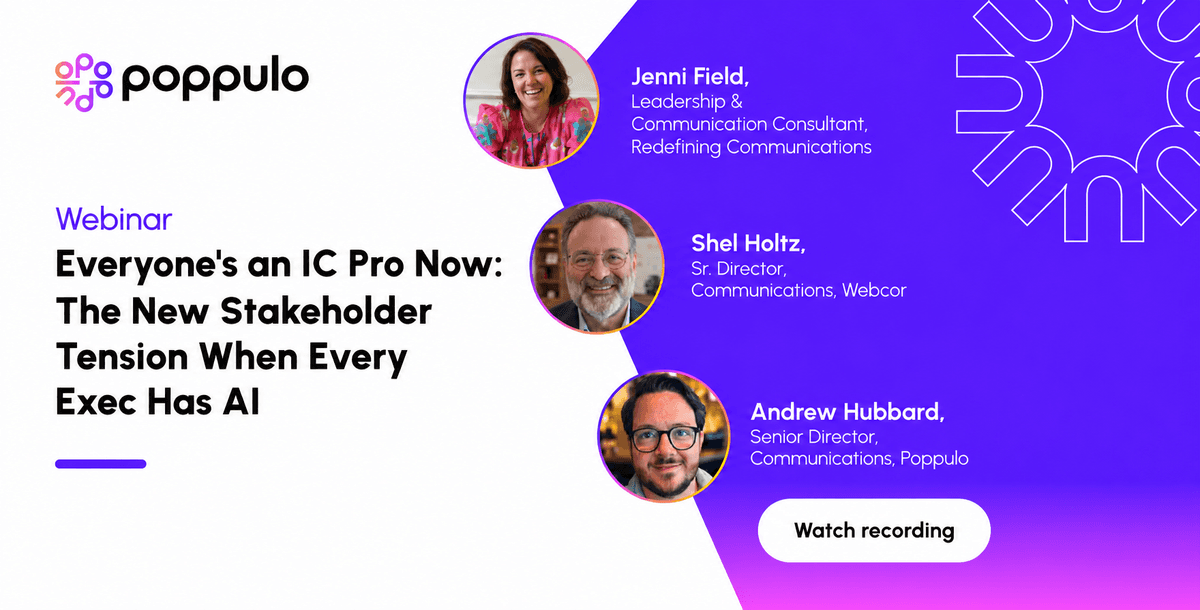
Everyone's an IC Pro Now: The New Stakeholder Tension When Every Exec Has AI
Sign-off used to mean a few comments in the margin. Now a routine leadership announcement comes back carrying six sets of detailed, confident, strangely similar feedback—because somewhere between your outbox and theirs, half your stakeholders ran it through an AI. Executives aren't just reviewing comms work anymore. Armed with the same tools, plenty of them now believe they can do it. Stakeholder management was already the hardest part of the job; it wasn't built for reviewers with an assistant that never runs out of opinions. This session is about easing that tension—running a review process that still works, and keeping the final say where it belongs. What you'll learn: How to recognize AI-assisted feedback and weigh it for what it is—directional input, not a rewrite Ground rules for review cycles when every stakeholder has a co-pilot How to push back on machine-made opinion without damaging the human relationship behind it How to keep the final say with IC—not with the loudest AI-assisted opinion Plus: a live audience poll putting the first real numbers on how far this has spread. Bring your worst example. Who it's for: Internal comms leaders and senior practitioners who own the review cycle—and intend to keep it. Watch the on-demand recording now.
How Leading Professional Services Firms Are Modernizing the Employee Experience
In most professional services firms, information is scattered, and valuable time is wasted trying to find it. Company news, policies, business updates, key documents—all in different places, and rarely in the first place you look. Now there's real risk on top of wasted time. Clients are questioning the value of professional advice at the same time AI is raising the stakes on quality and accuracy. As employees increasingly use AI to accelerate their work, firms need to ensure people are working from approved content, trusted knowledge, and the latest policies—not outdated or unofficial information. Keeping people aligned on standards, governance, and current policy is now part of how a firm can protect what it's spent years building. Join us to see how leading firms are building a modern digital workplace that gives employees one personalized place to find company news, documents, policies, people, and business applications—and see what's happening across the wider firm, so they spend less time searching and more time delivering work that clients trust. What you'll learn During this session, we'll show how professional services firms: Give employees a single place to find news, knowledge, policies, applications, and everyday resources. Keep people aligned on the standards, governance, and quality expectations that protect client work. Reach employees wherever they work, across mobile, Microsoft Teams, and digital signage. Make sure people receive only what's relevant to their role, office, or practice area, in their preferred language. Confirm critical updates are seen and acknowledged, with must-read communications and reporting. Connect colleagues across offices and practices, so local teams see the wider firm without losing their own focus. Use AI to help employees find the right policy, procedure, or precedent in seconds. Integrate with Microsoft Teams and Microsoft 365, so communications and knowledge sit inside the tools people already use. Measure real engagement and reach, not just publishing activity. Watch on-demand recording.