
Internal Communications Guides, Templates & Playbooks
Poppulo Named a Challenger in the Gartner® Magic Quadrant™ for Intranet Packaged Solutions 2026
Report
Poppulo: Every Employee. Completely Connected. For us, being named a Challenger in the Gartner® Magic Quadrant™ for Intranet Packaged Solutions is about more than a place on a chart. We believe it shows that Poppulo is helping organizations rethink what an intranet can be: the connective center of the employee experience, bringing the information and services people need together in one place and making them part of everyday working life for everyone, wherever they are. “We see a much bigger future for the intranet—one where it sits at the heart of the whole employee experience and touches every employee in a very real and relevant way. That’s the vision we’re pursuing at Poppulo. Being named a Challenger in the Gartner® Magic Quadrant™ is a proud moment for us, and it makes us even more excited about where we can take the intranet—and employee experience—next.” — Ruth Fornell, CEO, Poppulo One Intranet. An Entire Workforce. People do not all work in the same place, use the same devices, or get information in the same way. Someone at a desk checks the intranet or email. Someone on the move uses their phone. Someone on a factory floor, in a hospital, or in a store gets their info from a screen. One way of reaching people simply doesn’t work for an entire workforce. Poppulo gives organizations the breadth to reach employees through intranet, email, mobile, and digital signage, while connecting them to the information and services they need. That means employees can stay informed, find what they need, and get things done in ways that make sense for how and where they work. Built to Challenge. Governed to Be Trusted. Poppulo pioneered integrating AI into the employee experience, but we believed trust had to come first. That is why we became the first company in our sector to achieve ISO/IEC 42001 certification, the global benchmark for responsible AI management. For organizations in highly regulated industries or handling sensitive information, Poppulo's approach to AI has always been governed by rigorous risk controls and independent assessment. We are trusted by more than 10,000 organizations, including more than 40 of the Fortune 100—organizations where governance, security, and accountability are non-negotiable. While Poppulo challenges what an intranet can be, it will always be built on foundations enterprises can trust. What You’ll Find in the Gartner® Report An overview of the Intranet Packaged Solutions market An assessment of vendors based on their Ability to Execute and Completeness of Vision Details on the features and services offered by different providers Insight into how AI, employee services, and frontline communication are changing the market Guidance for organizations reviewing their intranet options Why This Report Matters An intranet is no longer just a desktop website. Organizations need to reach people in offices, hospitals, factories, stores, and other workplaces. They need to share information quickly and make it easy for employees to find answers, complete tasks, and stay up to date. We feel the Gartner® Magic Quadrant™ for Intranet Packaged Solutions gives business, IT, HR, communications, and procurement leaders a way to compare the market and understand what different providers offer. What’s Next for Poppulo Being recognized as a Challenger is an important step for us. It is also a starting point. Poppulo is continuing to build an employee experience that helps every employee find the information, services, and support they need, wherever they work. Our capabilities span AI-powered search and translation, Ask AI, visual workflow tools, employee communications, intranet features, mobile engagement, and digital signage. Together, these tools help organizations share information, answer questions, support employees, and make it easier for people to take action. Because keeping people informed is only the first step. The goal is to help every employee take part and get more done. Ready to Connect Every Employee? See how Poppulo can help your organization connect and engage every employee, wherever they work. Gartner, Magic Quadrant for Intranet Packaged Solutions, Mike Gotta, Helen Poitevin, Alexandra Earl, 29 September 2026. Legal Notice Gartner does not endorse any company, vendor, product or service depicted in its publications, and does not advise technology users to select only those vendors with the highest ratings or other designation. Gartner publications consist of the opinions of Gartner’s business and technology insights organization and should not be construed as statements of fact. Gartner disclaims all warranties, expressed or implied, with respect to this publication, including any warranties of merchantability or fitness for a particular purpose. Gartner and Magic Quadrant are trademarks of Gartner, Inc., and/or its affiliates.
Latest Guides
Filter By:
Poppulo Named a Challenger in the Gartner® Magic Quadrant™ for Intranet Packaged Solutions 2026
Poppulo: Every Employee. Completely Connected. For us, being named a Challenger in the Gartner® Magic Quadrant™ for Intranet Packaged Solutions is about more than a place on a chart. We believe it shows that Poppulo is helping organizations rethink what an intranet can be: the connective center of the employee experience, bringing the information and services people need together in one place and making them part of everyday working life for everyone, wherever they are. “We see a much bigger future for the intranet—one where it sits at the heart of the whole employee experience and touches every employee in a very real and relevant way. That’s the vision we’re pursuing at Poppulo. Being named a Challenger in the Gartner® Magic Quadrant™ is a proud moment for us, and it makes us even more excited about where we can take the intranet—and employee experience—next.” — Ruth Fornell, CEO, Poppulo One Intranet. An Entire Workforce. People do not all work in the same place, use the same devices, or get information in the same way. Someone at a desk checks the intranet or email. Someone on the move uses their phone. Someone on a factory floor, in a hospital, or in a store gets their info from a screen. One way of reaching people simply doesn’t work for an entire workforce. Poppulo gives organizations the breadth to reach employees through intranet, email, mobile, and digital signage, while connecting them to the information and services they need. That means employees can stay informed, find what they need, and get things done in ways that make sense for how and where they work. Built to Challenge. Governed to Be Trusted. Poppulo pioneered integrating AI into the employee experience, but we believed trust had to come first. That is why we became the first company in our sector to achieve ISO/IEC 42001 certification, the global benchmark for responsible AI management. For organizations in highly regulated industries or handling sensitive information, Poppulo's approach to AI has always been governed by rigorous risk controls and independent assessment. We are trusted by more than 10,000 organizations, including more than 40 of the Fortune 100—organizations where governance, security, and accountability are non-negotiable. While Poppulo challenges what an intranet can be, it will always be built on foundations enterprises can trust. What You’ll Find in the Gartner® Report An overview of the Intranet Packaged Solutions market An assessment of vendors based on their Ability to Execute and Completeness of Vision Details on the features and services offered by different providers Insight into how AI, employee services, and frontline communication are changing the market Guidance for organizations reviewing their intranet options Why This Report Matters An intranet is no longer just a desktop website. Organizations need to reach people in offices, hospitals, factories, stores, and other workplaces. They need to share information quickly and make it easy for employees to find answers, complete tasks, and stay up to date. We feel the Gartner® Magic Quadrant™ for Intranet Packaged Solutions gives business, IT, HR, communications, and procurement leaders a way to compare the market and understand what different providers offer. What’s Next for Poppulo Being recognized as a Challenger is an important step for us. It is also a starting point. Poppulo is continuing to build an employee experience that helps every employee find the information, services, and support they need, wherever they work. Our capabilities span AI-powered search and translation, Ask AI, visual workflow tools, employee communications, intranet features, mobile engagement, and digital signage. Together, these tools help organizations share information, answer questions, support employees, and make it easier for people to take action. Because keeping people informed is only the first step. The goal is to help every employee take part and get more done. Ready to Connect Every Employee? See how Poppulo can help your organization connect and engage every employee, wherever they work. Gartner, Magic Quadrant for Intranet Packaged Solutions, Mike Gotta, Helen Poitevin, Alexandra Earl, 29 September 2026. Legal Notice Gartner does not endorse any company, vendor, product or service depicted in its publications, and does not advise technology users to select only those vendors with the highest ratings or other designation. Gartner publications consist of the opinions of Gartner’s business and technology insights organization and should not be construed as statements of fact. Gartner disclaims all warranties, expressed or implied, with respect to this publication, including any warranties of merchantability or fitness for a particular purpose. Gartner and Magic Quadrant are trademarks of Gartner, Inc., and/or its affiliates.
The Employee Advocacy RFP Template to Launch & Scale Your Program
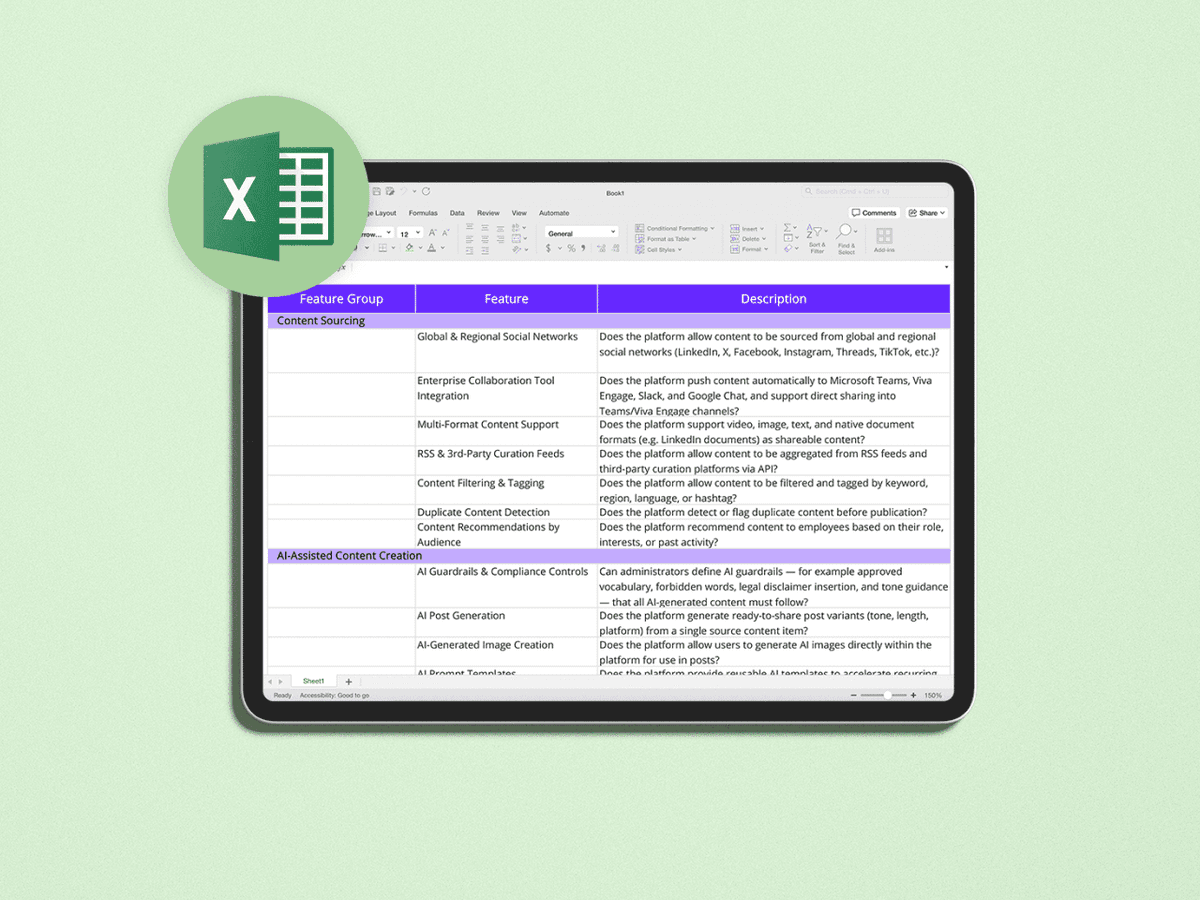
Choosing the right employee advocacy platform starts with asking the right questions. This free, ready-to-use RFP template helps you structure your evaluation process, compare vendors consistently, and ensure no critical requirement is overlooked. Whether you're launching a new employee advocacy program or replacing an existing solution, this template gives you a proven framework to accelerate vendor selection. Download the template to: Save hours of research and preparation Build a comprehensive employee advocacy RFP in minutes Evaluate vendors using consistent criteria Align internal stakeholders around the right requirements Make a confident, evidence-based buying decision What's Inside? The template includes: A complete employee advocacy RFP framework Hundreds of evaluation criteria covering all key platform capabilities A weighted scoring model to compare vendors objectively Guidance on how to customize the template to your organization's needs Best practices for running an efficient vendor selection process Delivered as an editable Excel workbook, it's ready to use immediately. Who Is This Template for? This resource is designed for professionals involved in selecting an employee advocacy platform, including: Internal Communications leaders Marketing and Brand teams Employee Advocacy program managers Digital Workplace teams HR and Employer Branding professionals Procurement and IT stakeholders supporting the buying process Why Download This Template? Creating an RFP from scratch is time-consuming and often results in missing important evaluation criteria. This template helps you focus on what really matters by providing a structured framework built around the capabilities modern employee advocacy platforms should offer. Instead of starting with a blank page, you can adapt the template to your specific needs and spend your time evaluating vendors—not building spreadsheets.
50 Questions to Ask Before You Choose an Internal Comms Platform
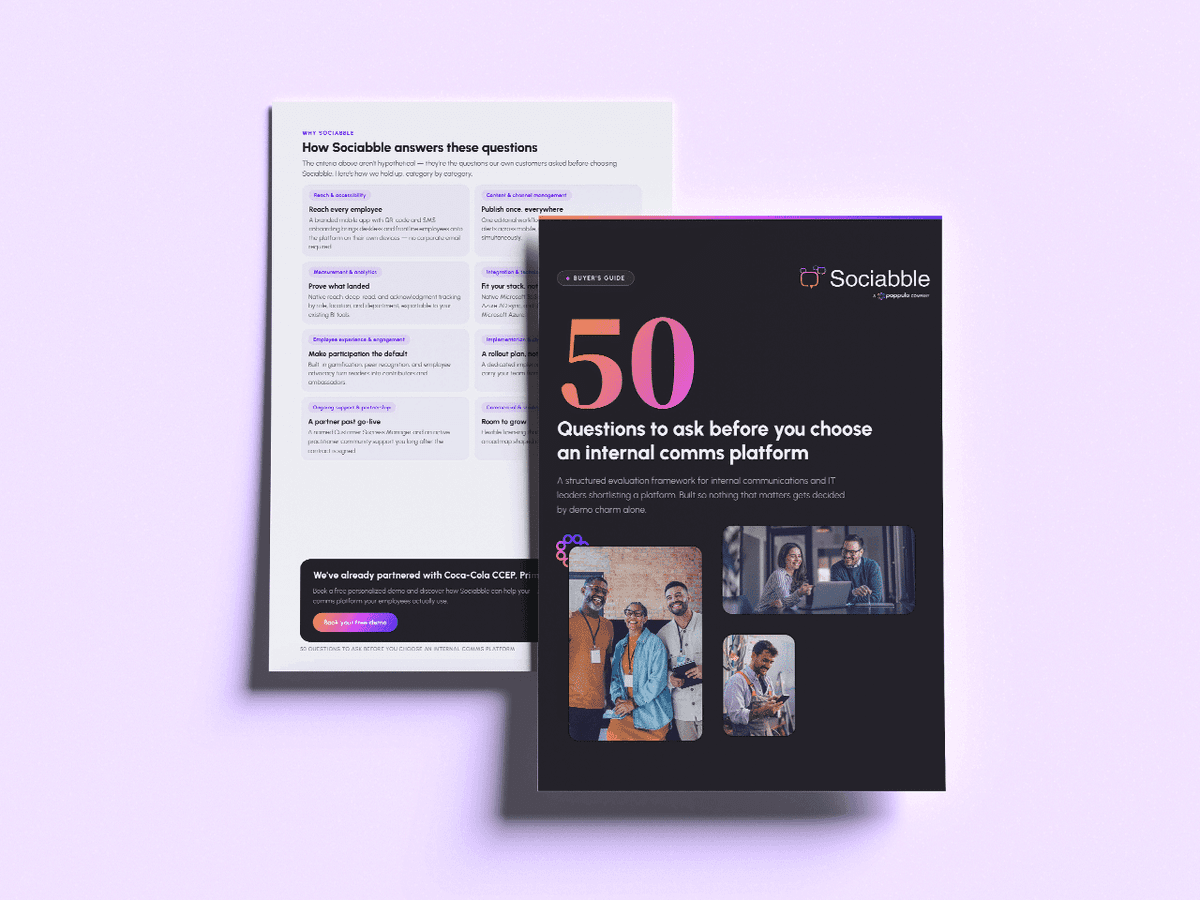
Selecting an internal communications platform is a decision you'll live with for years. In fact, it will touch almost every corner of your business. Yet most evaluation processes focus on product demos and bells & whistles, instead of the foundational questions that really matter. This practical buyer's guide was designed to give you a structured framework to compare vendors objectively, involve the right stakeholders, and avoid costly mistakes before signing a contract. It's made to take the pain and uncertainty out of the process, with a step-by-step structure anyone can follow. What You'll Learn Choosing the wrong platform rarely happens because of one missing feature. It usually happens because buyers overlook questions such as: Can we really reach every employee, including frontline workers? Will the platform integrate into our existing digital workplace? Can we measure communication effectiveness and prove business impact? Will employees actually adopt and use it? Will this platform still meet our needs three years from now? This guide helps you evaluate every vendor with confidence. You'll learn how to: Assess reach and employee experience Ensure every employee can access, engage with, and benefit from your communications. Evaluate content management and analytics Understand how platforms simplify publishing while giving you meaningful insights, not just vanity metrics. Validate technical fit and long-term scalability Ask the questions your IT team will thank you for, from integrations and security to future growth. Compare vendors objectively Use a structured evaluation framework and scoring matrix to make evidence-based decisions. A Practical Evaluation Framework The guide is organized around the eight areas that matter most during an enterprise software evaluation. These include: 1. Reach & Accessibility Can every employee be reached wherever they work? 2. Content & Channel Management Can communicators publish efficiently across every channel? 3. Measurement & Analytics Can you prove communications are effective? 4. Integration & Technical Fit Will the platform integrate into your digital workplace? 5. Employee Experience & Engagement Will employees actually use it and keep using it? 6. Implementation & Change Management How will you ensure a successful rollout and adoption? 7. Ongoing Support & Partnership What happens after the contract is signed? 8. Commercial & Strategic Fit Will the platform continue to support your organization as it grows? Who Is This Guide For? This guide is designed to address the needs of primary stakeholders and decision-makers. That includes: Internal Communications Leaders HR & Employee Experience Teams Digital Workplace Managers IT & Enterprise Architecture Teams Change Management Leaders Corporate Communications Teams Procurement & Project Sponsors Download Your Free Evaluation Checklist Get the complete buyer's guide with 50 expert questions , practical evaluation criteria, and a ready-to-use scoring matrix to help your team compare platforms objectively and choose the solution that will support your communication strategy for years to come.
The Internal Communications Measurement Masterclass & Playbook
Internal communicators measure plenty. Open rates, click-throughs, attendance, views, and reach—most IC teams have dashboards full of the stuff. What they struggle with is proving that any of it made a difference to the business. And business impact is the only measurement their leaders genuinely care about. It's a gap most IC practitioners feel acutely. Gallagher's 2026 Employee Communications Report found that seven in 10 internal communicators still measure only basic activity metrics, and fewer than one in eight measure business impact. Measurement is the weakest capability in their global readiness model, and teams relying only on activity data are the ones struggling most to demonstrate their value. This is a two-part guide built to close that gap. Part One is the Masterclass. It sets out why outcome measurement matters, the frameworks that make it manageable, and the principles separating measurement that proves impact from measurement that just fills a dashboard. Part Two is the Playbook. It's the templates, the worked example, and the sample dashboard—the practical tools you'll need for a successful comms campaign. Read the Masterclass for the thinking. The Playbook is where you'll find the tools to put it into practice. We hope you find them useful. Tim Vaughan Editorial Director, Poppulo
The Internal Communications Measurement Masterclass & Playbook—Part Two: The Playbook
Many IC teams measure and report on what's easy to count: email open rates, video views, all-hands attendances. Outputs that leadership don’t much care about. They want to know whether communications actually changed anything—whether people understood something important and whether behavior looked different afterward. Leaders want proof of impact, they want to see results. Outputs don't give them that. Outcomes do. Part One of this paper, the Measurement Masterclass, clearly showed why. Here, Part Two gives you the tools to measure outcomes: four templates you can fill in for your own campaigns, plus a full worked example showing all four completed together, so you can see how they fit before you use them yourself. What’s inside: The Know/Feel/Do Framework. Defines what a specific audience needs to know, feel, and do as a result of your communication—specific enough to measure. One template per audience segment. The Outcome/Output/Measurement Plan. For each outcome, sets out the communication tactic you'll use and how you'll measure whether it worked. This is the template you'll use most. The SMART Objectives Worksheet. A short exercise for turning a vague goal into a specific, measurable one, with a number and a deadline attached. The Power/Influence Grid. Maps your audience by power and attitude—champions, supporters, blockers, detractors—so you know where to put your effort. A worked example. All four templates completed end-to-end for a company-wide AI policy rollout, so you can see the whole process applied to one campaign from start to finish. A sample measurement dashboard. A one-page example of how to present outcome data to leadership. Written by Andrew Hubbard, Senior Director of Communications at Poppulo, and Joanna Hall of Afire Consulting.
Poppulo’s AI Jargon Buster
Lost in the AI Lingo? Here’s your cheat sheet to bots, buzzwords & brainy tech, made simple for internal comms pros.
Subscribe to get the latest resources in your inbox
Access On-Demand Webinars
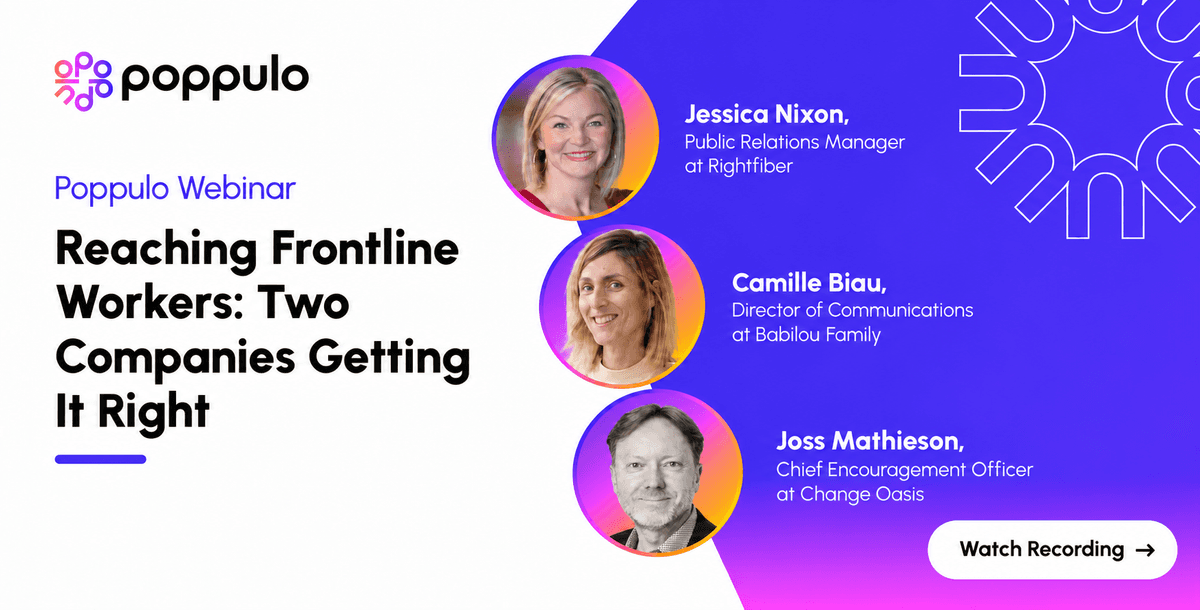
Reaching Frontline Workers: Two Companies Getting It Right
Frontline employees need the same company news, guidance, and connection as everyone else. Their working day makes that harder. They may be moving between sites, working shifts, serving customers, caring for children, or working in the field. Some have no company email. Some have no work phone. Many have little time to check internal channels. Join Joss Mathieson for a fireside chat with Camille Biau of Babilou Family, an international early-childhood education group with 14,000 employees in 10 countries, and Jessica Nixon of Rightfiber, a U.S. fiber broadband provider that has a dispersed workforce and has just gone through a merger. They will share what they’ve learned about reaching frontline employees, encouraging people to use new channels, and bringing people together during organizational change. What you'll learn: How to get frontline employees onto a new platform, and keep them using it, when nobody's forcing them to How to reach staff who have no work device during their shift How to bring two workforces onto one channel after a merger without either side feeling taken over How to support managers in the field so they aren't the only route to the frontline Who it's for: Internal comms and HR leaders responsible for frontline and shift-based employees, whether you're choosing a platform or trying to get more from the one you have. Watch the on-demand recording to hear how two companies are reaching their frontline employees and take away ideas you can put to work in your own organization.
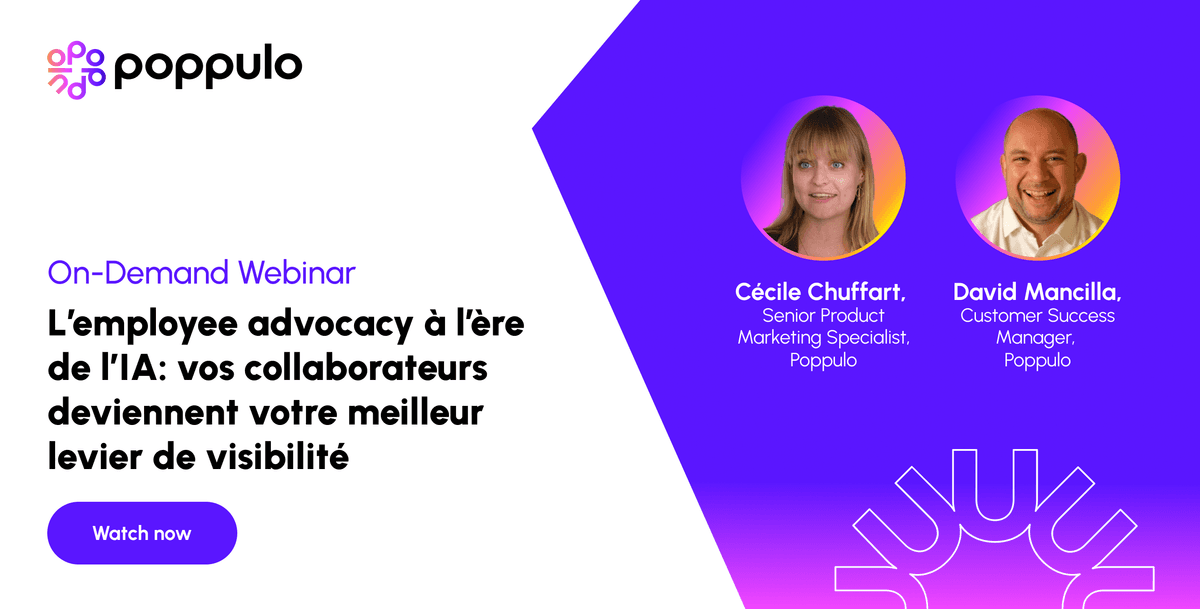
L’employee advocacy à l’ère de l’IA: vos collaborateurs deviennent votre meilleur levier de visibilité
La façon dont nous découvrons l’information évolue. La recherche alimentée par l’IA s’intègre progressivement dans les usages quotidiens, tandis que les voix de confiance et les expertises reconnues jouent un rôle croissant dans la visibilité des entreprises. Au cours de cette session, nous verrons ce que ces évolutions impliquent pour l’employee advocacy et comment adapter votre programme pour en tirer pleinement parti. Nous nous intéresserons aux contenus qui fonctionnent aujourd’hui, aux différents profils que vous pouvez mobiliser (dirigeants, experts, ambassadeurs et collaborateurs), ainsi qu’aux leviers concrets pour renforcer votre visibilité, l’engagement et l’impact de vos prises de parole. Nous vous montrerons également comment Poppulo permet de déployer concrètement une stratégie d’employee advocacy, facilement et à grande échelle. Découvrez comment mobiliser les bonnes personnes, leur proposer des contenus pertinents, faciliter leur participation et piloter efficacement votre programme, le tout depuis une plateforme unique. Au programme: • Comment l’IA transforme la visibilité et la découverte de l’information, et pourquoi la voix et l’expertise des collaborateurs comptent plus que jamais • Les clés d’un contenu d’Employee Advocacy performant aujourd’hui : une expertise utile et authentique, associée à des contenus pensés à la fois pour les internautes et pour l’IA • Comment mobiliser les bonnes voix, des dirigeants et experts métier aux ambassadeurs et à l’ensemble de vos collaborateurs • Comment construire un programme d’employee advocacy plus performant et plus intelligent pour gagner en visibilité, stimuler l’engagement et générer un impact mesurable • Comment Poppulo facilite concrètement l’employee advocacy en vous aidant à proposer des contenus pertinents, à engager vos collaborateurs et à piloter votre programme à grande échelle À qui s’adresse ce webinar: Aux professionnels de la communication, des réseaux sociaux, de la marque employeur, du marketing et de l’engagement collaborateur qui souhaitent lancer, renforcer ou déployer à plus grande échelle un programme d’employee advocacy. Que vous disposiez déjà d’un programme bien établi ou que vous commenciez tout juste à explorer l’employee advocacy, vous repartirez avec des pistes concrètes pour accroître la participation de vos collaborateurs et maximiser l’impact de votre programme. Inscrivez-vous dès maintenant pour découvrir comment l’employee advocacy évolue à l’ère de l’IA et comment faire de la voix et de l’expertise de vos collaborateurs de véritables leviers de visibilité et d’impact.
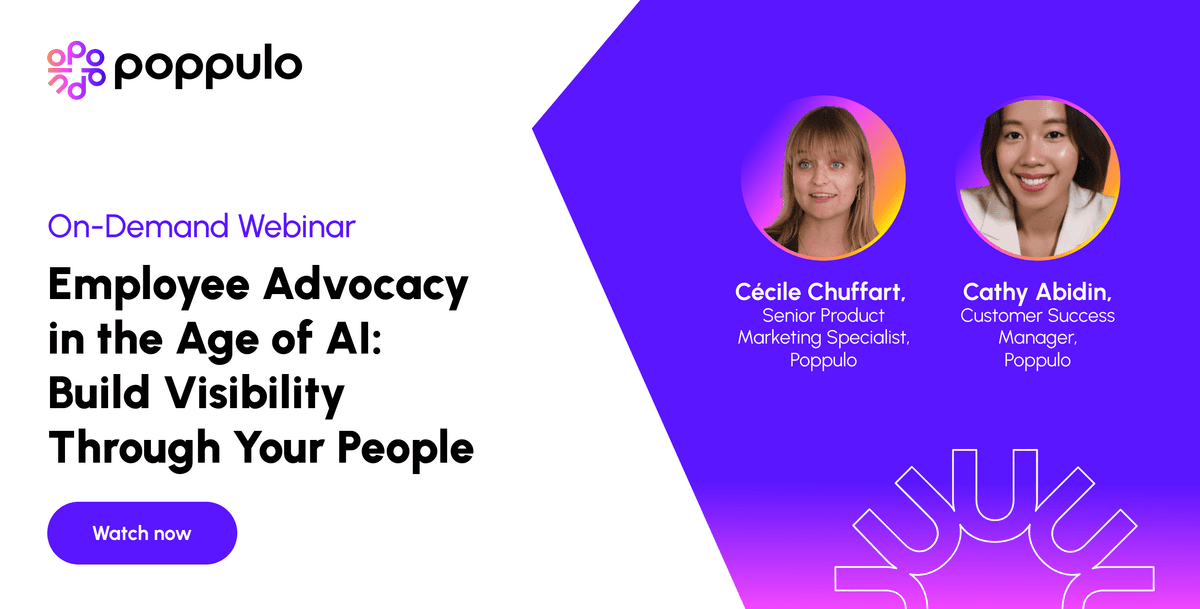
Employee Advocacy in the Age of AI: Build Visibility Through Your People
The way people discover information, brands, and expertise is changing. AI-powered search becomes part of everyday discovery, while trusted human voices and credible expertise are playing an increasingly important role in how organizations build visibility. In this session, we’ll explore what these shifts mean for employee advocacy and how you can adapt your program to make the most of it. We’ll look at the types of content that perform today, the different voices you can activate (from leaders and experts to ambassadors and employees) and practical ways to strengthen visibility, engagement, and impact. We’ll also show you how Poppulo brings employee advocacy to life and makes it easy to put into practice and scale. See how you can activate the right people, deliver relevant content, make participation simple for employees, and manage your program effectively. All from one platform. What you’ll learn : How AI is changing visibility and discovery, and why employee voices and expertise matter more than ever What makes advocacy content effective today, from useful, authentic expertise to content structured for both people and AI How to activate the right voices, from leaders and subject-matter experts to ambassadors and wider employee communities How to build a stronger, smarter advocacy program that drives visibility, engagement, and measurable impact How Poppulo supports employee advocacy in practice, making it easier to deliver relevant content, engage employees, and manage your program at scale Who it’s for: Communications, social media, employer brand, marketing, and employee engagement professionals who want to build, strengthen, or scale an employee advocacy program. Whether you’re already running an established program or exploring employee advocacy for the first time, you’ll leave with practical ideas to increase participation and impact. Watch now to discover how employee advocacy is evolving, and how to turn your employees’ voices and expertise into greater visibility and impact.